
Cleanroom Gloves Supplier: Nitrile vs Latex Selection

Cleanroom Gloves Supplier: Nitrile vs Latex Selection
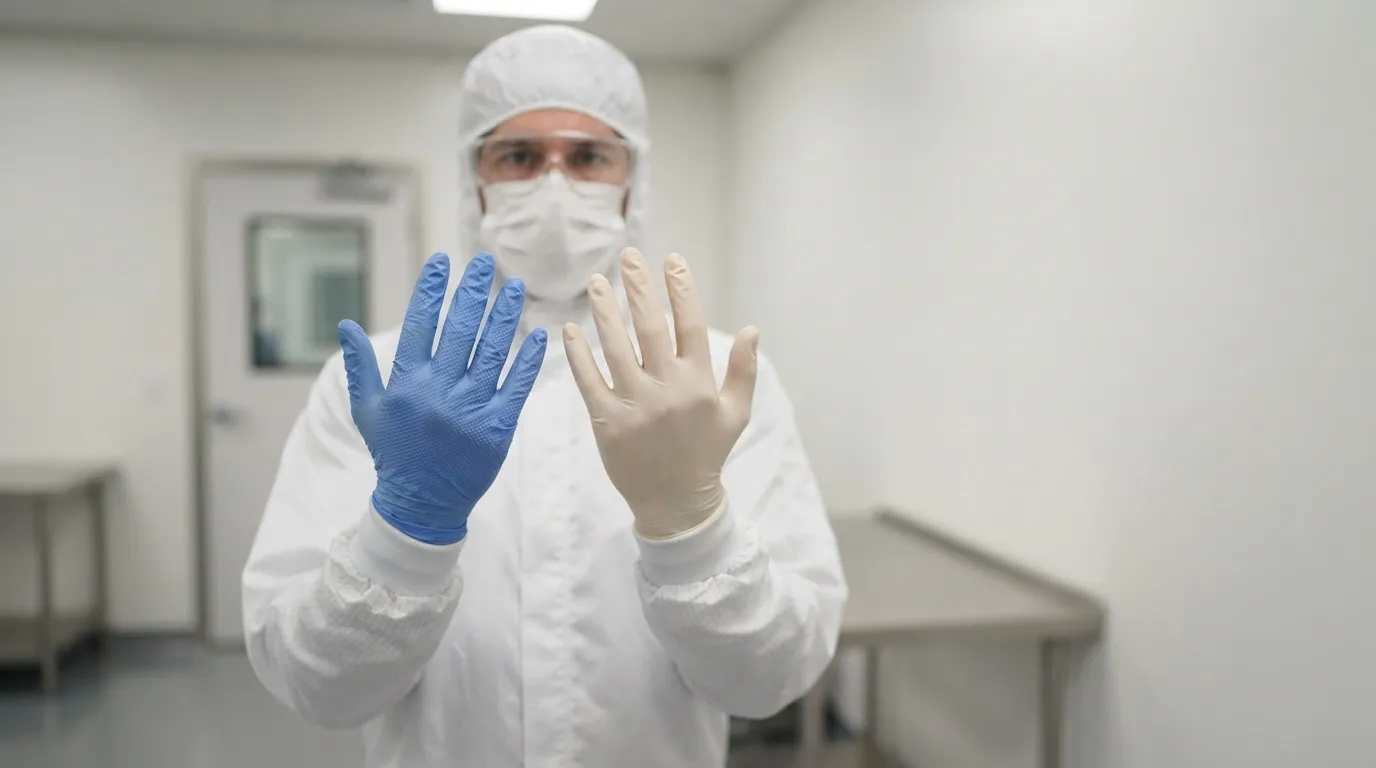
Cleanroom gloves are controlled-environment gloves selected on material, cleanliness or sterility evidence, class compatibility, fit, and supplier documentation. The right choice depends on the process, not just the room class: an ISO class label describes the cleanroom, not the glove, so buyers should verify product-level evidence before purchase.
Gloves sit at the boundary between personnel and product. They protect the process from particles, residue, and electrostatic discharge, while also protecting the operator from chemical and biological exposure. Glove selection is therefore one element of a wider contamination-control program, but the material and documentation decisions deserve their own attention.
Nitrile vs Latex Cleanroom Gloves: Which Should You Choose?
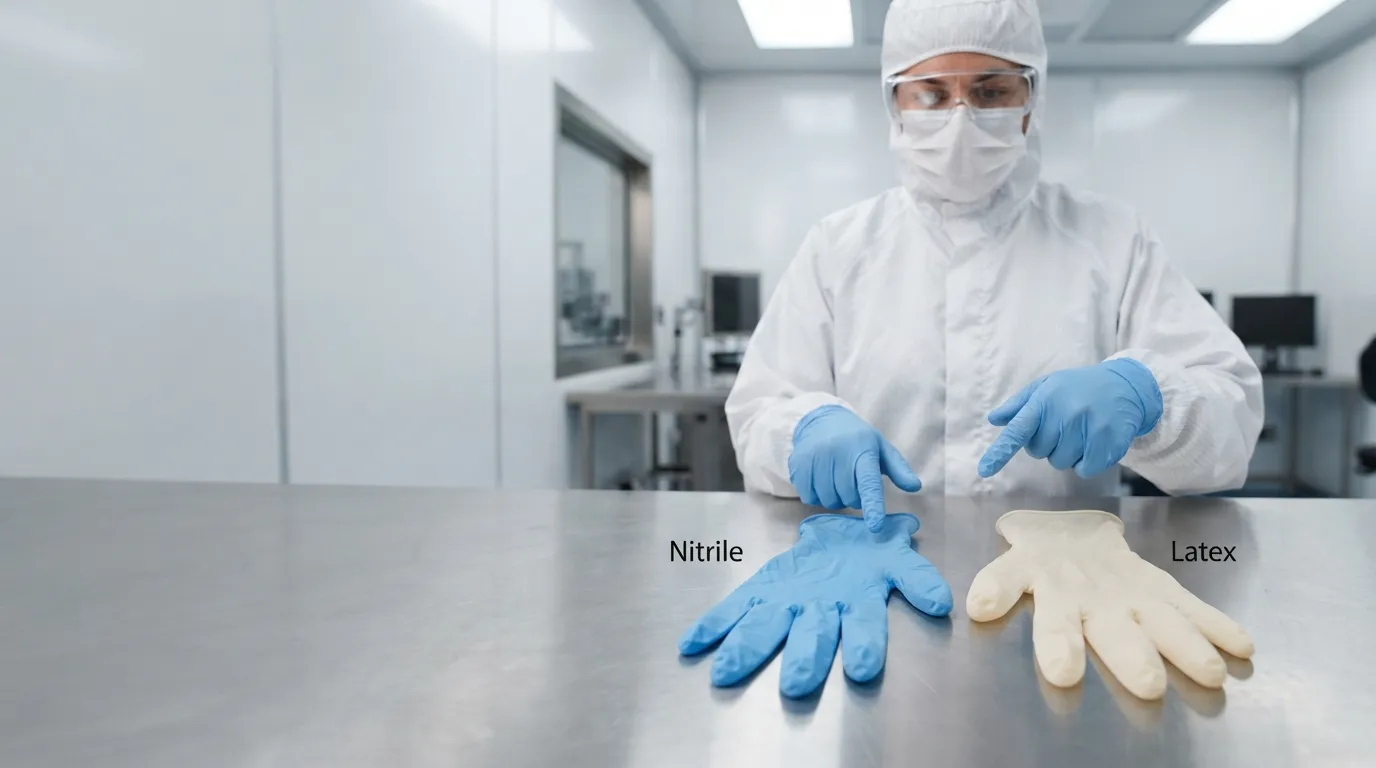
There is no universal winner between nitrile and latex. The right material depends on your allergy policy, chemical exposure, tactile requirements, and the documentation your quality team expects.
| Factor | Nitrile | Latex |
|---|---|---|
| Material | Synthetic acrylonitrile-butadiene rubber | Natural rubber latex |
| Latex allergy risk | None | Real risk; may be restricted by facility policy |
| Tactile sensitivity | Good | Excellent |
| Chemical resistance | Generally better for many solvents and chemicals | Varies; generally weaker for many chemicals |
| Powder-free options | Widely available | Widely available |
| Common cleanroom use | Electronics, pharmaceutical, general controlled environments | Medical device, applications requiring high dexterity |
Both materials are available as powder-free products. Powder-free status reduces the particulate and protein concerns associated with powdered gloves, but it does not make a glove sterile — sterility is a separate claim with its own evidence.
Nitrile Cleanroom Gloves
Nitrile is the most common latex-free choice in controlled environments. It provides good chemical resistance and suits cleanrooms where latex allergy is a concern.
Nitrile cleanroom gloves also have a dedicated international standard: ISO 23464:2020 specifies nitrile cleanroom gloves intended for use in ISO Classes 4, 5, and 6 cleanrooms. That does not mean every nitrile glove is certified to the standard — it means a buyer can ask a supplier whether a specific product is manufactured and documented to meet it.
Product-specific testing still matters. Research archived by the CDC shows that disposable nitrile glove integrity can vary by product and movement exposure, so the supplier's test documentation is not an optional extra.
Latex Cleanroom Gloves
Latex offers excellent tactile sensitivity and elasticity, which is why it remains common in medical-device manufacturing and other precision work. The main limitation is latex allergy: repeated exposure to natural rubber latex proteins can sensitise workers, and many facilities restrict latex for this reason.
Latex gloves can be clean-processed, powder-free, or sterile, but each attribute must be confirmed by the product's documentation. A latex glove labelled for cleanroom use is not automatically sterile or low-residue.
What Do Cleanroom Class Labels Actually Mean?
Cleanroom class labels cause confusion because they describe two different things: the room and the product.
| Term | What It Describes |
|---|---|
| ISO 14644 class | The airborne particle cleanliness of the room, such as ISO 5 or ISO 6 |
| Class 100 (legacy) | A former FED-STD-209E term, roughly equivalent to ISO 5 |
| ISO 23464 | A product standard for nitrile cleanroom gloves, not a room class |
An ISO 14644 class defines the maximum allowable concentration of airborne particles in the room. It does not, by itself, certify the gloves worn inside that room.
When a supplier describes a glove as "Class 100/ISO 5," the label usually indicates the intended environment, not a verified product classification. To verify the claim, you need product-level evidence: a technical data sheet, a certificate of conformity, or a batch test report showing the relevant measurement.
Sterile, Non-Sterile, and Powder-Free Gloves: What Is the Difference?
These three terms are often used as if they meant the same thing. They do not.
- Powder-free: manufactured without the powdered lubricant used to ease donning. This reduces particulate and protein concerns, but it is not a sterility claim.
- Sterile: processed and packaged to achieve a stated sterility assurance level. Sterile claims require documented evidence, such as a certificate of sterility.
- Non-sterile: may be clean-processed, washed, or cleanroom-packaged, but no sterility claim is made.
Packaging also matters. Double or triple bagging supports the controlled transfer of gloves through airlocks and gowning areas. If your process requires sterile gloves, the packaging and the sterility certificate should be checked together — a sterile glove inside damaged packaging has no useful sterility guarantee.
Are ESD-Safe Cleanroom Gloves Enough for Electrostatic Control?
No. An ESD-safe glove is one element of a static-control program, not the program itself.
A glove's ESD claim should be supported by measured surface-resistance data and a stated test method. Two units are commonly used, and they are not interchangeable:
- Surface resistance is expressed in ohms (Ω).
- Surface resistivity is expressed in ohms per square (Ω/sq).
A supplier should state which measurement was taken, which method was used, and what value the product achieved. Vague terms such as "antistatic" are not enough.
Even with a genuine ESD-safe glove, charge must have a path to ground. That path comes from a complete system: grounded wrist straps where applicable, static-dissipative flooring, proper footwear, and — for full personnel control — anti static apparel that prevents charge generation on the body and garments. A glove alone cannot provide that path.
Fit, Cuff Length, Thickness, and Packaging: What Specifications Matter?
Four physical specifications determine whether a glove is practical in daily use.
| Specification | What It Affects | Typical Unit |
|---|---|---|
| Size | Fit, dexterity, comfort, donning reliability | S to XXL, with width/length measurements |
| Cuff length | Wrist and forearm coverage | Inches or millimetres |
| Thickness | Tactile feel versus durability | Mil or micron |
| Packaging | Contamination-free transfer into clean areas | Single, double, or triple bagging |
Do not mix units when comparing products. If one supplier quotes cuff length in inches and another in millimetres, convert before comparing. The same applies to thickness: a 5 mil glove is not the same as a 5 micron glove.
Fit deserves particular attention. A glove that is too tight causes hand fatigue and increased movement; a glove that is too loose reduces tactile control and can shed particles through friction. Ask suppliers for a sizing chart and test fit during the sample-approval stage.
How to Match Cleanroom Gloves to Your Application
The right glove is the one that fits the contamination risks of the specific process.
| Application | Key Priorities | Glove Considerations |
|---|---|---|
| Semiconductor and electronics | Particle control, ionic residue, ESD | Nitrile, low-shedding, ESD data if required |
| Pharmaceutical and GMP | Sterility, gowning, documentation | Sterile or clean-processed, certificate of sterility |
| Medical device | Product protection, particulate control, traceability | Material depends on tactile and chemical needs; documentation essential |
| General controlled environments | Material, comfort, cost | Nitrile or latex based on allergy and tactile requirements |
A semiconductor application may tolerate a non-sterile glove but reject one with high ionic residue. A pharmaceutical filling line may require a sterile glove with a defined sterility assurance level. Always match the glove to the documented requirements of the process, not to a general preference.
For a broader view of how gloves fit into the overall management of controlled areas, see cleanroom contamination control.
How to Evaluate a Cleanroom Gloves Supplier

Supplier evaluation is where glove selection succeeds or fails. The supplier's documentation is your evidence, and it must be specific to the product or lot you are buying.
Request and review:
- Product technical data sheet (TDS), covering physical and performance specifications
- Certificate of conformity, confirming the product matches the specified requirements
- Certificate of sterility, when sterile gloves are required
- Safety data sheet (SDS/MSDS), for handling and hazard information
- Batch or lot test reports, showing the measurements for the actual lot supplied
- Sample approval, before committing to a full order
- Substitution control, so the supplier notifies you before changing material, formulation, or packaging
Know which document you are looking at. A TDS describes the product family's general specifications; a batch test report verifies the actual measurements of one production lot; a certificate of conformity confirms that a delivery meets the agreed specification; a certificate of sterility applies to a specific sterilisation process and batch. They are not interchangeable.
Ask the supplier to confirm MOQ, lead time, and packaging configuration before you shortlist them. And if the supplier says a glove is "ISO 5" or "Class 100," ask precisely which standard that refers to and which document proves it.
Many facilities also purchase cleanroom wipes on the same requisition cycle. Working with a single lint free cleanroom wipes supplier who applies the same documentation standards simplifies qualification and incoming inspection.
Choosing the Right Cleanroom Glove Starts with Documentation
The pattern runs through every section of this guide: choose the material for the process, verify the class claim with evidence, and hold the supplier to a clear documentation standard. Nitrile and latex both have legitimate places in controlled environments. Sterile, powder-free, and ESD-safe are separate claims, not interchangeable badges. The supplier who can provide the TDS, certificates, and batch test reports without hesitation is the one worth working with.
To discuss cleanroom consumables, contamination-control products, or documentation requirements for your facility, the Nabai team can help.
NEWS
GET SERVICE
With quality parts to meet every budget and friendly staff trained to make your visit informative and hassle free.