
Cleanroom Mop & Bucket Systems: Supplier Selection Tips

Cleanroom Mop & Bucket Systems: Supplier Selection Tips
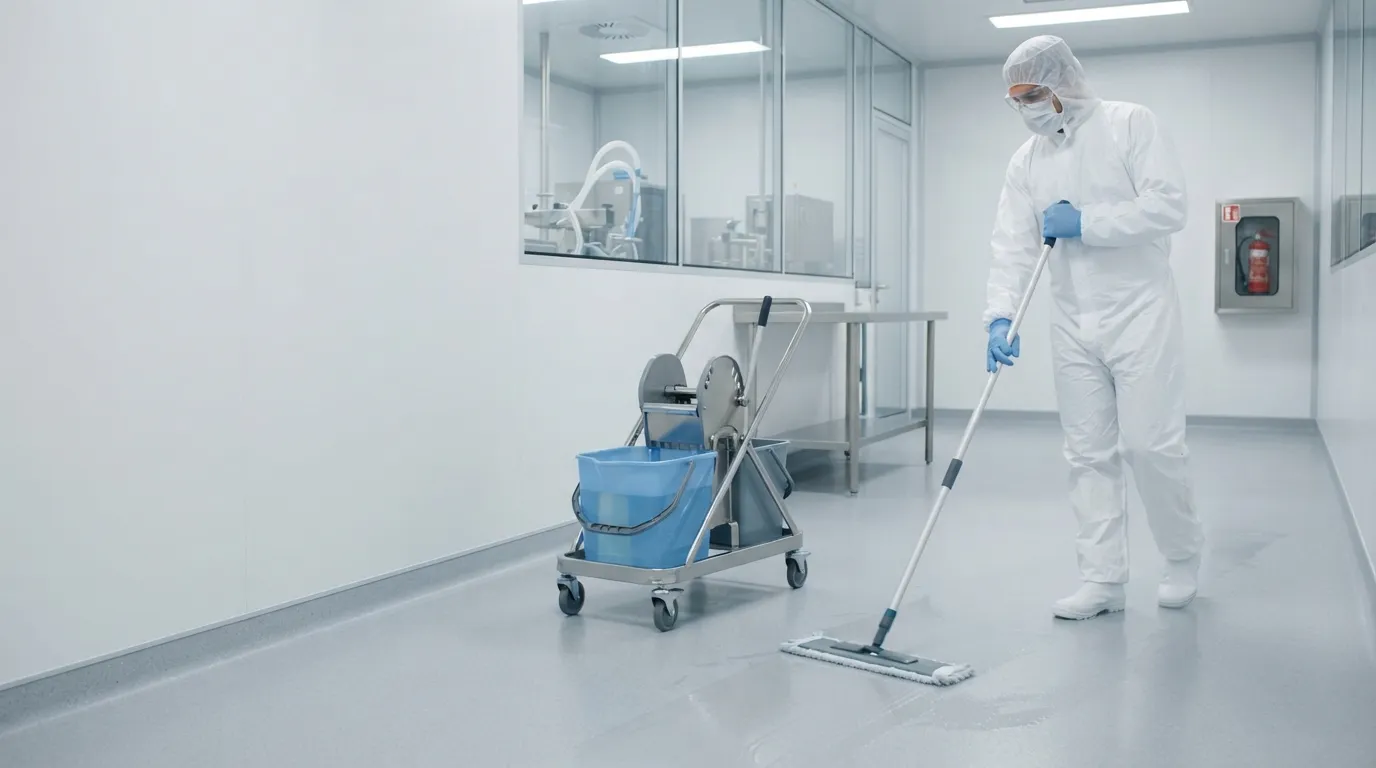
A cleanroom mop-and-bucket system is a wet-floor-cleaning setup designed for controlled environments, combining low-shedding mop components with a bucket configuration that separates fresh cleaning solution, rinse water, and used mop heads so the mopping process does not carry particles or residue back onto the cleaned floor. The right configuration depends on your cleanroom class, the disinfectants you use, and the documentation your facility's cleaning validation requires.
Cleanroom mop-and-bucket systems are one component of a complete cleanroom cleaning supplies program. They work alongside dry entry-control products and a documented cleaning procedure to keep particle loads within your facility's classification limits. For a broader look at preventing contamination across the whole cleanroom, see our guide on how to reduce dust contamination in cleanrooms.
Why Ordinary Mopping Can Reintroduce Particles Into a Cleanroom
Standard janitorial mopping works well enough in ordinary buildings because a small amount of residual dirt and moisture is acceptable. In a cleanroom, the same process can become a contamination source through several distinct routes:
- Dirty solution returned to the floor. When a mop is dipped back into the same bucket, the contaminated water is spread across the next section of floor. The bucket becomes a reservoir of particles rather than a cleaning tool.
- Used mop heads re-entering the clean solution. A mop head loaded with particles, fibers, and chemical residue is dipped into the cleaning solution, transferring that load directly into the liquid that is supposed to be clean.
- Wringer and bucket contamination. The wringer and the interior of the bucket collect soil over time. If the wringer is used to squeeze the mop over the fresh-solution bucket, contamination drips into the clean supply.
- Cross-zone transfer. The same mop, bucket, or trolley moved between rooms or areas carries particles from one zone to another.
- Lint shedding. Mop materials not designed for cleanroom use shed fibers onto the floor during cleaning.
- Incompatible chemical residue. Disinfectants or cleaning agents that are incompatible with the mop material or the floor surface can leave a film that traps particles and interferes with subsequent cleaning.
The common thread is that a poorly designed mopping process moves contamination around instead of removing it. A cleanroom mop-and-bucket system exists to prevent that movement by keeping clean and dirty elements physically separate.
What Makes a Mop System Cleanroom-Safe
A cleanroom mop-and-bucket system is more than a mop and a pail. Each component contributes to the system's ability to control contamination, and the material choices determine how well the system can be cleaned, disinfected, and validated.
Mop Heads: Low-Lint Materials and Residue Behaviour
The mop head is the only component that touches the floor, so its material and construction directly affect particle and residue control.
Low-lint polyester is the most common choice for cleanroom mops because polyester fibers are continuous and less likely to shed than natural fibers. Microfiber mops are also used in some controlled environments, but they behave differently: microfiber can pick up fine particles effectively, yet its chemical compatibility and laundering requirements differ from polyester. The right choice depends on your cleaning agents and your facility's mop-laundering or disposal policy.
The trade-off between single-use and launderable mop heads matters for contamination control. Single-use heads eliminate the risk of inadequate laundering but increase consumable cost and waste. Launderable heads reduce waste but require a validated laundering process that removes particles and residues without damaging the fibers. Whichever option you choose, ask the supplier what test method supports the low-lint claim. A statement like "low lint" is only meaningful when it is backed by a documented test.
Chemical compatibility is equally important. The mop head must tolerate the disinfectants used in your facility — for example alcohol, hydrogen peroxide, or hypochlorite-based products — without degrading, shedding, or releasing residues. Confirm compatibility with each chemical you plan to use, and check whether the supplier provides guidance on maximum concentrations and exposure times.
Buckets, Wringers, and Trolleys: Materials and Cleanability
The bucket and wringer determine how well the system separates clean and contaminated liquid.
Polypropylene buckets are lightweight, chemically resistant, and common in cleanroom mopping systems. Look for designs with smooth, rounded interiors and minimal crevices where soil can accumulate. Stainless steel buckets are more durable and can be easier to clean and sterilize, which makes them a common choice for pharmaceutical and other demanding applications.
The wringer or sieve must direct contaminated liquid away from the fresh-solution bucket. In a divided-bucket or multi-bucket arrangement, the wringer should sit over the used or rinse bucket, not the clean bucket. Some systems use a sieve that lifts the mop head above the liquid level, allowing excess solution to drain without the mop sitting in dirty water.
A trolley or cart is a practical addition when the system must move between areas. It keeps the buckets, mops, and accessories together and supports zone segregation: if equipment is color-coded and assigned to a specific area, the trolley helps ensure it does not cross into another zone.
Sterile, Autoclavable, and Cleanroom-Packaged Options
For sterile or aseptic manufacturing environments, the mopping system must meet higher standards. Some suppliers offer mop-and-bucket systems that are autoclavable, supplied sterile, or packaged in a way that prevents contamination during transport and storage. These are distinct attributes:
- Autoclavable means the materials and construction can withstand steam sterilization cycles.
- Sterile means the product is supplied free of viable microorganisms, with a documented sterilization method.
- Cleanroom-packaged means the product is protected from contamination until it enters the cleanroom, but it is not necessarily sterile.
These attributes must be documented by the manufacturer. A claim of sterility or autoclavability is only meaningful when the supplier provides the relevant specification, sterilization method, or certificate of analysis. Ask which of these attributes apply to each component — the mop head, bucket, wringer, and trolley may have different ratings.
Two-Bucket, Three-Bucket, or Presaturation: Which System Reduces Particle Redeposition?
The bucket configuration is the heart of a cleanroom mop-and-bucket system. Three main architectures are used in controlled environments, and each handles the separation of clean and contaminated elements differently.
| System Architecture | How It Works | Contamination Control | Best Fit |
|---|---|---|---|
| Two-bucket system | One bucket holds fresh mops; the other collects used mops | Prevents used mops from re-entering the clean-mop supply | Lower-risk areas or baseline controlled cleaning processes |
| Three-bucket system | Bucket 1: cleaning solution; Bucket 2: rinse water; Bucket 3: waste | Adds a rinse step before the mop returns to the cleaning solution | Facilities where rinse and waste must remain separate |
| Presaturation system | Mop heads are pre-wetted in a controlled solution before entering the area; a two-bucket arrangement separates fresh from used mops | Reduces in-room dipping and wringer contamination | Facilities that want consistent solution dosing and less operator variability |
Two-Bucket System: Fresh and Used Mop Separation
A two-bucket cleanroom mop system uses one bucket to hold fresh, ready-to-use mops and a second bucket to collect mops after they have contacted the floor. The used mop never returns to the fresh-mop container, so the clean supply remains uncontaminated.
This architecture is simple, inexpensive, and suitable for lower-risk areas. Its main limitation is that the used mop still holds particles and liquid after cleaning; without a rinse step, some of that load can be transferred to the next area if the mop is reused. Operator discipline is therefore essential: the used mop must go into the designated container, not back into the fresh supply.
Three-Bucket System: Adding a Rinse Step
A three-bucket system adds a rinse step to the mopping workflow. The first bucket contains the cleaning or disinfectant solution. The second contains rinse water. The third collects waste — the dirty liquid and used solution that must not return to the floor.
The typical sequence is: wet the mop in the cleaning solution, wring it, clean the floor, rinse the mop in the rinse-water bucket, wring it again, and then re-wet it in the cleaning solution. The waste bucket captures the liquid that is squeezed out of the mop after rinsing.
The rinse step removes soil and residual cleaning agent before the mop re-enters the clean solution. This makes a three-bucket system a stronger choice for facilities where chemical residue control and thorough particle removal matter more than operator simplicity.
Presaturation Systems: Controlling the Mop Before It Enters
A presaturation system prepares mop heads with the correct cleaning solution before they enter the cleanroom. Mops are wetted in a controlled container, then carried to the floor and used; after use, they are deposited into a separate used-mop container.
Presaturation is often arranged as a two-bucket system in which one bucket holds the pre-wetted fresh mops and the second receives used mops. Because the mop is already saturated with the correct solution concentration, the operator does not need to dip and wring the mop in the cleanroom, which reduces variability and limits the chance of contamination entering the clean solution.
This approach is useful when consistent disinfectant dosing matters, such as in pharmaceutical or biotechnology facilities where cleaning validation requires reproducible conditions. The trade-off is that presaturation systems require more preparation time and may require the solution to be prepared and verified before use.
Matching the Mop System to Cleanroom Class and Application
The right system for your facility depends on the cleanroom class, the products being manufactured, and the level of documentation your cleaning validation requires. The table below reflects common controlled-environment practice; it is not a universal mandate imposed by ISO 14644, which classifies air cleanliness rather than specifying mopping protocols.
| Environment | Typical System Architecture | Key Material and Documentation Considerations |
|---|---|---|
| ISO 5 / sterile pharmaceutical | Three-bucket or presaturation; sterile or autoclavable components where required | Sterility documentation, chemical compatibility with sporicidal agents, validated laundering or single-use mop heads |
| ISO 6–7 / semiconductor, pharmaceutical | Two- or three-bucket with low-lint mops | Particle control, chemical compatibility, zone-segregated color coding |
| ISO 7–8 / electronics, medical device | Two- or three-bucket | Low-lint mop heads, residue control, operator training |
| Controlled non-classified manufacturing | Two-bucket system | Baseline contamination control, cost efficiency, documented cleaning procedure |
In semiconductor and electronics facilities, the priority is particle control and residue minimization because particles can cause yield loss on wafers, displays, and circuit boards. In pharmaceutical and medical-device environments, the focus shifts to chemical residue control, sterility, and documentation that supports cleaning validation. The selection of a mop-and-bucket system should always follow from the facility's contamination-control objectives, not the other way around.
For detail cleaning of electronic assemblies and components after floor-level contamination control, cleanroom swabs for electronics cleaning complete the floor-to-detail cleaning sequence within a broader cleanroom consumables program.
Cleanroom Mopping Procedure: How to Wet-Clean Without Redeposition
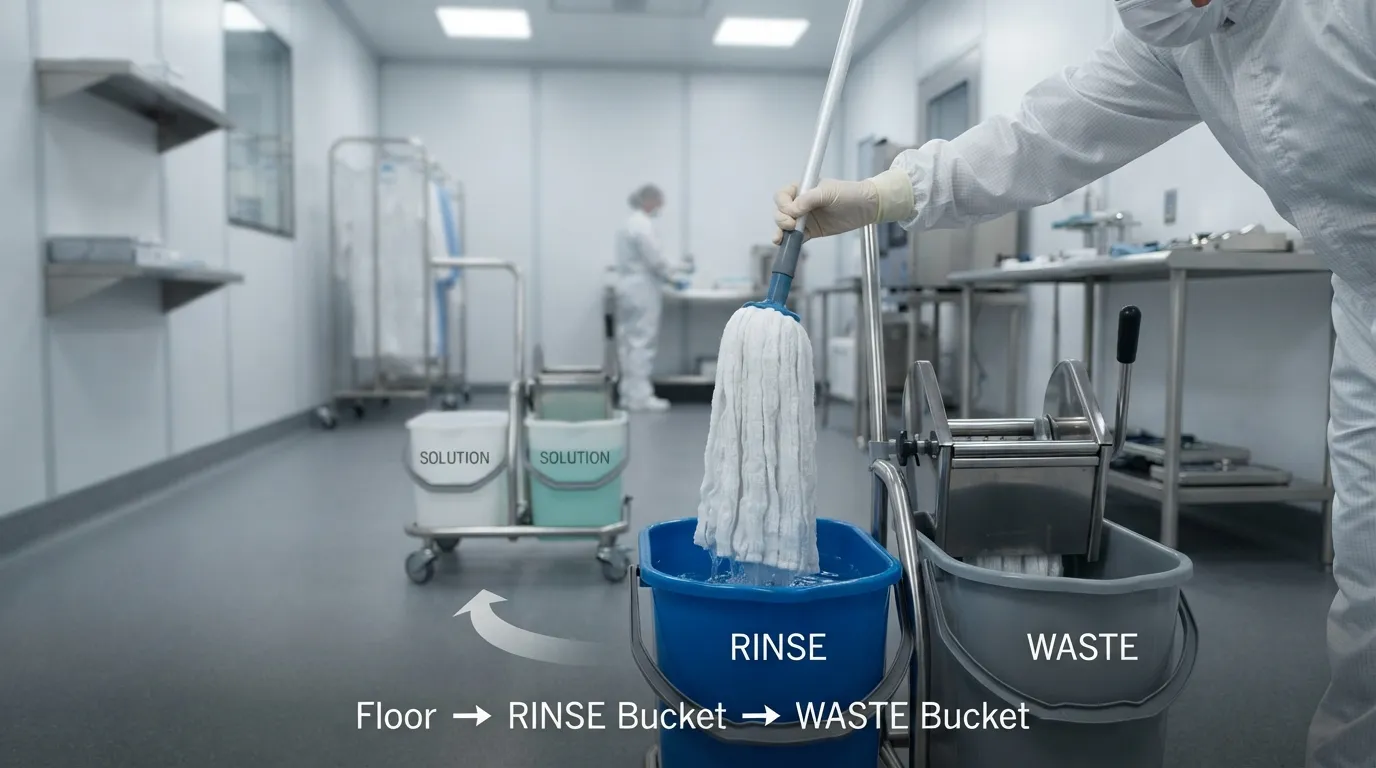
The system architecture only works if the operator follows a procedure that keeps clean and dirty elements separate. The steps below describe an illustrative cleanroom mopping workflow. Your facility's SOP and cleaning validation take precedence over any general guidance.
- Prepare the system. Position the clean-solution bucket, rinse bucket, and waste bucket in the correct places. Confirm that the disinfectant concentration matches the approved procedure.
- Segment the floor into zones. Work from the cleanest area toward the exit so the mop does not pass over already-cleaned surfaces. Use color-coded equipment if zones are assigned.
- Fill the clean-solution bucket. Use the disinfectant or cleaning agent specified in your SOP at the approved concentration.
- Wet the mop in the clean-solution bucket only. Do not dip the mop into the rinse or waste bucket.
- Remove excess liquid. Use the wringer or sieve so the mop is damp, not dripping.
- Mop in overlapping straight lines. Move from the cleanest point of the zone toward the exit. Keep a consistent direction and overlap each pass slightly.
- Return the used mop to the used or waste bucket. Never re-dip a used mop into the clean-solution bucket.
- Rinse the mop in the rinse-water bucket. If you are using a three-bucket system, rinse the mop before it returns to the cleaning solution.
- Replace or launder the mop head according to your facility's policy and the manufacturer's guidance.
- Clean and dry the system after use. Empty and rinse the buckets, dispose of waste solution correctly, and store the system so it does not become a contamination source.
- Record the cleaning per your facility SOP. Documentation supports your cleaning validation and provides traceability.
The most common operator error is the "single-bucket reflex": dipping the same mop repeatedly into the same water until the bucket is visibly dirty. In a cleanroom, if the bucket looks dirty, the mop has already been spreading contamination for some time.
Cleanroom Mop and Bucket Supplier Evaluation Checklist
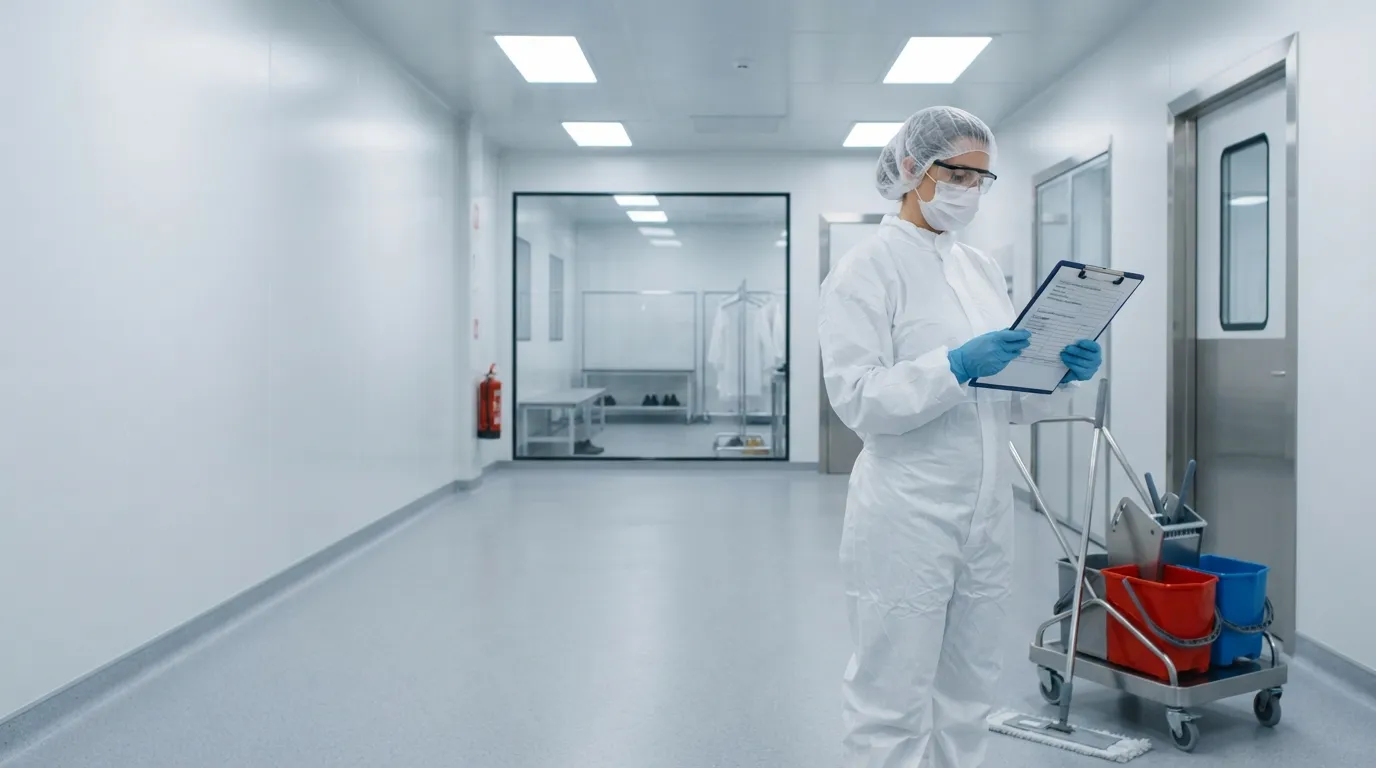
When you evaluate a cleanroom mop-and-bucket supplier, the goal is to verify that the product actually performs as claimed and that the supplier can support your facility's documentation and validation requirements. Use the checklist below as a starting point.
- Request a Technical Data Sheet (TDS) for each component. The TDS should describe materials, dimensions, and handling requirements for the mop head, bucket, wringer, and trolley.
- Ask which test method supports a low-lint or low-residue claim. A documented test method is more useful than a vague "cleanroom-grade" label.
- Confirm whether each component is autoclavable, sterile, or both, with documentation. The bucket, mop head, wringer, and trolley may have different ratings.
- Request batch-specific test reports where applicable. A general TDS describes the product line; a batch test report verifies the specific lot you are purchasing.
- Confirm chemical compatibility with your disinfectants. Provide the supplier with the list of chemicals and concentrations you use, and ask for written confirmation.
- Ask about lot traceability. If a problem arises, you need to trace the affected batch and remove it from service.
- Check packaging and delivery conditions. The product must arrive in a condition that does not introduce contamination.
- Inquire about MOQ, lead time, and replacement parts. A mop system is only useful if you can keep it operational and replace worn components.
- Ask about custom or color-coded components. Zone segregation is easier when mop heads, buckets, and handles are available in distinct colors.
- Separate product suitability from facility validation. A supplier can provide a product that is cleanable, autoclavable, and compatible with your chemicals, but the supplier cannot validate your cleaning process. That responsibility belongs to your facility.
A note on language: terms like "cleanroom grade" or "ISO suitable" are not certifications. They are descriptions. If a supplier claims a product meets a standard or is suitable for a specific cleanroom class, ask for the test report, certificate, or specification that documents that claim. If the supplier describes a product as sterile, ask for the sterilization method and the certificate of analysis. A buyer who verifies documentation before purchase avoids the more expensive problem of discovering an unsupported claim during an audit.
Summary: Build the Mop System That Supports Your Contamination-Control Program
A cleanroom mop-and-bucket system is not a single product; it is a set of decisions. You choose the mop material, the bucket architecture, the wringer design, the sterilization or laundering approach, and the documentation you will accept from a supplier. Each decision either strengthens or weakens the separation between clean and contaminated elements.
Start with the problem: what particles, residues, and chemicals does your cleaning process need to control? Then select the architecture — two-bucket for baseline control, three-bucket for stronger rinse and waste separation, or presaturation for consistent solution dosing. Verify that the materials are compatible with your disinfectants and that the supplier can provide the TDS, test reports, and traceability your facility requires. Finally, confirm that your own SOP and cleaning validation cover the equipment before it enters service.
A complete floor-contamination-control program combines dry particle removal at the entry point with correct wet cleaning inside the cleanroom. For the entry layer, explore cleanroom sticky rollers to capture particles from garments and equipment before they reach the floor. Each layer of the program — dry at the doorway, wet on the floor, and documented throughout — contributes to the particle control your process depends on.
NEWS
GET SERVICE
With quality parts to meet every budget and friendly staff trained to make your visit informative and hassle free.