
HEPA vs ULPA Filters: Efficiency, Airflow, and Cost

HEPA vs ULPA Filters: Efficiency, Airflow, and Cost
ULPA filters specify a higher particle-capture efficiency than HEPA filters, but their denser media imposes a higher airflow resistance. That resistance can reduce delivered airflow or raise fan energy consumption, so the correct filter class depends on your process requirements, system capacity, and the applicable filter standards — not on the headline efficiency figure alone.
Filter selection is one part of a complete cleanroom contamination control program. The two filter families are not interchangeable, and choosing the wrong one means either paying for efficiency you cannot use or failing to meet a process cleanliness target.
What Is a HEPA Filter?
A HEPA (High-Efficiency Particulate Air) filter is a particle filter rated to capture a specified percentage of airborne particles at a defined test condition. A widely used US benchmark is 99.97% at 0.3 µm, a value documented in NASA's controlled-environment design guidance. In the EN 1822 and ISO 29463 framework, HEPA classes are designated H13 and H14, with efficiency measured against the most penetrating particle size (MPPS) — the particle size at which the filter is least efficient.
A HEPA rating describes efficiency at a defined test condition. It is not a statement about pore size: filter media collect particles through several physical mechanisms, and no fixed "hole size" boundary exists.
What Is a ULPA Filter?
A ULPA (Ultra-Low Penetration Air) filter is a particle filter specified to a higher efficiency than HEPA. A common US industry reference is 99.999% at 0.12 µm. In the EN 1822 / ISO 29463 framework, ULPA classes are designated U15, U16, and U17, with the same MPPS-based rating principle.
ULPA media is physically denser than HEPA media. That density allows the higher efficiency specification to be met, and it is also the source of ULPA's higher airflow resistance — the trade-off examined in the next section.
HEPA vs ULPA: Efficiency Comparison
| Comparison Point | HEPA | ULPA |
|---|---|---|
| Acronym | High-Efficiency Particulate Air | Ultra-Low Penetration Air |
| Common US efficiency benchmark | 99.97% at 0.3 µm | 99.999% at 0.12 µm |
| EN 1822 / ISO 29463 classes | H13, H14 | U15, U16, U17 |
| Efficiency basis in the EN/ISO framework | MPPS | MPPS |
| Media construction | Standard high-efficiency media | Denser media |
| Installation consequence | Lower pressure drop | Higher pressure drop |
Efficiency figures above follow the commonly cited US references for cleanroom filter classes; the classification framework and class designations follow TSI's filter-testing technical overview.
The most penetrating particle size (MPPS) is the particle size at which a filter's efficiency is lowest. For HEPA and ULPA media, the MPPS usually falls in the sub-micrometre range, often around 0.1–0.3 µm depending on media construction and operating face velocity. Ratings quoted against MPPS are more meaningful than single-particle-size benchmarks because they define the filter's worst-case efficiency point.
Neither 0.3 µm nor 0.12 µm is a pore size. HEPA and ULPA media capture particles through interception, inertial impaction, diffusion, and electrostatic attraction. A figure stated at a specific particle size describes the efficiency measured at that size under controlled test conditions, not a sieve threshold.
Airflow and Pressure Drop: What ULPA's Higher Efficiency Costs
Pressure drop is the airflow resistance a filter creates. At the same face velocity and filter area, a ULPA filter has a higher pressure drop than a comparable HEPA filter because its denser media forces the air through a more restricted path.
The practical result is one of two outcomes: either the HVAC system or fan-filter unit (FFU) must work harder to deliver the same airflow — consuming more energy — or the delivered airflow falls. Airflow volume matters as much as filter efficiency in a cleanroom, because contamination control depends on dilution and directional airflow, typically expressed as air changes per hour. If a ULPA filter drops the delivered air changes below the level required to meet a room's particle-concentration target, the efficiency advantage of ULPA is lost in practice.
A prefilter upstream of the final filter reduces the particle load reaching the HEPA or ULPA stage and extends its service life, but it does not change the intrinsic pressure-drop difference between the two classes. Always compare pressure-drop values at the same rated airflow and face velocity; a resistance figure without a stated face velocity is not comparable.
Cost Comparison: Purchase Price vs Total Operating Cost
Purchase price is the most visible difference between HEPA and ULPA filters, but it is not the most consequential one. Total cost of ownership includes:
- Initial filter purchase price
- Fan energy over the filter's service life, which is typically higher for ULPA because of the greater pressure drop
- Maintenance and replacement labour
- System capacity: an HVAC or FFU that cannot deliver the required airflow through a higher-resistance filter may need modification, not just a filter swap
- Validation and documentation costs in regulated environments
A ULPA filter can therefore cost more in energy and system modification over its life than its purchase price alone suggests. The meaningful comparison is not "HEPA price versus ULPA price" but "cost of a HEPA system versus a ULPA system delivering the same airflow and meeting the same cleanliness target."
Which Cleanroom Class Needs Which Filter?
ISO 14644-1 classifies cleanrooms by the maximum allowable concentration of airborne particles at specified sizes. It does not prescribe a filter class. Whether a particular ISO class needs HEPA or ULPA depends on the required particle concentration, the airflow needed to achieve it, the sensitivity of the process, and the applicable validation standards. WHO GMP guidance for sterile pharmaceutical production, for example, relies on ISO 14644-based room classification and ISO 1822-4 for filter leakage determination — a useful illustration of why filter class and room class are governed by different standards.
A filter's efficiency rating and a room's ISO classification answer different questions. The rating describes what the filter media can remove in a laboratory test; the classification describes how clean the room air must be in operation. Installing a ULPA filter does not certify a room. Only particle-count testing of the installed system demonstrates that the room meets its classification.
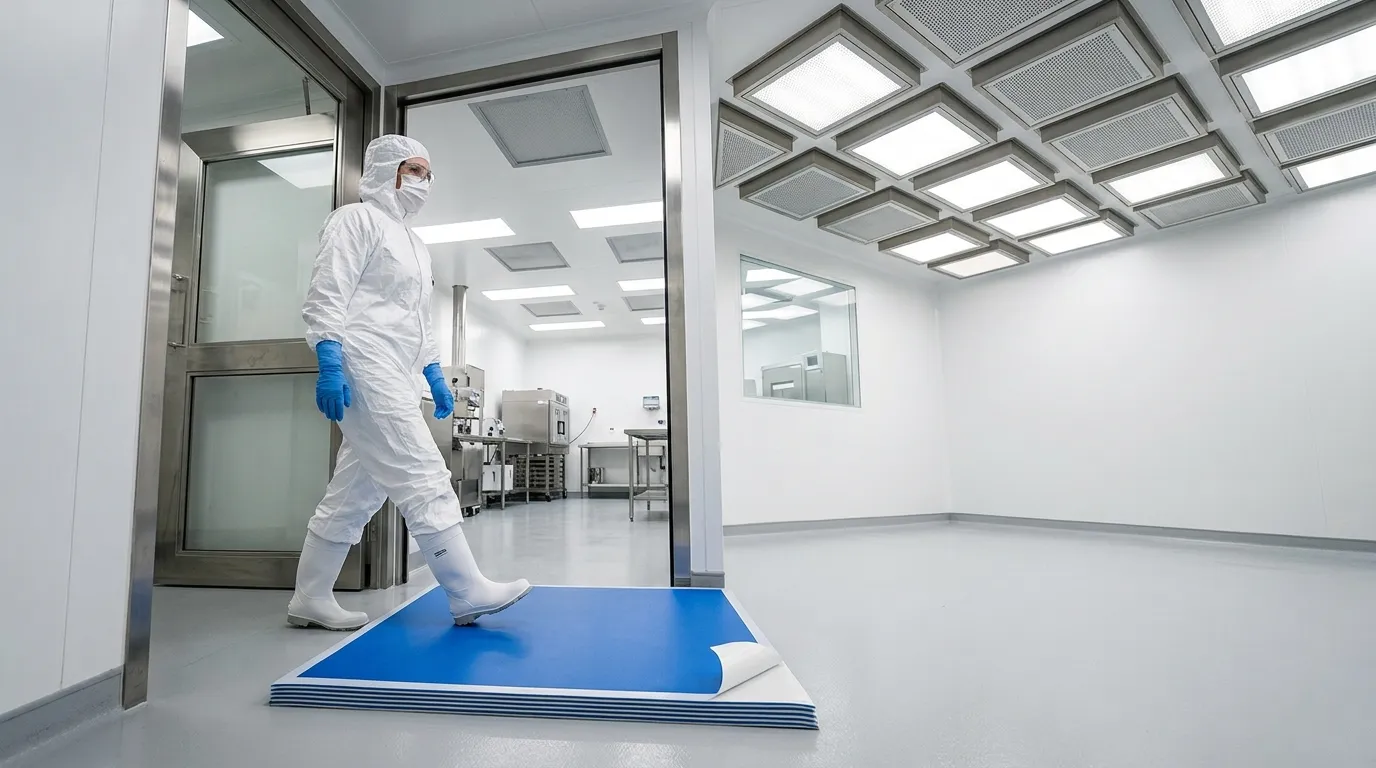
Filtration is one layer of a cleanroom contamination-control program. Sticky mats at cleanroom entry points control surface contamination carried in on shoes and trolley wheels; they do not control airborne particle concentration and do not replace filtration. Both measures address different contamination pathways, and both are needed in a complete program.
Understanding ISO Cleanroom Classes
ISO 14644-1 assigns cleanrooms to classes from ISO 1 (strictest) to ISO 9 (least strict). Each class limits the maximum number of particles per cubic metre at defined particle sizes. An ISO 5 cleanroom, for instance, permits orders of magnitude fewer particles at the same size than an ISO 8 cleanroom.
The class target tells you how clean the air must be. It does not, by itself, determine which filter media will achieve that cleanliness. The final result also depends on air-change rate, room design, pressure differentials, contamination sources, and the installed performance of the filter system.
When HEPA Is the Right Choice
HEPA filtration is commonly specified for ISO 5 through ISO 8 cleanrooms where the particle-concentration target can be met at an appropriate air-change rate. HEPA is generally less expensive to purchase, less demanding on fan capacity, and more economical to replace than ULPA.
Many pharmaceutical, medical-device, and electronics cleanrooms are designed around HEPA terminal filtration with validated air-change rates, a pattern consistent with WHO GMP guidance for sterile pharmaceutical products. Where the room meets its classification target and the process tolerates the particle level the system achieves, HEPA is the proportionate and defensible choice.
When ULPA May Be Justified
ULPA is justified where the process is sensitive to particles at a level that a HEPA system, running at the required airflow, cannot reliably achieve. Semiconductor wafer fabrication and advanced electronics assembly are the most common examples. NASA's controlled-environment design guidance likewise references ULPA where cleanliness beyond ISO Class 5 is required in its stated applications. ULPA may also be specified in localized critical zones — such as mini-environments or strict ISO 3–5 areas — rather than across an entire room.
The limiting factor is airflow. ULPA cannot compensate for a system that cannot deliver the required air changes. If the filter's pressure drop exceeds fan capacity, the room may fail its particle target even with a more efficient filter installed.
How HEPA and ULPA Filters Are Tested and Verified
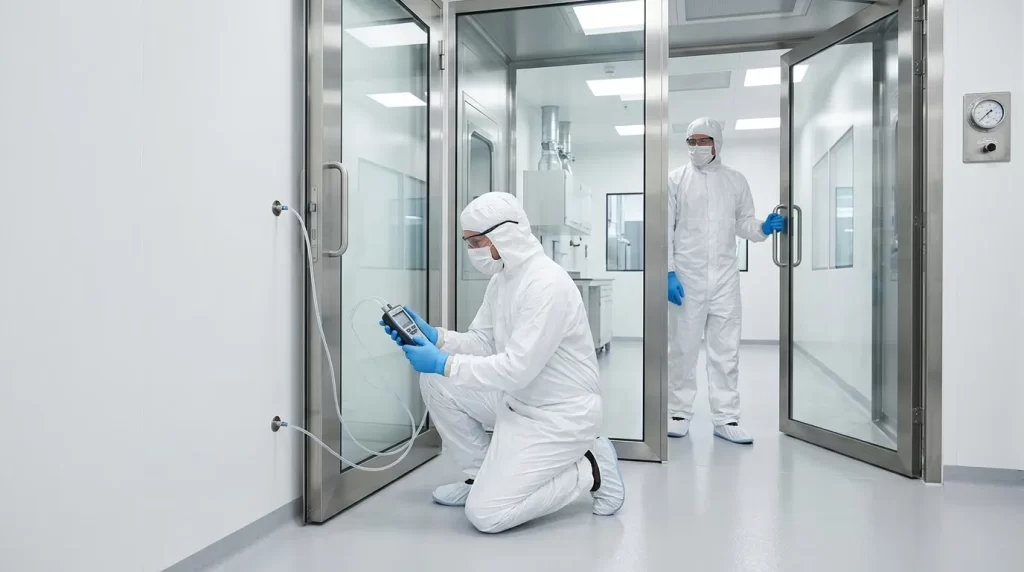
Two testing stages matter: classification testing of the filter media and verification of the installed filter.
Classification is performed in a laboratory. EN 1822 and ISO 29463 rate HEPA and ULPA filters by efficiency at the MPPS and assign classes: H13 and H14 for HEPA, U15 through U17 for ULPA. IEST-RP-CC001 provides a related performance-classification framework used in North America, as NASA's cleanroom design standard reflects. These ratings describe the design capability of the filter media, not the performance of a specific filter installed in your ceiling.
Installed verification is performed after installation. IEST-RP-CC034 covers factory, job-site, and installed leak-testing procedures for HEPA and ULPA filters. A leak scan challenges the filter with an upstream particle test and detects pinholes, frame bypass, gasket leakage, and damage from transport or installation. NIH's cleanroom HEPA technical guidance likewise sets out leak thresholds and repair restrictions for installed filters. After leak testing, particle counting of the room itself is used to confirm that the installed system meets its classification target — a separate process from filter certification, and the subject of our companion guide to cleanroom particle counting explained.
Two documents matter when you specify a filter. A technical data sheet (TDS) documents the filter's nominal class, dimensions, rated airflow, pressure drop, and handling instructions. A batch test report verifies the measured performance of the specific filter you receive, including efficiency and leak-scan results. They answer different questions: what the product is designed to do, and what the delivered unit actually did.
What HEPA and ULPA Filters Cannot Remove
HEPA and ULPA filters remove particles. They do not remove gases, VOCs, odours, or molecular contamination. Ammonia, siloxanes, acid gases, and organic vapours pass through particle filters unless the air-handling system also includes chemical filtration media such as activated carbon or impregnated sorbents.
Facilities running both particle-sensitive and molecularly sensitive processes — semiconductor fabs are the clearest example — must plan for both filtration types. Where the contamination problem extends beyond particles, filter selection alone is not the complete answer. For a broader view of particle-removal methods, see our guide on how to remove dust particles from air.
How to Choose: HEPA or ULPA?
Work through the steps in order.
- Define the cleanliness target. Identify the ISO class the process must meet under ISO 14644-1, including the particle sizes and concentrations that must be controlled.
- Assess process sensitivity. Determine whether the product can tolerate the particle exposure a validated HEPA system would allow. Semiconductor and advanced electronics processes are the common cases where ULPA earns its cost.
- Verify air system capacity. Calculate the air changes per hour needed to meet the target, then confirm that the HVAC or FFU can deliver that airflow through the filter's pressure drop. If it cannot, a more efficient filter will not fix the room.
- Compare total cost of ownership. Include purchase price, energy demand at the design face velocity, replacement cost, and validation effort for both options.
- Confirm standards and documentation. Specify the filter class under EN 1822 / ISO 29463 or IEST-RP-CC001, and require a factory scan report, a batch test report, and a technical data sheet from the supplier.
- Involve the cleanroom engineer. Filter selection interacts with fan curves, duct design, pressure differentials, and validation protocol. The engineering review is what turns a filter choice into a compliant room.
If the system can deliver the required air changes with HEPA and the process does not demand stricter cleanliness, HEPA is the proportionate answer. If the process cannot tolerate what HEPA delivers and the air-handling system can accommodate ULPA's pressure drop, ULPA is the justified upgrade.
For facilities where the challenge is wider dust ingress rather than filter selection specifically, our guide on how to reduce dust contamination in factories covers the broader problem.
Questions to Ask Before Buying a HEPA or ULPA Filter
Use this checklist when comparing supplier quotes:
- What filter class is offered, and which standard defines it (EN 1822, ISO 29463, or IEST-RP-CC001)?
- What efficiency is stated, and at which test particle size or MPPS?
- What is the rated airflow, and what is the pressure drop at that airflow and face velocity?
- What are the exact dimensions, frame style, and gasket or gel-seal configuration?
- Does the supplier provide a factory scan-test report for each filter?
- Is batch or serial-number traceability available for the delivered units?
- What are the storage, handling, and installation requirements?
- Which leak-test method will be used at installation, and who performs it?
- Are prefilters included or recommended to protect the final filter stage?
Each checklist item maps to a specification or test document you should be able to review before the filter is installed.
Bottom Line: HEPA vs ULPA
ULPA's higher efficiency is real, but it is not a free upgrade. The denser media that creates that efficiency also raises pressure drop, and pressure drop affects both delivered airflow and operating cost. For most cleanrooms, HEPA filtration at a validated air-change rate is the correct and proportionate choice. ULPA is justified when the process demands stricter particle control than HEPA can provide and the air-handling system can support the additional resistance.
Evaluate the decision by starting from the required ISO class, then working through process sensitivity, system capacity, and total cost — not by assuming a higher efficiency percentage is always the better filter. Filter selection is one decision within a broader cleanroom contamination control program, and the same level of scrutiny should be applied to the rest of that program.
NEWS
GET SERVICE
With quality parts to meet every budget and friendly staff trained to make your visit informative and hassle free.