
Cleanroom Pass Boxes: Moving Materials Without Breaking the Pressure Cascade

Cleanroom Pass Boxes: Moving Materials Without Breaking the Pressure Cascade
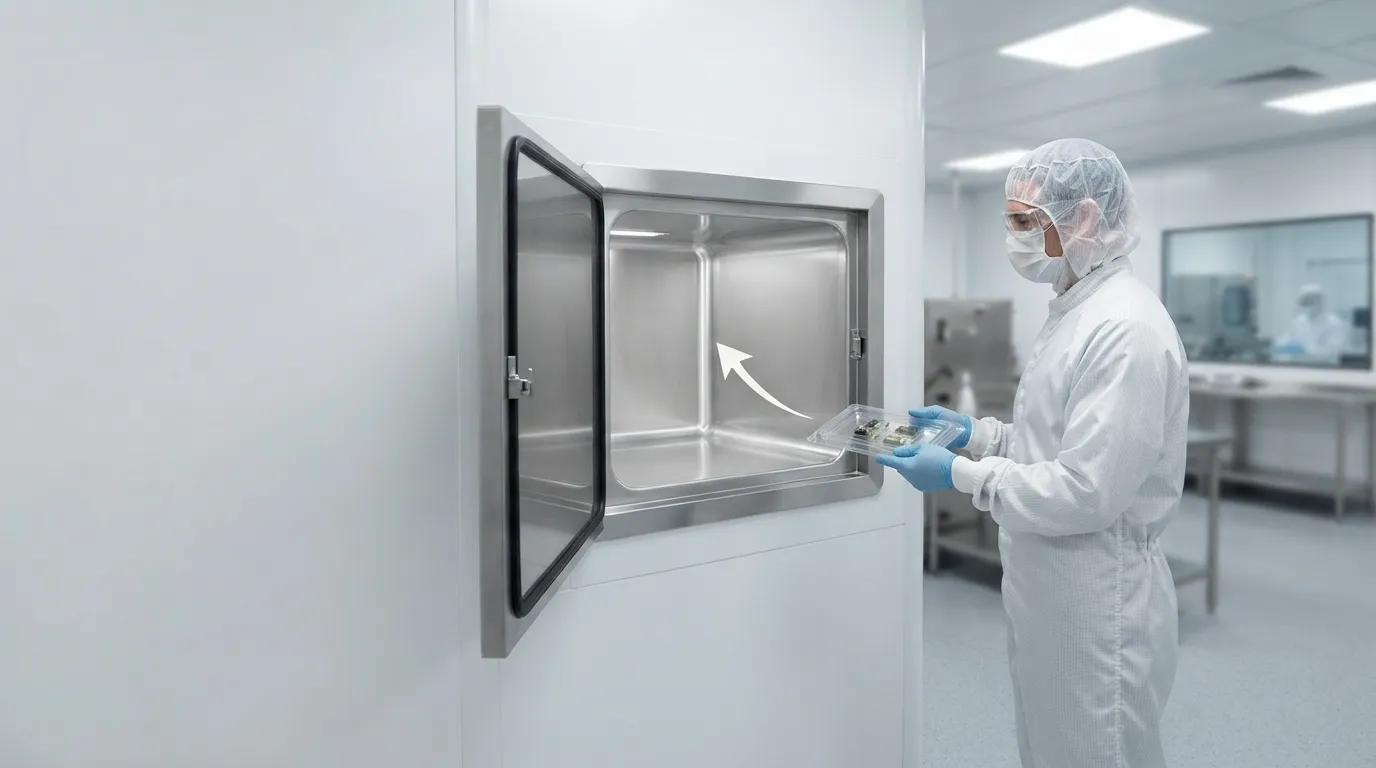
A cleanroom pass box is an interlocked transfer chamber that lets materials move between controlled areas without opening the main cleanroom door. It supports contamination control and pressure-cascade discipline, but it does not automatically guarantee either — the right configuration, correct installation, and verifiable supplier documentation all determine whether the transfer route actually protects the cleanroom.
If you are evaluating a pass box for a cleanroom supplier, the practical question is not just which box to buy, but what evidence you need to confirm it will do the job. This guide covers the equipment types, the pressure relationship you are trying to protect, and the documentation a credible supplier should provide before you issue a purchase order.
What Is a Cleanroom Pass Box?
A cleanroom pass box — also called a pass-through chamber — is a small, enclosed transfer chamber mounted in a wall between two areas of different cleanliness or pressure classification. It has two access doors, one on each side, and the doors are interlocked so that both cannot be open at the same time. Materials are placed inside from one side, the door is closed, and the material is retrieved from the other side.
The pass box exists for one core reason: to keep personnel out of the material-transfer route. If people walked materials through the cleanroom door every time a component or consumable was needed, the entry itself would become a constant source of particles and a repeated disturbance to the room's pressure relationship. A pass box shortens that exposure and creates a defined, repeatable transfer procedure.
It does not replace gowning, air showers, or the cleanroom's own ventilation system. It works with those controls, not instead of them.
The Pressure Cascade: What Pass Boxes Can and Cannot Do
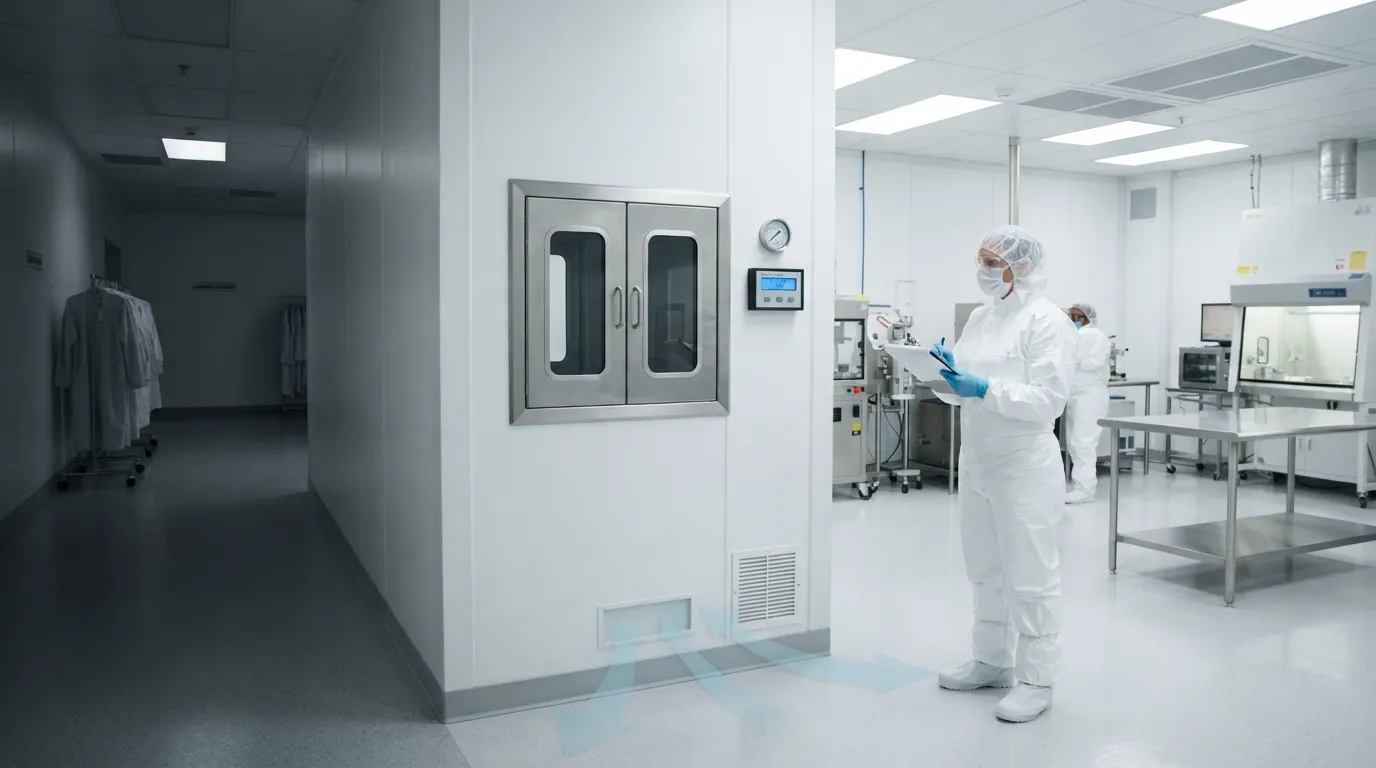
Cleanrooms are often arranged in a pressure cascade. The cleanest room has the highest pressure, and air flows outward toward less clean areas. That outward flow is what keeps particles from drifting into the critical zone. The pressure difference between rooms is deliberate, and anything that opens a door between those rooms threatens it.
A pass box reduces that threat because it avoids opening the full personnel door. But the pass box itself does not create or regulate the pressure difference. It is a controlled opening, not a pressure-control device.
When both doors are closed, the pass box is a sealed volume between the two spaces. When one door is opened, the chamber briefly equalizes with the room on that side. When that door closes and the other opens, the chamber equalizes with the second room. That exchange is why interlocking and transfer discipline matter: if both doors are opened at once, the cleanroom and the less-clean area are effectively connected, and the pressure cascade is bypassed.
A dynamic pass box, which moves and filters air inside the chamber, can improve conditions inside the chamber. It does not, however, maintain the pressure cascade between the two rooms. The room pressure relationship is maintained by the facility's HVAC system and by disciplined use of the pass box.
For broader context on how pass boxes fit into a full contamination-control strategy, see our guide to cleanroom contamination control.
Static, Semi-Active, and Dynamic Pass Boxes
Pass boxes are generally described in three configurations. The terms are not always used identically by every supplier, so the definitions below are the practical starting point for a conversation with a vendor.
| Type | Internal Air Handling | Typical Use | What to Verify |
|---|---|---|---|
| Static pass box | None — sealed chamber, no powered airflow | Low-risk transfers between areas of similar cleanliness; occasional material movement | Door interlock function, cleanability, sealed construction |
| Semi-active pass box | Some airflow, often exhaust or a supplemental fan unit; definition varies by supplier | Intermediate risk; supplier-specific design | Supplier must define the airflow mode and its purpose |
| Dynamic pass box | Internal fan and HEPA filtration, with recirculating or exhaust arrangement | Higher-risk transfers where particle control inside the chamber is required | Filter class, airflow behavior, recovery time, test evidence |
Static Pass Boxes
A static pass box is the simplest configuration. It has no powered internal airflow, no HEPA filter, and no internal air-handling components. Its contamination control relies on the sealed chamber, the door interlocks, and the discipline of the operators using it.
Static boxes are often sufficient when the transfer is low risk: materials are not highly particle-sensitive, the rooms are not separated by a large cleanliness difference, or the transfer happens infrequently. They are also easier to clean because there are no internal fans or filters to protect.
Semi-Active Pass Boxes
The term "semi-active" is not standardized across the industry. Some suppliers use it for a static box with an exhaust fan, some for a unit with a fan-filter unit that operates only during a transfer cycle, and some for a box with a UV lamp but no filtration. Because the definition varies, you should ask the supplier to explain exactly what the air does inside the chamber, when it runs, and what performance evidence supports it.
Dynamic Pass Boxes
A dynamic pass box contains an internal fan and a HEPA filter. The fan moves air through the filter to control particle levels inside the chamber during and after a transfer. Dynamic boxes are commonly specified when the destination room has a higher cleanliness classification, when the material itself is particle-sensitive, or when the transfer is expected to happen frequently enough that the chamber needs active protection.
The presence of a HEPA filter and fan is not proof of performance. The supplier should be able to state the filter class, describe the airflow arrangement, and provide test evidence that the unit performs as claimed.
Interlocked Doors and Transfer Discipline
The single most important safety feature on any pass box is its door-interlock system. An interlock ensures that only one door can be opened at a time, which prevents a direct air path between the two rooms.
Mechanical vs. Electronic Interlocks
| Feature | Mechanical Interlock | Electronic Interlock |
|---|---|---|
| How it works | Physical linkage prevents one door opening while the other is open | Sensors and a controller lock one door while the other is open |
| Monitoring | None — no record of door activity | Can log activity, trigger alarms, and integrate with facility monitoring |
| Reliability | Simple and robust | Depends on controller and power supply |
| Best suited to | Low-complexity applications where simplicity is valued | Applications requiring accountability, alarms, or remote supervision |
Interlocks support the procedure, but they do not replace operator training. A pass box with a working interlock still needs a clear operating rule: load from the clean side, close the door, confirm the door is sealed, then retrieve from the other side. Any bypass of that routine defeats the purpose of the equipment.
When evaluating a supplier, ask for the interlock logic in writing. A mechanical interlock should be shown in the schematic. An electronic interlock should be documented with its alarm behavior and fail-safe state — what happens to the doors if power is lost or the controller fails.
Materials, Construction, and Cleanability
The chamber material and internal construction directly affect how well the pass box can be cleaned and how long it will hold up in a controlled environment.
Stainless steel is the most common construction material for pass boxes in pharmaceutical, medical, and food-related cleanrooms. Grades such as 304 and 316L are frequently specified, with 316L offering higher corrosion resistance. The choice between them depends on the cleaning agents used, the process chemicals present, and the application's own requirements.
Internal geometry matters as much as the metal itself. Corners should be coved or rounded where possible, because sharp internal corners trap particles and are difficult to clean. Welds should be smooth and free of crevices. A viewing window and interior light are useful for confirming that the chamber is empty and clean before the next transfer.
If the supplier offers a "washdown" version, ask what the warranty and material certification cover. A hygienic design claim should be backed by material certificates and, where relevant, surface-finish documentation.
For cleaning agents and procedures that suit controlled environments, see our range of cleanroom cleaning supplies.
HEPA Filtration and Internal Airflow in Dynamic Pass Boxes
A dynamic pass box uses a fan to move air through a HEPA filter, either recirculating the air inside the chamber or exhausting it to the surrounding area. The purpose is to reduce the particle load in the chamber so that the material being transferred does not carry contamination into the cleaner room.
Buyers often ask whether a dynamic pass box is always better. The answer depends on the application. A dynamic box adds complexity, cost, and maintenance — the fan and filter must be tested, and the filter must be replaced periodically. If the transfer route does not require active air cleaning, a static box is simpler and easier to maintain.
If you are specifying a dynamic unit, request:
- the HEPA filter class as supplied;
- the airflow arrangement (recirculating, exhaust, or both);
- the airflow velocity and how it was measured;
- the chamber recovery time after the door closes, if the supplier provides it;
- the filter-integrity test procedure and evidence.
Some dynamic pass boxes also include a UV lamp. UV can assist with surface decontamination inside the chamber, but it is not a substitute for validated cleaning, and it does not make the pass box a sterilizer. If UV is critical to your process, ask the supplier for the UV source, wavelength, exposure time, and any test evidence for the intended microorganisms.
How to Select the Right Pass Box for Your Cleanroom
Selection should start with the transfer route, not with a model number. Define the movement first, then match the equipment to it.
Define the Transfer Route and Room Relationship
Write down:
- the source room and its cleanliness classification;
- the destination room and its cleanliness classification;
- the pressure relationship between the two rooms;
- the size and weight of the largest item that must pass through;
- the transfer frequency per shift or per day;
- any sensitivity of the material to particles, static, moisture, or temperature.
This information is also what the supplier needs to give you an accurate quotation. A pass box selected without the load size, room classes, and pressure relationship is a guess.
Personnel entry is a separate route; if you also need to control personnel access, you may evaluate an air shower manufacturer for cleanroom entrance as a complement to material transfer.
Decide Static vs. Dynamic Based on Risk
| If the transfer is… | Then a… |
|---|---|
| Low frequency, similar room classes, and material is not highly particle-sensitive | Static pass box is often sufficient |
| Frequent, with a meaningful cleanliness difference between rooms | Dynamic pass box may be justified |
| High value or particle-sensitive material, or a strict regulatory environment | Dynamic pass box with proper documentation is the safer choice |
The decision is a risk judgment. Any supplier who insists that one type is universally correct without understanding your room relationship is not giving you engineering advice — they are giving you a sales pitch.
Documentation and Qualification: What the Supplier Must Prove
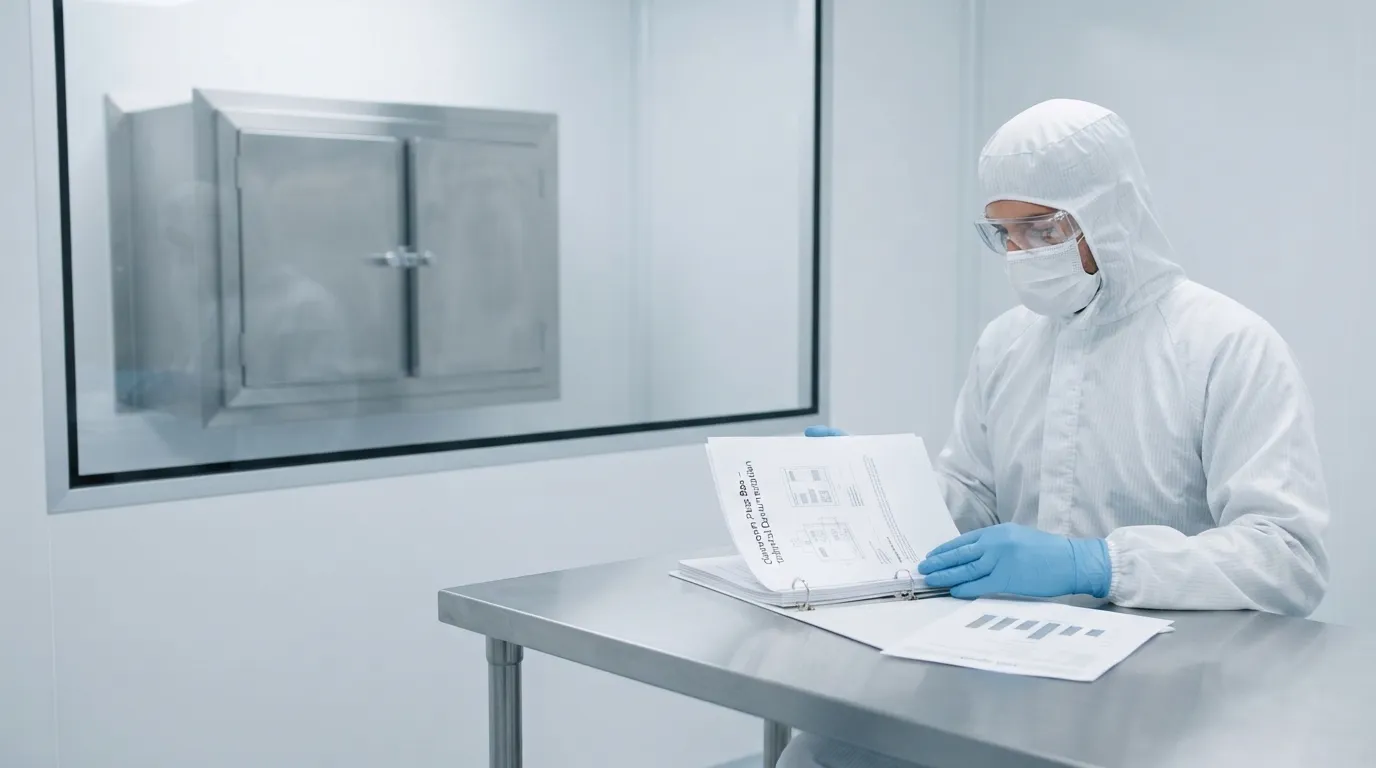
The difference between a pass box that works and one that merely looks right is almost always the documentation. Ask for these items, and keep them in the project file:
| Document | What It Should Show | Why It Matters |
|---|---|---|
| Technical data sheet (TDS) | Model-level dimensions, materials, filter class, electrical, and control specifications | Defines the intended product and design |
| Dimensional and installation drawing | Overall size, wall opening, utility connections, access clearances | Confirms it will fit the installation location |
| Wiring and interlock schematic | Electrical logic, interlock behavior, alarm and fail-safe states | Proves the access control works as claimed |
| Test report | Measured values for the specific unit or batch — filter integrity, airflow, particle test, recovery time where applicable | Provides actual evidence, not just intended specifications |
| Qualification support documents | IQ/OQ/PQ protocols and report templates, when required | Defines installation and performance acceptance criteria |
TDS vs. Batch Test Report
A technical data sheet is a statement of intended specifications. It describes what the product is designed to do, what materials are used, and how the unit is configured. It is not evidence that a particular unit actually met those specifications.
A test report is the evidence. It records measured values from a specific unit or batch — for example, a filter-integrity leak test result or an airflow reading taken at the factory. A batch test report should be matched to that batch, not generalized to every pass box the supplier has ever made.
When you compare suppliers, do not let a TDS stand in for a test report. Ask for both, and ask which test methods were used.
Qualification Documents: IQ/OQ/PQ Context
If the pass box is going into a regulated environment, such as a GMP pharmaceutical facility, the supplier should be able to support installation qualification (IQ), operational qualification (OQ), and performance qualification (PQ). These are not certifications that the supplier hands you automatically — they are collaborative activities between the supplier, the installer, and your quality team.
Ask the supplier whether they provide documentation support for these activities. A supplier that cannot explain the expected installation and testing sequence will slow down your project.
For context on cleanroom classification and the standards behind it, ISO 14644-1 defines air cleanliness by particle concentration, and ISO 14644-4 covers cleanroom design, construction, and start-up considerations.
Questions to Ask a Cleanroom Pass Box Supplier
Before you request a quotation, prepare the supplier with your transfer-route information. Then ask these questions:
- What type of pass box do you recommend for this transfer route, and why?
- Is the interlock mechanical or electronic, and what happens if power is lost?
- What are the chamber materials, surface finish, and internal corner geometry?
- If the unit is dynamic, what is the HEPA filter class and how is filter integrity tested?
- If the unit includes UV, what is the wavelength, exposure time, and validation evidence?
- What is the load capacity of the shelves and the chamber floor?
- What documentation will be supplied with the unit?
- What is the installation requirement — is mounting hardware included?
- Do you provide wiring and interlock schematics, or are they available on request?
- What is the lead time for a custom configuration, and what are the minimum order requirements?
Red flags include: no drawings available, no test method identified, "ISO compliant" without a defined scope, a TDS used as if it were a test report, and any claim that a pass box is "sterile" or "contamination-free" without qualification evidence.
Nabai's Role: Cleanroom Contamination-Control Consumables and Pass-Box Sourcing
Nabai is a manufacturer and exporter of cleanroom contamination-control consumables and ESD-protection products, including cleanroom sticky mats, sticky rollers, sticky paper, and protective films. These products support the same overall goal as a pass box: keeping particles and static away from critical manufacturing areas.
Nabai does not publicly list cleanroom pass boxes as a standard catalog product, so pass-box supply or sourcing should be confirmed directly. If you need assistance with contamination-control consumables for your transfer route, or you want to confirm current pass-box sourcing options, contact the Nabai team directly.
NEWS
GET SERVICE
With quality parts to meet every budget and friendly staff trained to make your visit informative and hassle free.