
Lint Free Cleanroom Wipes Supplier Selection

Lint Free Cleanroom Wipes Supplier Selection
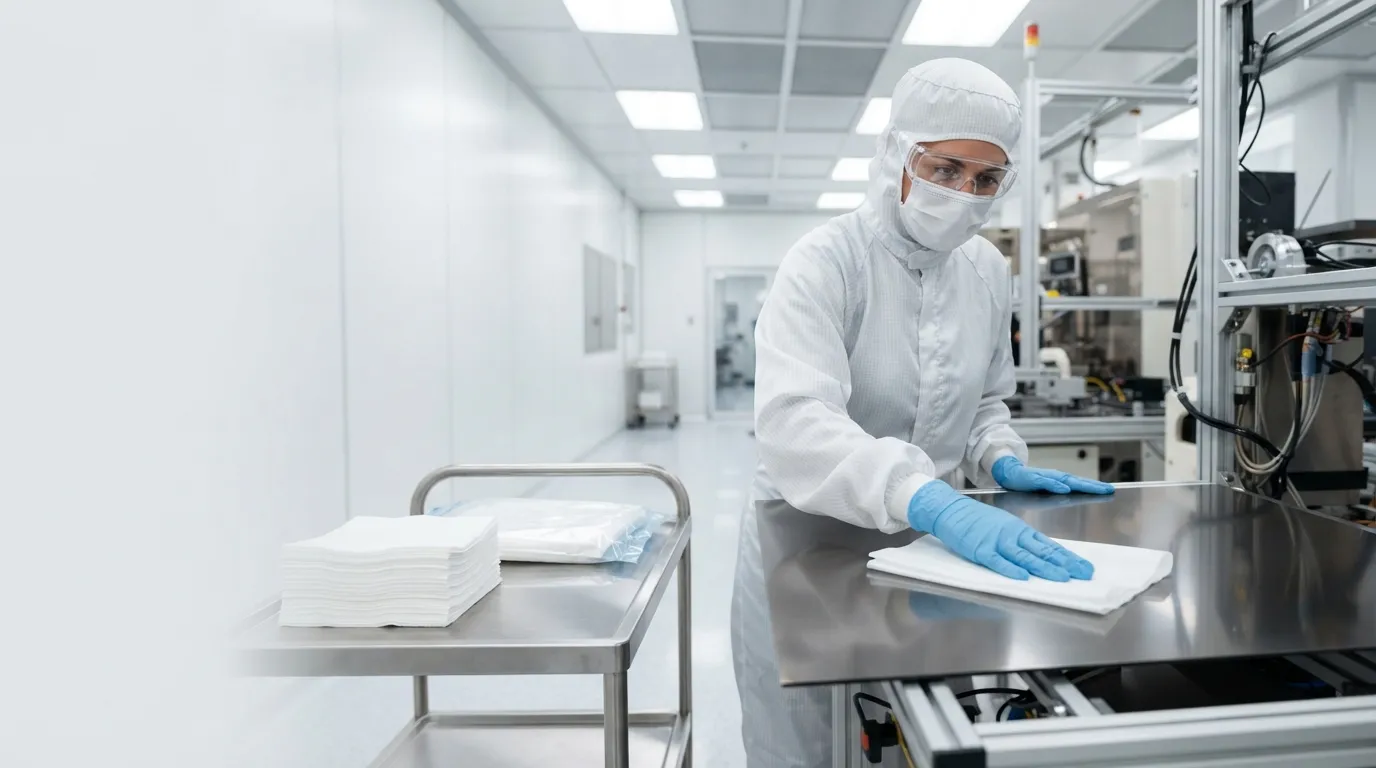
A lint-free cleanroom wipe is a low-lint, low-particle cleaning wiper whose fabric, edge construction, cleanroom class rating, sterility status, and supplier documentation must all match the controlled environment and cleaning task it is used for. "Lint-free" is a practical performance claim, not an absolute guarantee of zero fiber release. The correct way to evaluate a lint-free cleanroom wipe is to compare its material, edge seal, published cleanliness data, and the evidence its supplier can provide.
This guide is written for cleanroom managers, process engineers, quality professionals, and procurement teams who need to turn a "lint-free" label into a defensible specification. It covers four selection pillars: fabric and construction, edge sealing, class rating and documentation, and supplier verification.
What Does "Lint Free" Mean in a Cleanroom Wipe Specification?
In cleanroom procurement, "lint-free" means a wipe is designed to shed very low levels of fibers and particles under normal use. It does not mean zero shedding. Every wipe releases some fibers, especially after cutting, folding, or heavy wiping pressure.
Cleanroom wipes control lint in two ways: through the material and construction, and through edge sealing. Continuous-filament polyester is manufactured from long, unbroken fibers, which reduces the loose fiber ends that can break off during wiping. A sealed edge — produced by ultrasonic, laser, or heat sealing — prevents the cut edge from fraying and releasing particles. An unsealed cold-knife edge may be acceptable for less critical tasks, but it carries a higher risk of edge shedding.
When a supplier describes a wipe as "lint-free," ask what test method or particle-shedding data supports the claim. A supplier that cannot provide a test report, batch certificate, or clearly documented specification should not be treated as a reliable source for critical cleanroom use. Wipes are one part of a larger contamination-control strategy; see our guide to cleanroom contamination control for the broader context.
Cleanroom Wipe Fabrics and Construction: Polyester, Nonwoven, Polycellulose and Microfiber
The fabric determines how a wipe behaves under real cleaning conditions: how much it sheds, how much liquid it holds, whether it leaves residue, and how durable it is.
| Material / Construction | Strengths | Limitations | Typical Use | Evidence to Request |
|---|---|---|---|---|
| Continuous-filament polyester | Low fiber shedding; durable; good solvent resistance for common cleanroom chemicals | Higher cost; not always the most absorbent option | Electronics, semiconductor, precision and optical cleaning | Material construction, edge-seal method, particle-shedding test data |
| Nonwoven / polycellulose blend | Absorbent; disposable; lower cost per wipe | Generally more prone to shedding than continuous-filament; less durable | General cleanroom wiping, spill cleanup, lower-class areas | Fiber composition, particle test, any class claim |
| Microfiber | High absorbency; strong particle capture | Quality varies widely; must be validated for cleanroom use; edge sealing is critical | Precision optics, residue-free surface cleaning | Fiber construction, edge sealing, cleanroom test data |
| Knitted polyester with polyurethane | Durable and soft, with a smooth surface for delicate substrates | Product-specific performance; requires manufacturer documentation | Critical surfaces needing both durability and gentleness | Full construction details, TDS, sterility status if required |
For any fabric, the supplier should state the construction clearly. "Polyester wipe" is not a complete specification: the buyer needs to know whether the material is continuous-filament or spun, knitted or nonwoven, and how the edges are finished.
Edge Sealing: Ultrasonic, Laser, Heat-Sealed and Cold-Knife Options
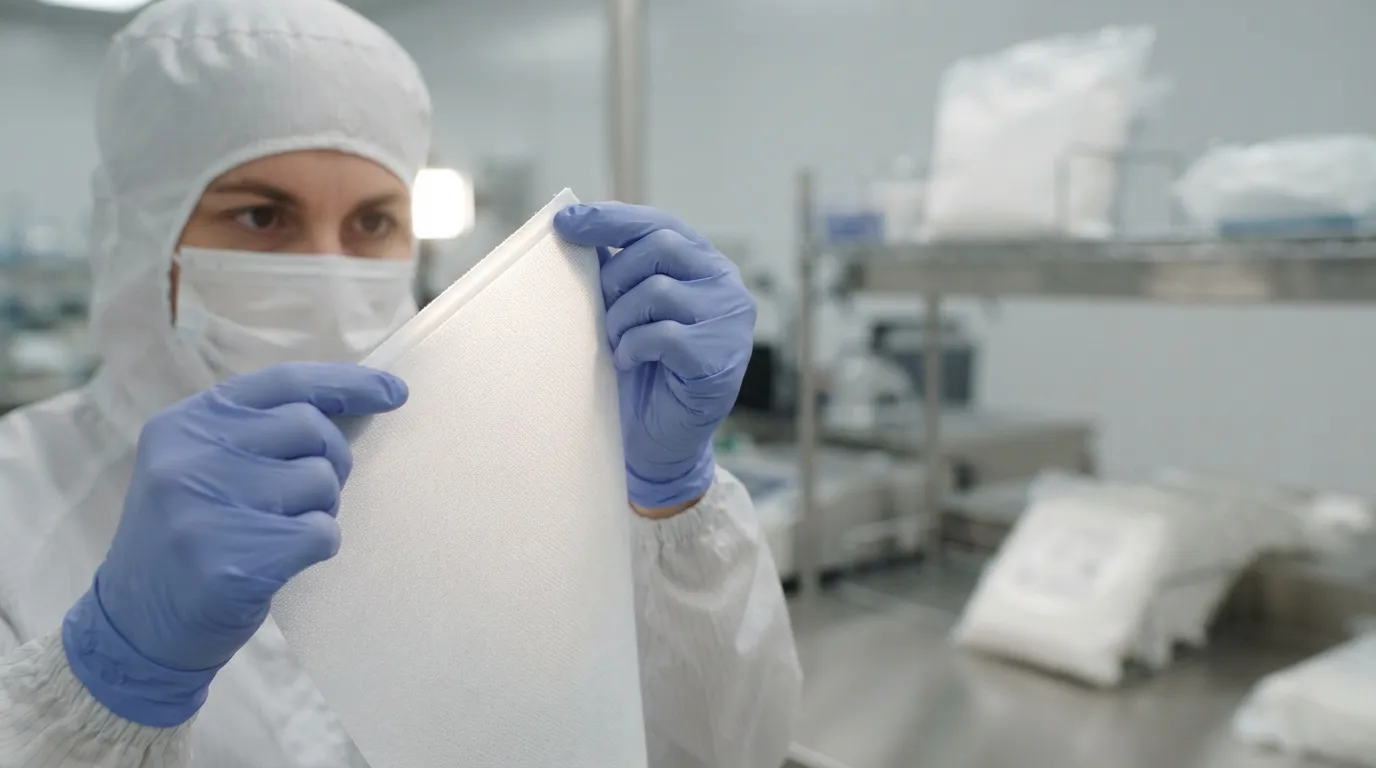
The edge is often the first place a wipe breaks down. An unsealed cut edge exposes fiber ends, and those fibers can transfer to the surface being cleaned.
| Edge Type | How It Works | Particle-Control Consideration | What to Confirm With the Supplier |
|---|---|---|---|
| Ultrasonic sealing | High-frequency vibration bonds synthetic fibers together | Creates a fused edge that resists fraying; common on polyester wipes | That the seal is continuous and that particle data covers the edge |
| Laser sealing | A laser melts the edge to fuse fibers | Produces a smooth sealed edge; requires precise process control | Edge consistency and particle-shedding data |
| Heat sealing | Heat and pressure bond the edge | Effective on thermoplastic materials | That the seal remains intact through handling and storage |
| Cold-knife / cut edge | The wipe is cut without sealing | Leaves exposed fiber ends; higher shedding risk; may suit low-risk applications | Whether an unsealed edge is acceptable for the target cleanroom class |
The correct edge type depends on the application and the risk tolerance of the process. For critical precision cleaning, a sealed edge is normally required. For general wiping in less sensitive areas, a cleanly cut edge may be acceptable.
Cleanroom Class and Documentation: What ISO 14644-1 Does and Does Not Prove
A cleanroom wipe's "class rating" is a common source of confusion. ISO 14644-1:2015, the international standard for cleanroom classification, defines air cleanliness by particle concentration. It was confirmed in 2021. When a supplier labels a wipe "ISO Class 5" or "Class 100," that label is a product claim, not a room certificate. An ISO Class 5 room may require a wipe that performs well in that environment, but the wipe itself needs its own test evidence.
Class labels are useful only when they are tied to a specific test method and a specific product. A buyer should treat "ISO Class X wipe" as a shorthand for "this wipe has been tested to a defined particle-shedding level" — and then ask to see the data.
TDS, SDS, Batch Test Report and CoA: What Each Document Does
| Document | What It Tells You | When to Request It |
|---|---|---|
| TDS (Technical Data Sheet) | Model-level specification: material, construction, edge type, size, packaging | During product evaluation, for every model under consideration |
| SDS (Safety Data Sheet) | Safety and handling information | When wipes will be used with chemicals or where safety documentation is required |
| Batch test report / Certificate of Analysis (CoA) | Lot-specific test results, such as particle or absorbency data | Before accepting a shipment, and for each new batch |
| Sterility certificate | Confirmation that a specific batch was sterilized and by what method | For pharmaceutical, medical, or aseptic processes |
A TDS describes what the manufacturer intends to produce. A batch test report verifies what a specific lot actually measured. Both are needed for critical applications.
Sterile vs Non-Sterile Wipes: How to Choose
Some cleanroom processes require sterile wipes. This is common in pharmaceutical manufacturing, GMP environments, and medical-device assembly, where microbial contamination is as important as particle contamination. Sterile wipes are typically sterilized by gamma irradiation and packaged to maintain sterility until the package is opened.
Non-sterile wipes are suitable for many electronics and general precision-cleaning applications where bioburden is not a process risk. Choose sterile wipes only when the process requires them, and verify the sterilization method and certificate for each batch. "Cleanroom compatible" and "sterile" are not the same thing.
How to Match a Lint Free Cleanroom Wipe to Your Application
| Application | Key Wipe Requirements | What to Confirm With the Supplier |
|---|---|---|
| Semiconductor and wafer handling | Very low particle shedding; low residue; high-purity packaging; ESD consideration | Particle test data, packaging integrity, ESD classification if required |
| Electronics and PCB assembly | Low lint; solvent compatibility; ESD-safe option for static-sensitive components | Chemical compatibility, ESD surface resistance, edge seal |
| Pharmaceutical and GMP | Sterility if required; low extractables; full documentation; lot traceability | Sterility certificate, batch test report, change-control documentation |
| Medical device manufacturing | Low residue; controlled packaging; sterility if required | Sterility method, packaging data, residue testing |
| Optical and display | Low particulates; non-abrasive; residue-free | Particle and residue data, fabric construction |
| Precision manufacturing | Durable construction; chemical compatibility; consistent quality | Material specification, TDS, batch consistency evidence |
For guidance on wiping technique and surface protection, see how to clean sensitive surfaces safely.
How to Verify a Lint Free Cleanroom Wipes Supplier
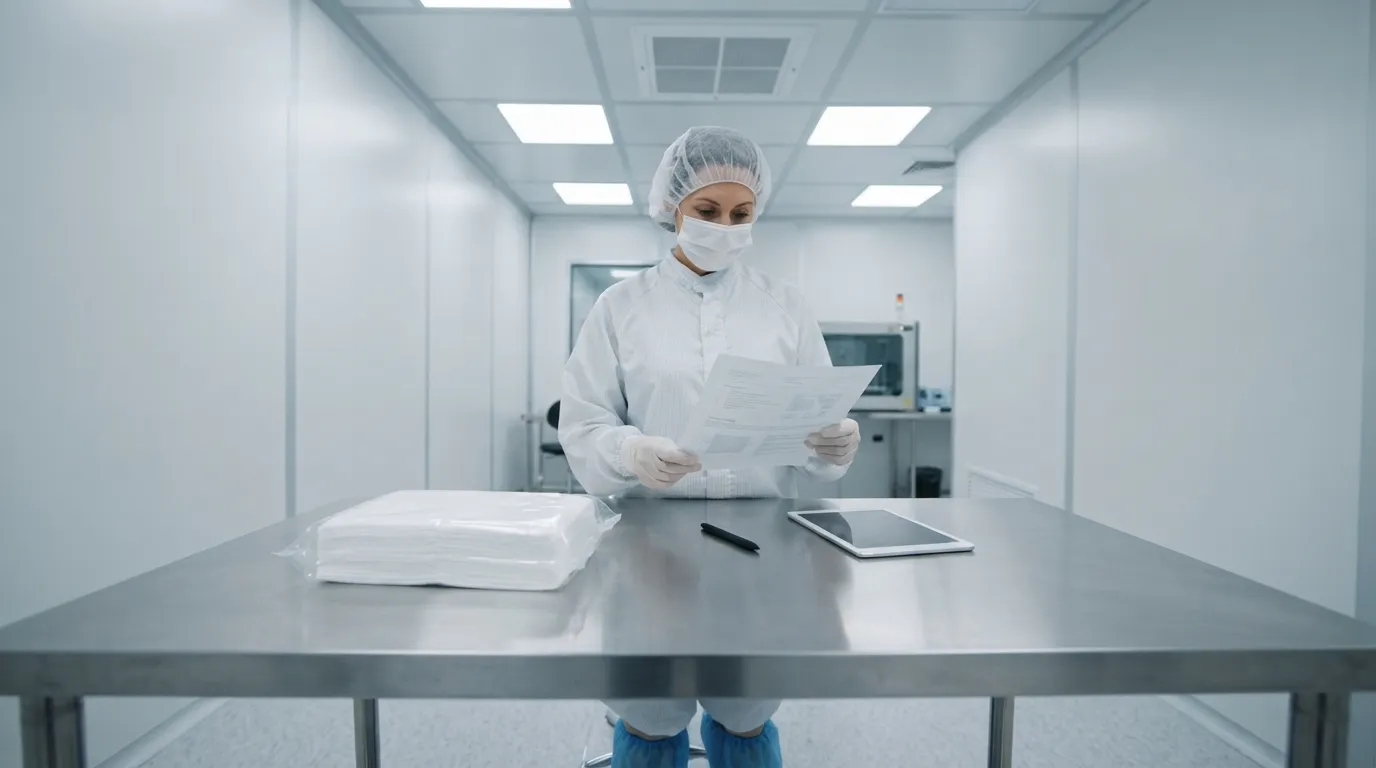
The supplier is as important as the wipe itself. A responsible supplier should be able to document every claim it makes.
- Request a TDS for every wipe model under evaluation.
- Request a batch test report or Certificate of Analysis for the specific lot you intend to purchase.
- Ask for the test method behind any "lint-free" or ISO class claim.
- Confirm packaging specifications, including whether the wipes are double-bagged for cleanroom transfer.
- Confirm lot traceability and shelf life.
- Ask about samples and incoming-inspection support.
- Request change-control procedures so you are notified if material or process changes affect the product.
- Ask how the supplier handles quality investigations and contamination incidents.
For volume purchasing and order details, see our page on cleanroom polyester wipes bulk.
Questions to Ask Before Ordering Lint Free Cleanroom Wipes
- What is the exact material and construction of this wipe?
- How are the edges sealed?
- What particle-shedding or fiber-release data do you have, and what test method was used?
- Is this wipe sterile? If so, what sterilization method is used?
- What documents are available for this batch — TDS, SDS, CoA, batch test report?
- How is the product packaged, and is each lot traceable?
- What are the MOQ, lead time, and custom options?
Talk to Nabai About Your Cleanroom Consumables Requirements
Nabai is a B2B manufacturer and exporter of cleanroom and ESD contamination-control consumables. If you need help turning this selection framework into a cleanroom wipe specification, or want to know which cleanroom contamination-control consumables Nabai currently supplies, contact the Nabai team to request current product information, documentation, and quotation support.
NEWS
GET SERVICE
With quality parts to meet every budget and friendly staff trained to make your visit informative and hassle free.