
ESD Wrist Strap and Grounding Cord Supplier

ESD Wrist Strap and Grounding Cord Supplier
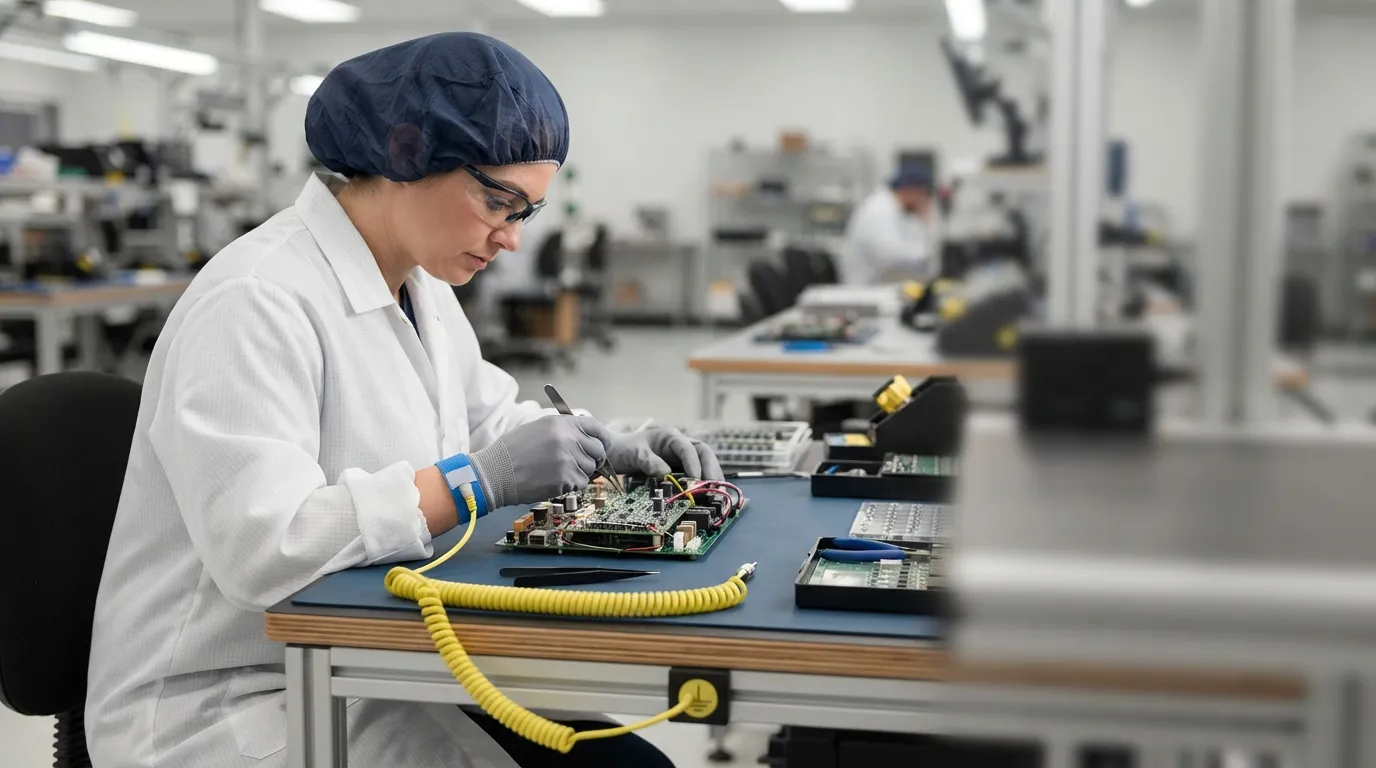
An ESD wrist strap and grounding cord form a complete personnel-grounding system: the wristband contacts the operator's skin, the grounding cord connects the band to a verified grounding point, and the full path returns to the common-point ground of the ESD protected area. Without the cord and a tested ground connection, the wristband alone is not a functional ESD wrist-strap system.
Personnel grounding is one part of a complete esd equipment strategy, but it is the part that protects operators directly. This page focuses on corded wrist straps for buyers who need to compare suppliers, verify configurations, and confirm that a product will perform as claimed.
What Is an ESD Wrist Strap and Grounding Cord?
An ESD wrist strap is a two-part system. The wristband wraps around the operator's wrist and makes contact with skin through a conductive element. The grounding cord connects the wristband to a grounding point bonded to the ESD protected area's ground.
The ESD Association maps ANSI/ESD S1.1 to wrist straps and wrist-strap systems, meaning the standard covers the band and the cord as one assembly. Source: ESD Association
A wristband sold without a cord is sometimes labeled an anti-static bracelet. It does not connect the operator to ground. When you source wrist straps for production, confirm that the product includes a compatible grounding cord.
How the Operator Ground Path Works
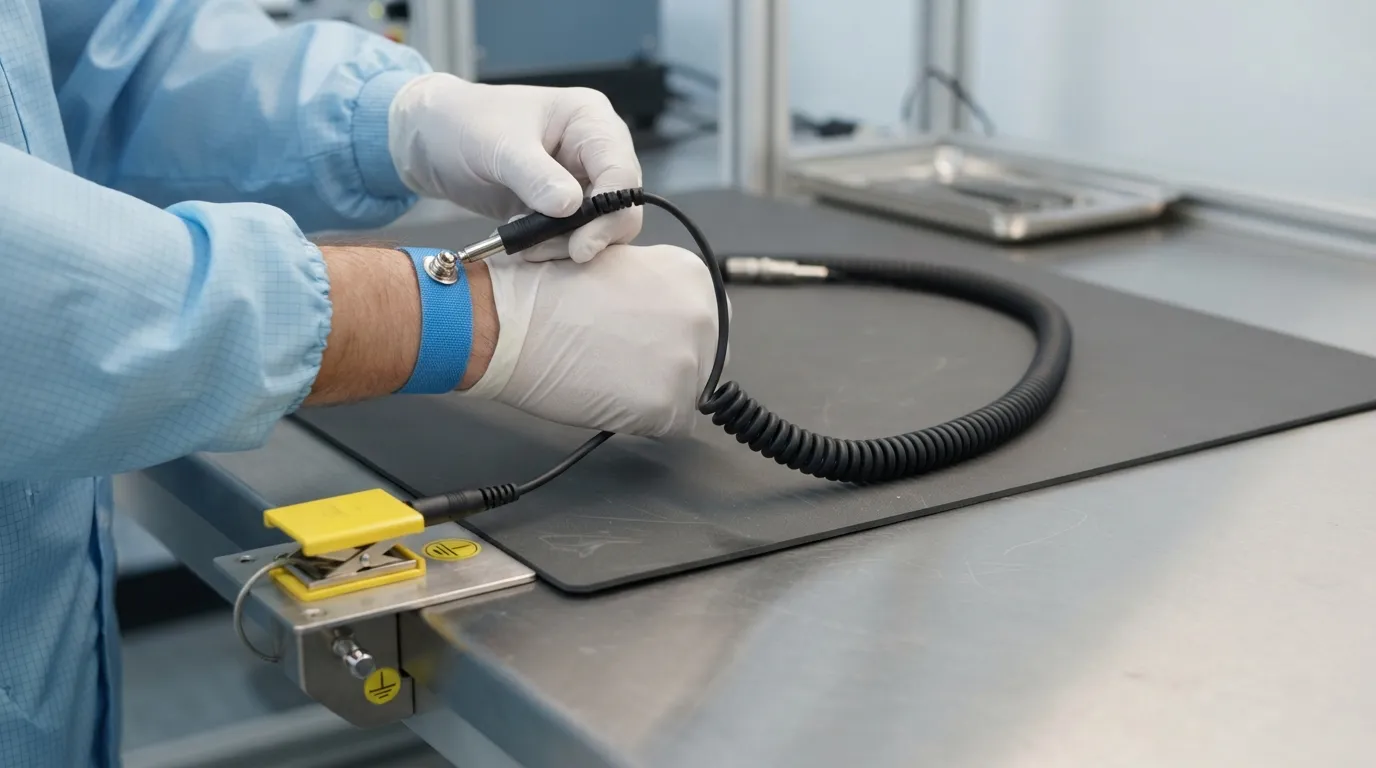
A compliant operator ground path requires four continuous connections:
- Skin-to-band contact. The wristband must fit snugly against bare skin.
- Band-to-cord connection. Most systems use a snap fastener, commonly 4 mm or 10 mm.
- Cord-to-ground connection. The cord terminates at a dedicated grounding point, typically a banana plug, alligator clip, or quick-disconnect fitting.
- Ground-to-common-point bond. The grounding point must be bonded to the ESD protected area's common-point ground.
The ESD Association's sample ESD control document, based on IEC 61340-5-1, states that wrist-strap connection points and work surfaces should be connected to ground via a common-point ground and tested before use. Source: ESD Association
If any element fails — a frayed cord, a dirty snap, a disconnected ground wire, or a loose band — the system fails silently. The operator looks grounded but is not. Testing the complete path is part of a functional ESD program, not an optional extra.
Single-Wire vs Dual-Wire: Which Configuration Should You Specify?
The choice depends on the monitoring requirements of your workstation.
| Factor | Single-Wire | Dual-Wire |
|---|---|---|
| Electrical path | One conductor through the cord | Two separate conductors |
| Typical use | Workstations with periodic strap testing | Workstations with continuous monitoring |
| Monitoring support | Limited; a break may go unnoticed until the next test | Detects a break immediately |
| Cost and complexity | Lower | Higher; requires compatible monitoring equipment |
SCS/Desco, a manufacturer of ESD control products, lists both single-wire and dual-wire categories in its wrist-strap range. Source: SCS/Desco
Choose single-wire when you have a defined testing schedule at fixed stations. Choose dual-wire when continuous monitoring is required.
Key Specifications to Compare When Sourcing
These specifications decide whether a wrist-strap system fits your workstations and your ESD program.
- Wristband material and adjustability. Fabric bands with elastic or Velcro adjustment fit most operators; metal bands suit high-durability applications. The band must fit snugly.
- Cord length. Measure from the operator's wrist to the grounding point and add working slack.
- Cord durability and strain relief. The cord-to-snap and cord-to-plug junctions are the most common failure areas. Look for molded or reinforced strain relief.
- Resistor value. Many cords include a current-limiting resistor. The value must be stated in the datasheet; verify it against your ESD program requirements rather than assuming a universal figure.
- Cleanroom suitability. Confirm the wristband material is compatible with the cleanroom classification. Do not assume all fabric bands are low-shedding or all metal bands are cleanroom-approved.
- Electrical continuity. The supplier should provide the measured system resistance and the test method used. Resistance for a strap-and-cord assembly is reported in ohms, which is not the same as surface resistivity in ohms/square — a value that applies to materials such as mats and films.
Connector and Grounding-Point Compatibility
Connector mismatches are a common sourcing error.
| Connector | Typical Use |
|---|---|
| 4 mm snap | Standard band-to-cord connection |
| 10 mm snap | Some heavy-duty or monitored systems; confirm compatibility with the band and cord |
| Banana plug | Common ground-point termination |
| Alligator clip | Temporary connection; less common for production workstations |
Specify the exact connector in your RFQ. A strap that fits the operator but not the grounding jack is a failed purchase.
Documentation and Compliance: What Evidence Should a Supplier Provide?
A compliance claim is only as reliable as the documentation behind it.
The ESD Association lists ANSI/ESD S1.1-2021 as the standard for wrist straps and notes that it is technically equivalent to IEC 61340-4-6. Source: ESD Association
Equally important is what a standard does not do. ANSI/ESD S20.20 and IEC 61340-5-1 define a facility-level ESD control program. They do not certify a single wrist strap in isolation. A strap can be qualified to ANSI/ESD S1.1 while the facility still needs a program standard such as ANSI/ESD S20.20 to govern how the strap is used, tested, and maintained.
TDS vs Test Report: What Is the Difference?
| Document | What It Provides | When You Need It |
|---|---|---|
| Technical datasheet (TDS) | Product specifications: materials, cord length, connector type, resistance range | Initial evaluation and comparison |
| Test or qualification report | Evidence that a specific model or batch passed a named test method, with results and date | Product approval, batch verification, and audits |
A TDS describes what the product is designed to be. A test report proves what a specific unit or batch measured. If a supplier provides only a TDS, ask for the qualification report before approving the product.
Supplier Evaluation Checklist and RFQ Questions
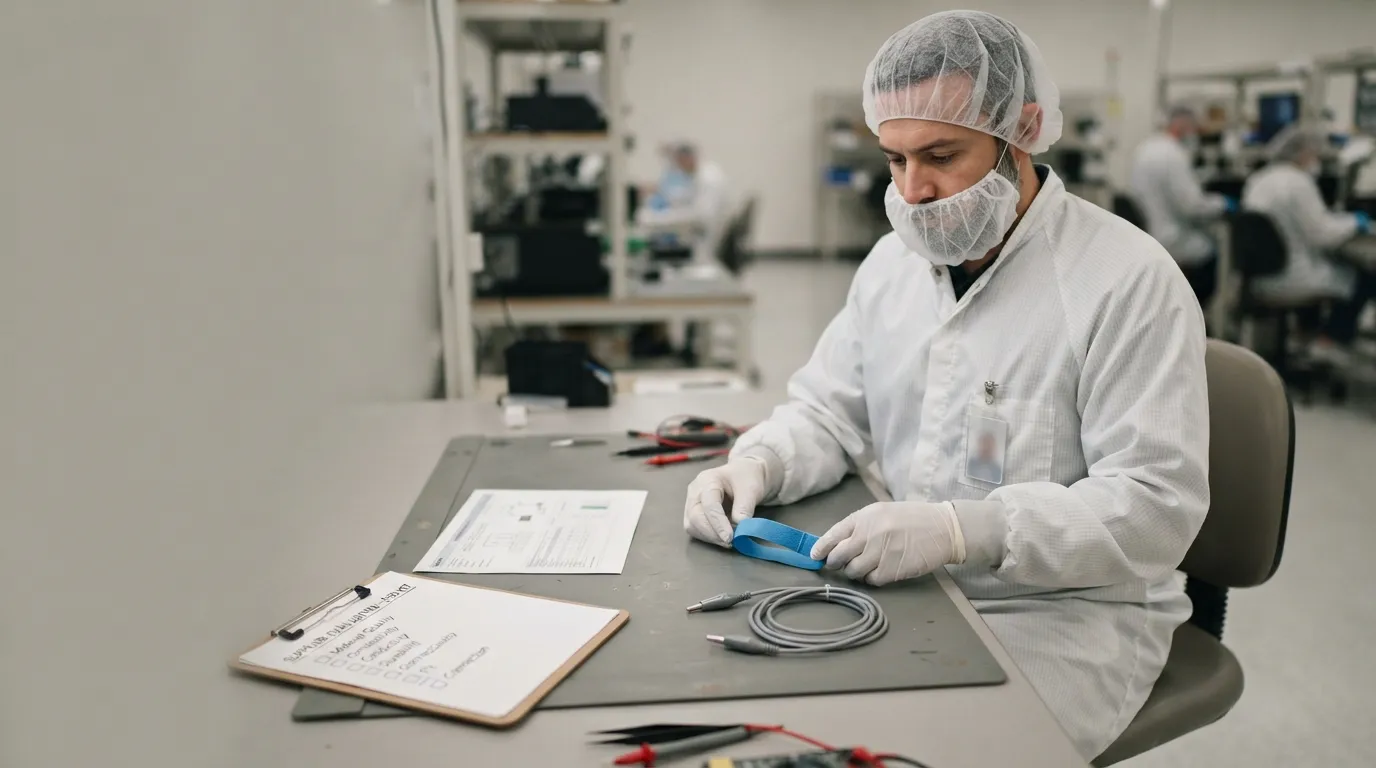
Use this checklist to structure your RFQ and compare supplier responses.
- Product identification. Request model numbers for the wristband, the cord, and the complete set.
- Configuration. Confirm single-wire or dual-wire, cord length, connector types, and whether band and cord are sold as one SKU.
- Resistance specification. Ask for the nominal resistance of the strap-and-cord assembly and the test method.
- Wristband sizing. Request the available size range and the adjustment mechanism.
- Material information. For cleanroom or sensitive processes, request material details and the test method behind any cleanroom claim.
- TDS and test report. Request both for the exact model number quoted.
- Sample policy. Ask whether samples are available for fit and continuity testing before the first production order.
- MOQ and lead time. Clarify minimum order quantity and current lead time for the configuration you need.
- Batch consistency. Ask how the supplier controls batch-to-batch consistency and whether test reports are available per batch.
- Customization. If you need private labeling, custom cord length, or specific connectors, ask what minimum volume applies.
Common Mistakes When Sourcing ESD Wrist Straps
These errors appear repeatedly in ESD programs, and each one is avoidable.
- Buying a wristband without a ground connection. A band alone is not an ESD wrist strap.
- Assuming wireless wrist straps are equivalent. NASA's testing found that wireless wrist straps do not connect the wearer to ground and did not meet ESD requirements in the tested configuration. Source: NASA
- Skipping the fit test. The best cord cannot compensate for a band that does not maintain skin contact.
- Mismatching the connector. A 4 mm snap system and a 10 mm snap system are not interchangeable without an adapter.
- Accepting a generic compliance claim. "Meets ESD standards" is not evidence. Ask for the named standard, test method, and report.
- Treating the wrist strap as the entire ESD program. The strap grounds the operator; it does not replace grounded mats, ionization for insulators, training, or periodic verification.
How a Wrist Strap Fits into an ESD Protected Area
The wrist strap is one layer of a complete static-control plan:
- The operator wears a wrist strap for personnel grounding.
- A grounded anti static mat provides a controlled work surface for static-sensitive components.
- An ionizing air blower for static control neutralizes charge on insulators such as plastic housings and labels, which cannot be grounded.
- ESD footwear and heel straps support standing operators where wrist straps are inconvenient or mobility is required.
These elements are complementary, not interchangeable. The wrist strap handles the operator, the mat handles the work surface, and the ionizer handles the insulators. For a broader view of the controls that prevent ESD damage across a facility, see how to prevent electrostatic discharge damage.
How to Request a Quote or Sample
When you contact a supplier, include enough information to receive an accurate response:
- Describe the application: production line, repair bench, cleanroom, or field service.
- State the configuration: single-wire or dual-wire, cord length, and connector types.
- List the documentation you require: TDS, qualification report, and material declarations if relevant.
- Ask about the sample policy and approval process.
- Confirm MOQ, lead time, and customization options.
The more specific the RFQ, the more comparable the supplier responses will be. A supplier that provides the requested documentation and configuration details is demonstrating the discipline you need in a long-term ESD partner.
NEWS
GET SERVICE
With quality parts to meet every budget and friendly staff trained to make your visit informative and hassle free.