
Cleanroom Particle Counting Explained: What Counts Mean

Cleanroom Particle Counting Explained: What Counts Mean
Cleanroom particle counting measures the number and size distribution of airborne particles in a cleanroom or controlled environment. It is performed with an airborne particle counter, usually a light-scattering instrument that draws a known volume of air through a sensing zone, counts particles at set size thresholds, and reports the result as particles per cubic metre. That concentration is then compared with a cleanliness limit, most commonly an ISO 14644-1 class limit, to classify the room or monitor its performance. The count tells you how many particles are in the air, but it does not identify what those particles are made of, whether they are viable, or exactly where they came from.
This guide explains how particle counting works, how to read a particle-count report, and what the results can and cannot tell you. It is written for cleanroom managers, quality engineers, and facility teams who need to interpret real monitoring data rather than just collect it.
What Is Cleanroom Particle Counting?
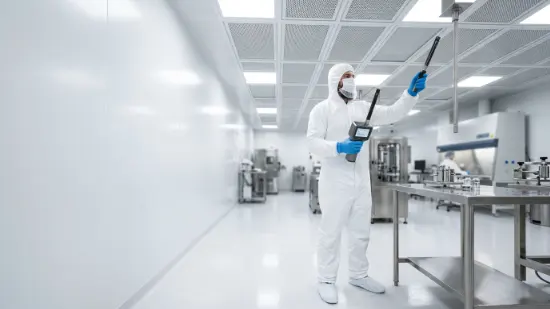
Cleanroom particle counting is a quantitative method for measuring airborne particle concentration in a controlled space. Air is sampled at a known flow rate, particles are counted by size threshold, and the result is expressed as the number of particles per cubic metre of air.
ISO 14644-1, the international standard for cleanroom classification, defines cleanroom air cleanliness by airborne particle concentration. The measured concentration is compared with the limit for a target ISO class. If the concentration is at or below the limit at the required particle sizes and sampling locations, the room meets that classification.
Particle counting is not a microbial test, a surface cleanliness test, or a chemical contamination test. It answers one specific question: how many particles of a certain size are present in the air at the time of sampling.
What Does an Airborne Particle Counter Measure?
An airborne particle counter reports two related pieces of information:
- the number of particles detected, and
- the size threshold at which those particles were counted.
The instrument does not collect particles for later analysis. It counts them optically as they pass through the sensing area, then records them in size categories.
Particle Sizes and Thresholds
Particle counts are usually reported as "≥0.5 µm" or "≥5.0 µm." That means the counter recorded every particle equal to or larger than that threshold in the sampled air.
The size range matters because different industries care about different particles. A semiconductor fab may focus on sub-micrometre particles that can damage a wafer, while a pharmaceutical facility may also be concerned with larger particles that could carry contamination.
For cleanroom classification, the applicable threshold range is commonly between 0.1 µm and 5.0 µm, as described in the FDA’s recognized consensus standard entry for ISO 14644-1.
Cumulative vs Differential Particle Counts
Particle-count data can be presented in two ways:
- Cumulative count: all particles equal to or larger than a stated threshold, for example ≥0.5 µm.
- Differential count: particles within a defined size interval, for example 0.5 µm to 1.0 µm.
ISO classification limits are typically expressed as cumulative concentrations at specified thresholds. When you read a report, check whether the result is cumulative or differential so you do not compare two different types of data.
Sample Volume and Concentration
A particle counter does not report a useful result until the raw count is converted to a concentration.
The basic relationship is:
Particle concentration = number of particles counted ÷ volume of air sampled
For example, if a counter samples one cubic metre of air and records 3,520 particles at ≥0.5 µm, the concentration is 3,520 particles per cubic metre. If the same number of particles is counted in a smaller air volume, the concentration would be higher.
This is why the report must state the sample flow rate, sampling duration, and sample volume. Without the volume, the count cannot be interpreted.
How Does a Light-Scattering Airborne Particle Counter Work?
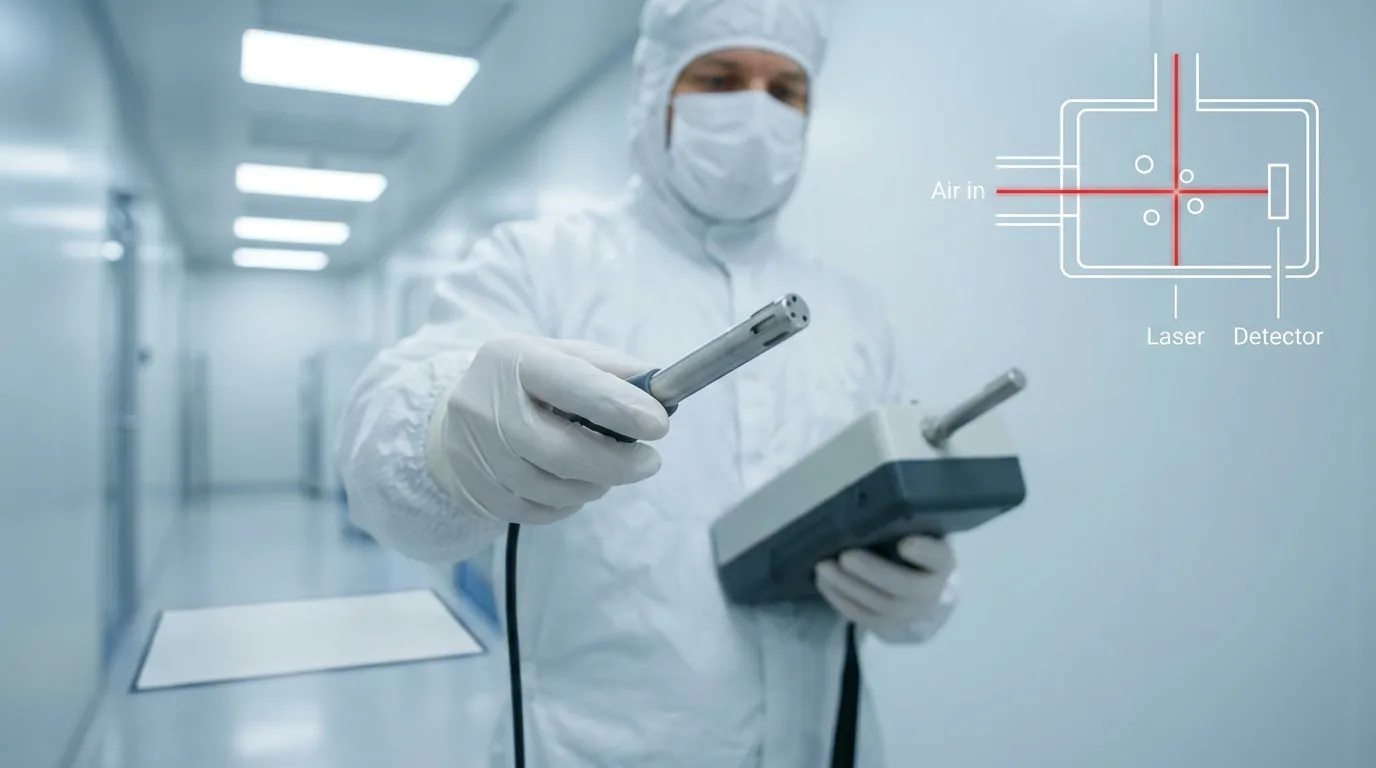
The most common instrument for cleanroom classification is a light-scattering airborne particle counter (LSAPC). It works by drawing air through a focused light source—usually a laser—and detecting the light that particles scatter as they pass through the beam.
The basic process is:
- Air is drawn into the instrument at a controlled flow rate.
- The air passes through a sensing chamber illuminated by a laser or other light source.
- Each particle scatters light as it crosses the beam.
- A photodetector measures the scattered light.
- The instrument estimates particle size from the amount of scattered light.
- Particles are assigned to size thresholds and counted.
- The instrument records the counts and calculates the concentration for the sampled volume.
The instrument does not analyze the chemical composition, biological status, or source of the particles. It sizes and counts them.
Calibration and Verification of Particle Counters
A particle counter is only useful if its measurements are trustworthy. Calibration verifies that the instrument counts and sizes particles correctly.
ISO 21501-4 covers light-scattering airborne particle counters for clean spaces. It specifies calibration and verification requirements for instruments used to measure particle size distribution and particle number concentration.
For anyone reading a particle-count report, the practical point is simple: check that the instrument was calibrated, that the calibration was current, and that the report includes the instrument identity and calibration reference. A cleanroom can fail or pass on the basis of a measurement. That measurement should come from an instrument you can trace.
How Particle Counts Are Compared with ISO 14644-1 Limits
ISO 14644-1 does not judge whether a room "looks clean." It sets numerical limits on airborne particle concentration at specified particle-size thresholds.
The process works like this:
- The cleanroom is tested under a defined condition, usually at rest or in operation.
- Air samples are taken at specified locations and sample volumes.
- The instrument reports particle concentration at the required thresholds.
- The measured concentration is compared with the ISO class limit.
- If the concentration does not exceed the limit at any required location or size, the room meets that class.
ISO 14644-1 specifies the classification framework. The standard is the authority for determining whether a cleanroom meets a stated class.
Understanding a Concentration Limit
A concentration limit is the maximum allowable number of particles per cubic metre at a defined particle size.
For example, the ISO Class 5 limit at ≥0.5 µm is 3,520 particles per cubic metre. That means a room classified as ISO Class 5 cannot have a measured concentration above that value at that particle size, under the conditions defined by the standard.
The same logic applies across classes and size thresholds. Always compare the measured result with the limit for the same particle size, the same unit, and the same room condition.
At-Rest vs In-Operation Sampling
A particle count only has meaning when you know the room condition at the time of sampling.
- At rest: the room is complete, equipment is installed and operating as agreed, but no personnel are present.
- In operation: the room is operating in its normal production state, with personnel and activities underway.
Personnel are a major source of particles. A room can meet a class limit at rest and exceed it in operation. The report should state which condition was tested so the result is not misinterpreted.
Certification vs Routine Monitoring: What Each Tells You
Certification and routine monitoring answer different questions. Both are necessary, but they are not interchangeable.
| Certification (ISO 14644-1) | Routine monitoring (ISO 14644-2) | |
|---|---|---|
| Purpose | Classify or verify air cleanliness against a defined limit | Provide ongoing evidence that the cleanroom continues to perform |
| Timing | Point-in-time assessment | Planned, recurring program |
| What it provides | Pass/fail result against an ISO class | Trend data, early warnings, and drift detection |
| Typical use | New rooms, requalification, formal classification | Daily, weekly, or monthly monitoring of critical areas |
ISO 14644-2 concerns monitoring to provide evidence of cleanroom performance related to air cleanliness by particle concentration. It supports the idea that one certification test is not enough. The room must be monitored over time to show that it remains under control.
What a Certification Test Provides
A certification test is a formal assessment against a stated ISO class. It typically includes:
- a defined sampling plan with specified locations,
- measurement at the particle sizes required by the class,
- a pass/fail comparison against the class limit,
- a record of the room condition at the time of testing.
The result is a snapshot. It confirms the condition of the room on that day, under those conditions, with that instrument.
What Routine Monitoring Provides
Routine monitoring is the ongoing measurement program that supports day-to-day cleanroom control. It provides:
- trend data over time,
- early warning of contamination drift,
- evidence that changes in personnel, equipment, or process do not push the room out of control.
Routine monitoring does not replace certification. It extends it.
Portable vs Fixed/Continuous Monitoring
The right monitoring approach depends on the room, the process, and the risk.
- Portable particle counters are useful for certification, troubleshooting, and periodic surveys. They can be moved to the locations where data is needed.
- Fixed or continuous monitors provide real-time data in critical zones. They are common in semiconductor and pharmaceutical environments where rapid detection of a problem matters.
Many facilities use both. A portable counter supports formal classification and investigation. Fixed monitors provide continuous visibility in higher-risk areas.
What Cleanroom Particle Counting Cannot Tell You
Particle counting is a powerful tool, but it has clear boundaries. NASA notes that while airborne particle counters are a primary metric for defining cleanroom class, they do not identify the contaminant. That distinction is easy to forget when a count result is high.
A particle count cannot tell you:
- What the particle is made of. Dust, skin cells, metal fragments, and product residue can all produce counts.
- Whether the particle is viable. A standard airborne particle counter does not distinguish living microorganisms from inert particles.
- Whether surfaces are clean. Airborne counts describe the air, not the surfaces in the room.
- Why the count is elevated. The counter records the number of particles, not their source.
- Whether a filter is working. A high or low count can suggest a filtration problem, but it does not prove filter integrity or efficiency. Filter performance is verified with methods designed for that purpose.
These limitations are not weaknesses in the method. They are the reason particle counting must be combined with other monitoring tools and engineering judgment.
Particle Counts vs Microbiological Monitoring
Non-viable particle counting and microbiological monitoring are different measurements.
A particle counter counts particles without determining whether they are alive. Microbial monitoring requires a separate method, such as active air sampling onto culture media or a rapid microbiology technique.
A low airborne particle count does not guarantee that the room is free of viable microorganisms. In pharmaceutical and healthcare environments, both measurements are usually needed.
Particle Counts vs Surface Contamination Testing
Airborne particle counts do not measure surface contamination. Particles settle onto surfaces over time, so a room can have low airborne counts and still have contaminated surfaces.
Surface cleanliness is assessed with separate methods, such as surface sampling, particle fallout measurement, or visual inspection under appropriate lighting. Each method answers a different contamination-control question.
How to Read a Cleanroom Particle Count Report
A particle-count report should be complete enough for someone else to judge whether the result is valid. If information is missing, the measurement cannot be fully trusted.
| Report field | What to check |
|---|---|
| Room or area identified | Confirm the report covers the room you expected. |
| Date and time of sampling | Confirm the data is current and relevant. |
| Room condition | At rest or in operation? |
| Sampling locations | Are the locations representative of the cleanroom? |
| Instrument identity | Model and serial number should be listed. |
| Calibration status | Was the counter calibrated, and is the certificate current? |
| Flow rate and sample volume | Can the count be converted to a concentration? |
| Particle-size thresholds | Which thresholds were reported, and are they appropriate for the class? |
| Particle concentration | Expressed in particles per cubic metre? |
| Applicable limit | Which class limit was used, and was the result a pass or fail? |
| Notes or deviations | Any alarms, instrument faults, or unusual conditions? |
Check the Instrument and Calibration Details
The instrument section of the report is easy to skip, but it is the first place to look when a result seems unexpected.
Verify that:
- the counter is identified by model and serial number,
- calibration was current at the time of sampling,
- the flow rate and sample volume were recorded,
- the particle-size thresholds are listed,
- no alarm or fault conditions were noted during the run.
If the instrument data is missing, the particle count should not be used as the basis for a compliance decision.
What to Do When a Particle Count Is Elevated
A high particle count is a signal, not a verdict. The correct response is to verify the measurement, investigate the cause, and then act.
Use this sequence:
- Verify the instrument and sampling setup first. Was the counter calibrated? Was the flow rate correct? Was the report complete?
- Check the room state. Was the room at rest or in operation? Were personnel or process activities unusually high?
- Look for recent changes. New people, new materials, maintenance, cleaning, or equipment changes can affect counts.
- Check airflow and filtration. Is supply air reaching the sample location? Is there a possible leak, airflow blockage, or filter concern? If filtration is a suspect, compare hepa vs ulpa filter difference to understand the options.
- Review cleaning and entry control. Are contamination-control procedures being followed? Tracked-in contamination can be reduced with entry controls such as a cleanroom sticky mat.
- Retest after corrective action. Confirm that the change actually improved the result.
- Escalate when needed. If the cause is not obvious, involve a qualified cleanroom engineer or certification provider.
A high count does not automatically mean the room is dirty or the filter is failing. It means something changed, and the measurement system is the place to start looking.
Filtration, Entry Control and Cleaning as Possible Factors
When particle counts rise, several control layers may be involved:
- Filtration: a change in supply-air filtration, airflow patterns, or filter integrity can affect airborne counts.
- Entry control: particles can be tracked in on shoes, carts, and materials. Sticky mats and other entry-control products may reduce that load, but they do not measure airborne cleanliness.
- Cleaning: ineffective or inappropriate cleaning can allow particles to accumulate and re-enter the air.
If the investigation points toward routine dust accumulation rather than a single event, broader corrective actions may be needed. See how to reduce dust contamination in cleanrooms for practical guidance.
Particle Counting Across Industries: What Changes
The core measurement principle is the same everywhere. What changes is the critical particle size, the monitoring frequency, and the supporting tests required by the industry.
| Industry | Why particle counting matters | Typical focus |
|---|---|---|
| Semiconductor and electronics | Small particles can damage wafers, masks, and sensitive components | Very small particle sizes; continuous monitoring in critical zones |
| Pharmaceutical and GMP | Airborne particles are monitored alongside viable microorganisms | Both non-viable and viable monitoring; regulatory expectations |
| Medical devices and healthcare | Particulate and bioburden control may both be critical | Cleanroom behavior and product protection |
| Food, optical, cosmetic, and precision manufacturing | Product quality and visual appearance can be affected by particles | Application-specific thresholds and routine monitoring |
The measurement method is the same. The monitoring plan should be designed around the product, the process, and the regulatory or customer requirements that apply.
Particle Counting in a Full Contamination-Control Program
Particle counting detects contamination; it does not control it. A cleanroom stays clean because filtration, airflow, gowning, procedures, cleaning, material handling, and entry controls work together.
Measurement is the feedback loop in that system. Without it, you cannot tell whether the controls are working. With it, you can identify problems early, investigate their cause, and verify that corrective action made a difference.
Use particle counting as the starting point. When you know what the data can and cannot tell you, you are in a much better position to act on it.
NEWS
GET SERVICE
With quality parts to meet every budget and friendly staff trained to make your visit informative and hassle free.