
Silicone Contamination in Electronics: How to Prevent It

Silicone Contamination in Electronics: How to Prevent It
Silicone contamination in electronics manufacturing is the transfer or deposition of silicone-based material onto a surface where it can interfere with adhesion, coating, bonding, or other surface-sensitive processes. The contamination can be invisible to the eye yet still enough to create a weak boundary layer that degrades product reliability. Preventing it requires controlled materials, verified tooling, and documented supplier evidence rather than a generic cleaning step.
This guide explains what silicone contamination is, how it enters an electronics production line, why it matters for adhesion and coating, and how to qualify a silicone-free sticky roller — and the supplier behind it — before you bring it into a cleanroom.
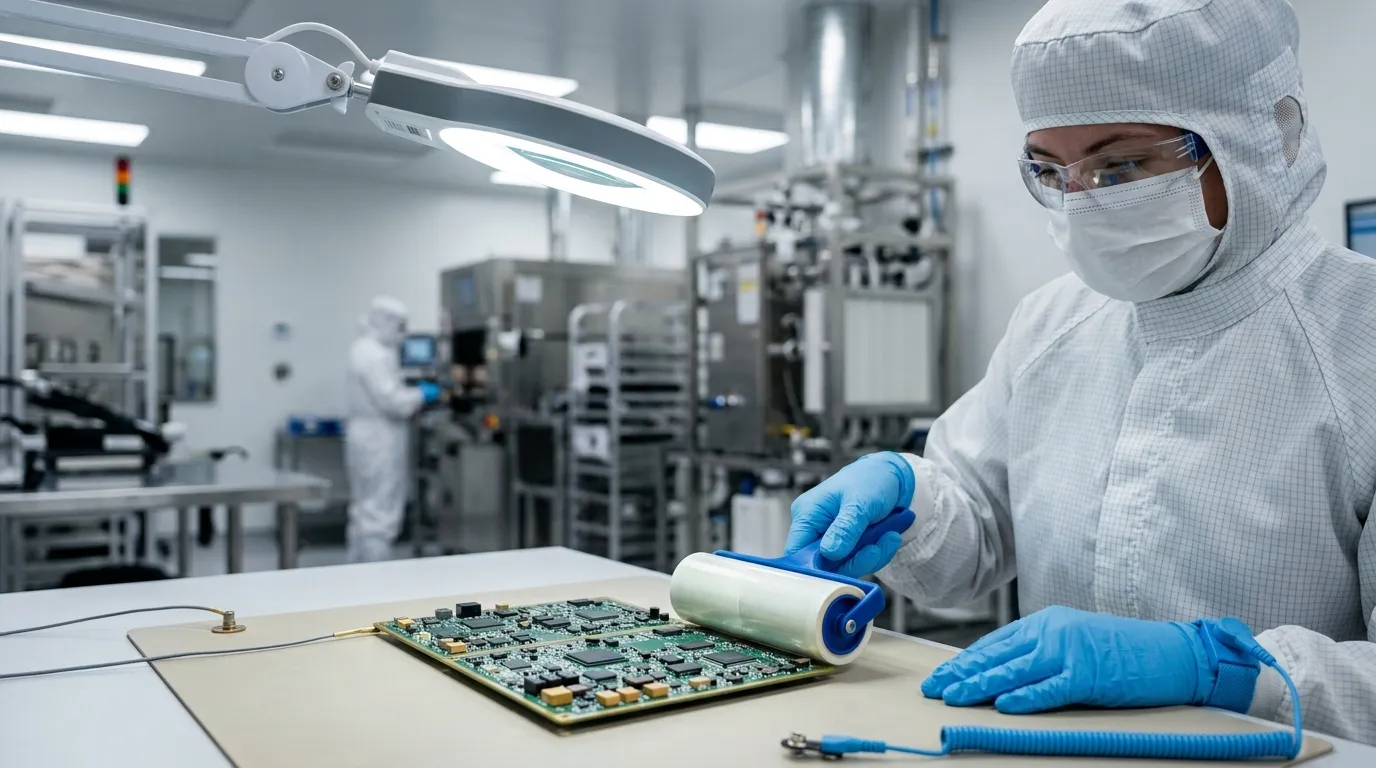
What Is Silicone Contamination in Electronics Manufacturing?
Silicone contamination is the presence of unwanted silicone-based material on a surface that must remain chemically clean for subsequent processing. The term "silicone" refers to synthetic polymers built on a siloxane backbone. It is not the same as "silicon," the element used to make semiconductor wafers. In a cleanroom context, silicone contamination is a process risk; silicon contamination is a different materials-science issue.
Silicone can be present in several forms:
- Silicone oil – a mobile liquid that spreads easily.
- Uncured silicone – a partially reacted material, often found in sealants and adhesives.
- Cured silicone – a fully crosslinked elastomer or resin, commonly used in gaskets and coatings.
- Silicone adhesive – a pressure-sensitive adhesive used in tapes, labels, and protective films.
Because silicone has a very low surface tension, even a small amount can spread into a thin, nearly invisible film. This spreading behavior, described in ESA materials research, makes silicone contamination particularly difficult to detect. In electronics manufacturing, this molecular-level film can alter wettability, block adhesion, and interfere with coatings and bonding.
Why Silicone Contamination Is a Problem for Electronics Manufacturing
The main danger of silicone contamination is the weak boundary layer it creates. When a thin, low-surface-energy silicone film sits between a substrate and a coating, adhesive, or bonding agent, the film prevents intimate contact and reduces the bond's strength.
The consequences include:
- Adhesion failure of conformal coatings, paints, or encapsulants.
- Bonding failure in adhesive joints.
- Coating defects such as dewetting, pinholes, or poor flow.
NASA research has shown that silicone can cause severe or even catastrophic bond-system failure, depending on the materials and processes involved. The same study notes that removing the contamination is difficult and often process-specific. In other words, not every electronics process fails at the same contamination level — but the risk is real wherever adhesion or coating quality is critical.
Where Does Silicone Contamination Come From?
Silicone can enter an electronics plant from many directions. The most common in-plant sources include:
- Sticky rollers, wipes, and swabs whose materials or packaging contain silicone.
- Adhesive tapes, labels, seals, and lubricants.
- Protective films and their release liners.
- Gloves, hand creams, cosmetics, and maintenance materials.
- Neighboring processes that release silicone oils or vapors.
- Processing and support materials that were never tested for silicone content.
NASA's study on silicone contamination identifies processing and support materials as credible sources of contamination. The lesson for a factory is that source tracing matters: before you change a cleaning procedure, you need to know where the silicone is coming from.
For example, a sticky roller used to clean a PCB surface can itself become a contamination vector if its adhesive or film contains silicone. The same concern applies to cleanroom swabs for electronics cleaning, which are often used for spot cleaning and might transfer more than they remove.
Silicone-Free vs No-Residue vs ESD-Safe: What's the Difference?
The terms "silicone-free," "no-residue," and "ESD-safe" are often used as if they mean the same thing. They do not.
| Term | What It Means | What It Does Not Mean |
|---|---|---|
| Silicone-free | The product is manufactured without silicone-based materials, within a defined scope. | It does not prove the product leaves no other residue. It also does not guarantee every component is silicone-free unless the supplier says so. |
| No-residue | The product leaves no visible or measurable residue in a specific test. | It does not prove the product is silicone-free. A product can be residue-free in one test and leave residue under different pressure, temperature, or substrate conditions. |
| ESD-safe | The product controls static electricity within a defined resistance range. | It does not prove the product is silicone-free. A static-dissipative roller can still contain silicone materials. |
For an electronics manufacturer, these are three separate qualification axes. A silicone-free roller must also be evaluated for residue transfer and ESD performance, and each property must be verified with its own test and its own documentation.
How to Prevent Silicone Contamination in Electronics Production
Prevention is more reliable than remediation. A practical prevention program includes:
- Inventory silicone-containing materials. Identify every tape, film, roller, wipe, swab, glove, seal, and lubricant used near sensitive production lines. Label them clearly.
- Segregate silicone-containing materials. Keep them away from coating, bonding, and assembly areas where silicone can transfer.
- Request supplier declarations. Ask every consumables supplier to state in writing whether their product contains silicone, and to define the scope of that statement.
- Perform incoming inspection. Check new batches of rollers, wipes, and films for visible residue, and run a simple transfer test before approving them for production.
- Control changes. When introducing a new tape, film, roller, or glove, review it for silicone content before it enters the cleanroom. Change control is the last line of defense against an unintended source.
- Train personnel. Hand creams, cosmetics, and maintenance products are common silicone sources that no supplier declaration can catch.
Cleanroom ISO class controls airborne particles, not molecular silicone. A high-grade cleanroom can still have a silicone contamination problem if process materials are not controlled.
For processes where the cost of failure is especially high, such as lithium battery electrode coating, the contamination threshold is even lower. A sticky roller for lithium battery electrode production must be qualified to the same standard as the electrode itself.
How to Choose and Qualify a Silicone-Free Sticky Roller
Choosing a silicone-free sticky roller is not as simple as reading the label. You need to verify the product's actual construction, request the right evidence, and test the roller under your own process conditions.
What "Silicone-Free" Must Cover
"Silicone-free" is a scope claim. A roller might have a silicone-free film but a silicone-based adhesive, or a silicone-free roller surface but a handle, core, or packaging that contains silicone. Ask the supplier to state exactly which components are covered by the claim. If the supplier cannot define the scope, the claim is not actionable.
What Supplier Evidence Should You Request?
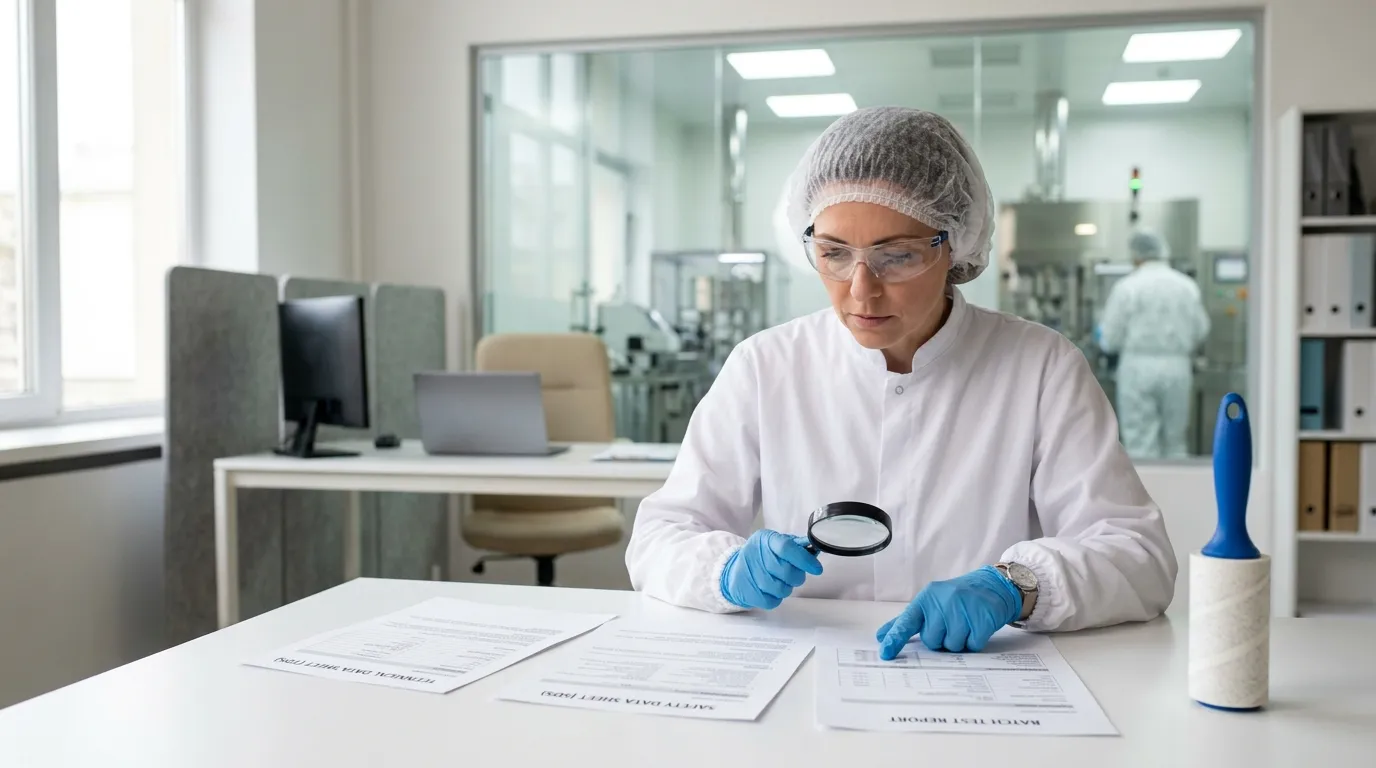
| Document | What It Provides | What It Does Not Prove |
|---|---|---|
| TDS (Technical Data Sheet) | Declared physical and electrical specifications, such as dimensions, thickness, tack, and surface resistance. | A TDS does not prove the product is silicone-free. It describes what the product is, not every material it does not contain. |
| SDS (Safety Data Sheet) | Hazard and handling information. | An SDS is not a material declaration for silicone content. It covers regulatory hazards, not every process material. |
| Supplier declaration | A written statement about silicone content and its scope. | A declaration is only as good as the supplier's process control. It should name the test method and the covered components. |
| Batch test report | Results from a specific production batch under defined test conditions. | A batch report verifies only that batch, not the entire product line. It also only proves what the chosen test method can measure. |
A supplier who cannot provide a clear declaration and batch-level evidence is not yet a qualified supplier. If you are evaluating a specific product, check the silicone free pp sticky roller product page for the supplier's declared claims.
How to Qualify a Roller Sample Before Production Use
A simple sample test can reveal whether a roller transfers residue to your actual process surface.
- Define the test substrate. Use the same material you process, whether that is a bare PCB, a coated surface, or a film.
- Define the test procedure. Use the same pressure, number of passes, and roller speed as production.
- Run a control. Take a substrate that has not been touched by the roller and set it aside.
- Test the roller. Pass the roller across the substrate exactly as you would in production.
- Inspect both surfaces. Use visual inspection first, then contact angle measurement, and if available, FTIR, XPS, or GC-MS. A change in surface energy or the appearance of a new peak is a red flag.
- Document the result. Keep the sample, the test conditions, and the observation in your incoming inspection record.
Repeat the test with the next batch. A single good result does not prove every future batch will be identical.
For electronics PCBs specifically, you should also confirm that the roller is appropriate for your application before adopting it as standard. You can review the options available in the range of pcb sticky rollers.
How to Respond to Suspected Silicone Contamination
If you suspect silicone contamination, do not reach for the nearest solvent. The correct response depends on the form of silicone and the substrate you are working with.
First, isolate the source. Stop using the suspected tool or material, and trace where the contamination entered the process. Then consider analysis: contact angle measurement can indicate a surface-energy change, while FTIR, XPS, or GC-MS can identify the material more specifically.
When cleaning is attempted, it must be validated. Silicone oil may be removable with a compatible solvent, while cured silicone or a fully crosslinked adhesive may resist common solvents. In one NASA-tested example, isopropyl alcohol did not dissolve the tested silicone adhesive. The same study emphasizes that cleaning effectiveness must be verified for the specific materials and processes involved.
| Situation | Recommended Approach | Caution |
|---|---|---|
| Suspected silicone on a large flat surface | Use a validated sticky roller that is documented as silicone-free | Test the roller on a representative sample first |
| Suspected silicone in a small area, such as a connector or component | Use a cleanroom swab for electronics cleaning with a validated solvent | The swab material and solvent must both be qualified |
| Suspected silicone under a conformal coating | Remove the coating and clean according to the coating manufacturer's validated process | Do not assume a general flux remover will remove silicone |
| Cured silicone or silicone adhesive residue | Contact the material supplier for a compatible removal method | Aggressive solvents can damage solder mask, components, or substrates |
The goal is to avoid turning a contamination problem into a damage problem. Every cleaning step should be tested on a sacrificial sample before you apply it to production material.
Summary and Next Steps
Silicone contamination in electronics manufacturing is a process risk that is easy to underestimate because it is often invisible. It can enter through rollers, tapes, films, swabs, gloves, and even hand cream. Once present, it can create a weak boundary layer that degrades adhesion, coating, and bonding performance.
Prevention requires three steps: control your materials, request the right evidence, and qualify every consumable before it reaches the line. For a silicone-free sticky roller, the evidence trail matters as much as the label. Define the scope of "silicone-free," ask for a TDS, SDS, supplier declaration, and batch test report, and run a simple transfer test on your own substrate.
If you are evaluating a silicone-free roller for your electronics line, review the specifications and documentation on the silicone free pp sticky roller product page, and request a sample so you can run the qualification steps described above.
NEWS
GET SERVICE
With quality parts to meet every budget and friendly staff trained to make your visit informative and hassle free.