
Qualifying a Sticky Roller for Battery Electrode Production

Qualifying a Sticky Roller for Battery Electrode Production
A sticky roller can be a useful tool for loose-particle control in lithium battery electrode production, but direct contact with coated electrodes should never be assumed safe. Any roller used on or near electrode coatings must be qualified through application-specific testing for particle pickup, adhesive residue, coating integrity, and static behavior before production use.
This guide explains where sticky rollers fit in electrode manufacturing, which specifications matter, and how to run a qualification trial before allowing one near your coating line.
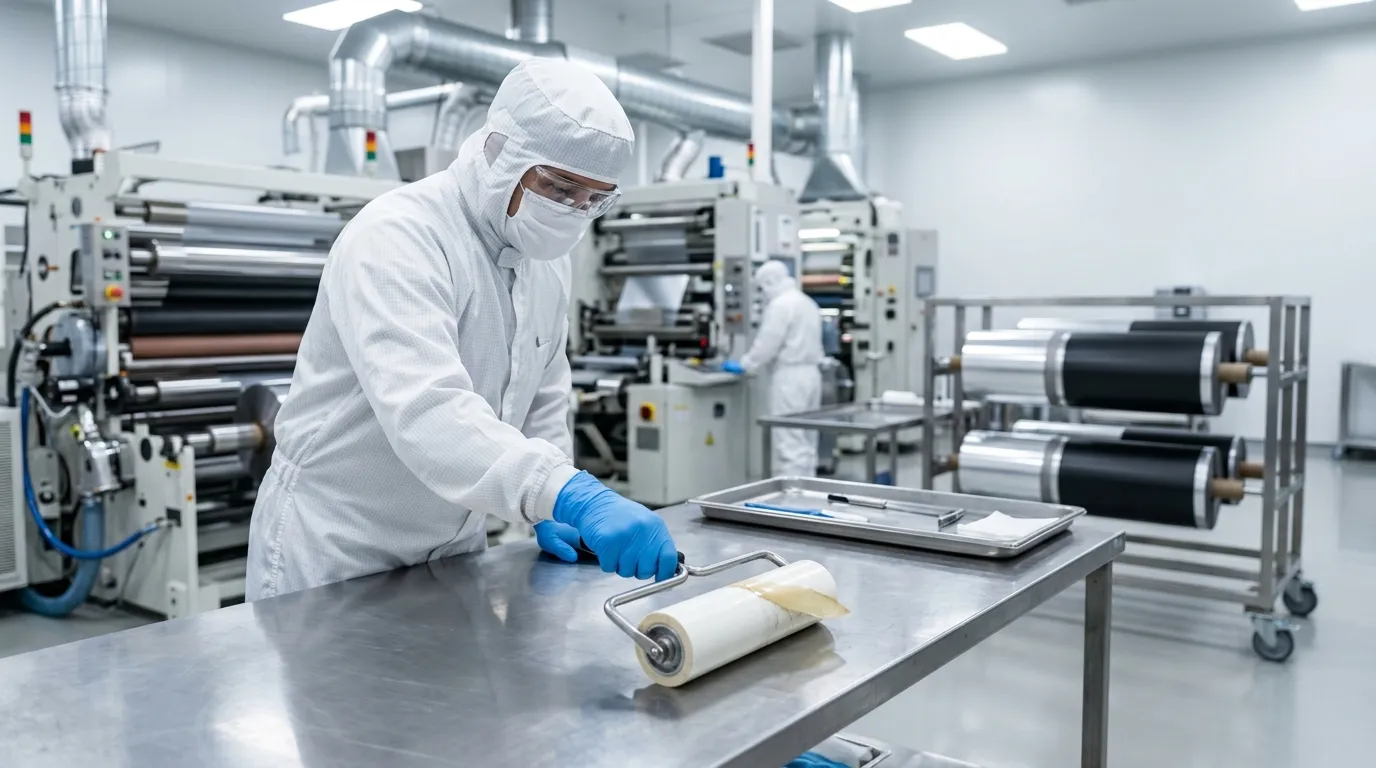
Why Particle Control Matters in Electrode Production
Lithium-ion electrode manufacturing involves several distinct stages: slurry preparation, coating onto a current-collector foil, drying, calendering, and slitting. Each stage can introduce or expose particles that may affect electrode quality and downstream cell performance.
As electrode manufacturing moves from slurry to finished rolls, contamination can come from multiple directions. The environment contributes airborne particles. Process equipment can shed wear debris. Coating materials can contain agglomerates or foreign matter. Slitting edges are a known source of particulate generation. Research on electrode foils has identified coating, calendering, slitting, and the production environment as sources of contamination that can affect cell reliability (ScienceDirect).
Particle detection and inspection systems play an important role in identifying contamination during production (Leica Microsystems). But detection tells you that particles exist — it does not remove them. That gap is where an adhesive roller can help, provided it is used correctly.
Where a Sticky Roller Can Be Used in Electrode Production
A sticky roller is not a calendering roller. Calendering compresses and densifies electrode material; a sticky roller only contacts surfaces to capture loose debris. Confusing the two is a costly mistake.
The table below maps common use locations against the level of risk and the validation required.
| Use location | Contact type | Risk level | Required validation |
|---|---|---|---|
| Workbenches, tooling, fixtures, equipment frames | Indirect | Low to moderate | Residue and static control |
| Packaging surfaces, protective films, outer wrapping | Indirect | Low | Residue control |
| Air-lock and gowning surfaces near the production area | Indirect | Low | Residue control |
| Dried, cured electrode coating on foil | Direct | High | Full qualification: pickup, residue, coating integrity, static behavior |
| Uncoated current-collector foil | Direct | Moderate to high | Residue and static validation plus surface-integrity check |
| Wet, uncured, or partially dried coating | Direct | Very high | Do not use |
The decision table above is the starting point. The sections below explain why the validation requirements differ.
Direct Contact vs Indirect Contact
The distinction between direct and indirect contact is the single most important safety decision in this article.
Indirect contact means rolling surfaces near the electrode line: workstations, tooling, fixtures, packaging, or protective films. These surfaces collect loose dust that could later transfer to the electrode or the production environment. Indirect rolling carries far lower risk because the roller never touches the coated product itself. Even so, the roller must not leave adhesive residue or generate unacceptable static charge on tooling that later contacts the electrode.
Direct contact means rolling the coated electrode surface or bare current-collector foil. Direct contact must be treated as a controlled experiment, not a routine cleaning step. The tack of the adhesive, the pressure applied, and the adhesion quality of the coating all interact. Until you have tested the specific roller construction on your specific coating and substrate at the relevant coating state, direct contact is unproven.
Loose Particles vs Coating Defects
A sticky roller can capture loose particles sitting on a surface. It cannot remove particles embedded in the coating, and it cannot repair coating delamination.
If a roller pulls coating material off the foil, the problem is not simply "high tack." The coating may have an adhesion failure, or the tack and rolling pressure may be unsuitable for that substrate. Either way, this is a stop condition, not a problem the roller can solve by being used more carefully.
Rolling is a surface-cleaning action. Distinguish loose external contamination from coating-origin defects before you decide whether a sticky roller belongs in the workflow at all.
How Sticky Rollers Work: Tack, Construction, and Residue
A sticky roller captures loose particles through adhesive contact. The adhesive surface picks up dust and debris, and the used layer or surface is then removed or cleaned. Three variables control whether this works safely on electrode-related surfaces: tack, construction, and residue behavior.
| Variable | What it controls | Risk if mis-specified |
|---|---|---|
| Adhesive tack | How strongly particles are pulled off the surface | Too low: poor pickup. Too high: coating stress |
| Roller construction (base film, adhesive type) | Compatibility with the surface and environment | Incompatible material can shed, transfer, or react |
| Residue behavior | Whether anything is left behind | Adhesive residue or silicone transfer can contaminate electrodes |
PE vs PP Sticky Rollers
Polyethylene (PE) and polypropylene (PP) are both common base materials for industrial sticky rollers. They differ in stiffness, clarity, chemical resistance, and available ESD-safe constructions. Neither material is inherently "electrode-safe." Suitability depends on the specific adhesive formulation, the construction of the roller, and the result of a qualification test on your actual coating.
Do not assume that a PE roller is gentler than a PP roller, or vice versa. The base film matters, but the adhesive and the overall construction usually determine whether a roller leaves residue or applies excessive force to a coating.
Tack, Pickup, and Coating-Damage Trade-off
Tack is the adhesive property that governs how strongly the roller grabs particles. Higher tack tends to improve pickup, but it also increases the force applied to the surface. On a weakly adhered electrode coating, that force can disturb or lift material.
The correct tack depends on four variables:
- the coating formulation and its adhesion to the foil;
- whether the coating is fully cured and dried;
- the type and size of particles you need to remove;
- the pressure applied during rolling.
Tack should be specified as a measured value with a defined test method, not as a vague "high," "medium," or "low" description. Peel-adhesion values are commonly reported in gram-force per width (for example, gf/25mm), and the test conditions matter as much as the number. For a more detailed explanation of how tack is measured and what the unit means, see our guide on adhesive tack measurement gf/25mm explained.
Residue and Silicone Transfer
Residue is the contamination risk that causes the most damage in electrode production. Two types matter:
- Adhesive residue — adhesive material left on the rolled surface. This can transfer to the electrode, interfere with coating adhesion, or create defects in downstream processing.
- Silicone transfer — silicone compounds transferred from a roller or release liner to the surface. Silicone can be a contamination risk in coating and lamination processes because it alters surface energy and can affect adhesion.
"No-residue" is not a property you can assume from a product description. It must be verified by a defined test method on your specific surface. If residue control is critical for your process, review the product details of a no residue sticky roller and request the relevant test data from the supplier.
Static Control: Does an Electrode Line Need an ESD-Safe Sticky Roller?
Rolling an adhesive surface across a material can generate triboelectric charge. Whether that matters depends on the static sensitivity of your process, the materials you handle, and your facility's ESD-control program.
"ESD-safe" is not a marketing label. It requires a measurable electrical property and a defined test method. Two terms are commonly confused:
| Term | Unit | What it measures |
|---|---|---|
| Surface resistance | ohms (Ω) | The electrical resistance measured between two points on a surface |
| Surface resistivity | ohms per square (Ω/sq) | The inherent resistivity of the material's surface, independent of electrode geometry |
A roller described as static-dissipative or conductive must have resistance or resistivity data from a named test method, not just a product name. Ask the supplier whether the ESD property comes from the full construction of the roller or only from a surface treatment. A full-structure ESD roller is more reliable than one whose only conductive feature can wear away.
If your electrode line requires static control, review the construction and test data for an anti static sticky roller before assuming it meets your process requirements.
How to Qualify a Sticky Roller Before Production Use
Qualification before production use is the only reliable way to verify that a sticky roller removes particles without damaging electrode coating. Run a small controlled trial before allowing any roller near coated material.
Step 1 — Define the test surface. Identify the exact substrate, coating formulation, and coating state (dried, cured, calendered, or uncoated foil) that the roller will contact. Test on that specific surface. Results from a workbench surface do not transfer to a coated electrode.
Step 2 — Select candidate rollers. Choose two or three rollers with different construction and tack levels. Include a conservative low-tack option and a higher-tack option so the comparison has a meaningful range.
Step 3 — Use representative particles. Test with the type and size of particles that actually appear in your process. If the contamination is carbon, metal fines, or general dust, use equivalent test particles. Avoid testing with only large or heavy debris.
Step 4 — Measure particle pickup. Roll the candidate rollers over a defined area with a defined number of passes. Compare pickup visually or by weighing the roller before and after use. Record the number of passes and the pressure applied.
Step 5 — Inspect the coating surface. After rolling, inspect the coated surface for visible damage, edge lift, or coating material transferred to the roller. If the roller picks up coating, that is a stop condition for that product and tack level.
Step 6 — Check for residue and transfer. Inspect the rolled surface for adhesive residue using the appropriate method for your material. If silicone transfer is a concern, request an appropriate analytical check. A clean visual surface is not proof of residue-free performance.
Step 7 — Measure static behavior if required. If the process requires ESD control, measure the roller's surface resistance or resistivity under your environmental conditions. Record the test method, humidity, and temperature.
Step 8 — Document and approve per batch. Record the results for each product model and batch. Approve a specific roller model and batch for a defined use location — not a product category for all purposes.
What to Ask a Sticky-Roller Supplier

Buying a sticky roller for electrode production is a specification decision, not a catalog decision. Ask the supplier for documentation that supports your qualification trial.
| Document or data | Why it matters | What to check |
|---|---|---|
| Technical Data Sheet (TDS) | States the product's construction, dimensions, tack, ESD data, storage, and shelf life | Are units and test methods named? |
| Batch test report | Verifies the specific batch's resistance, tack, residue, or other critical values | Does the report match the batch you received? |
| SDS/MSDS | Documents safe handling of adhesive or material | Request if your EHS team requires it |
| Residue or silicone test data | Confirms whether the product is genuinely low-residue or silicone-free | Was the test run on a surface similar to yours? |
| Storage and shelf-life information | Adhesive performance can change during storage | Can the supplier guarantee stability through the stated shelf life? |
| Customization and supply options | Confirms whether size, printing, or private label is available | Does the supplier support your planned procurement model? |
A TDS describes the product. A batch test report proves what that specific batch did under test. Do not confuse the two. For critical applications, request both.
Limitations and Common Mistakes
Even a well-qualified sticky roller has limits. Keep these constraints visible in your process planning.
- Never roll a wet, uncured, or partially dried coating. The coating is not stable enough for adhesive contact.
- Never use a sticky roller to remove embedded particles or repair coating defects. It is a surface-cleaning tool, not a rework tool.
- Never substitute a consumer lint roller in a controlled production environment. Consumer products are not manufactured to cleanroom or industrial specifications.
- Do not assume "cleanroom" or "ESD-safe" automatically means electrode-compatible. The qualification trial is the only valid test.
- Stop rolling immediately if you observe visible coating pickup, adhesive residue, edge lift, or a change in static behavior.
- A sticky roller is not an alternative to slurry filtration, particle detection, or environmental contamination controls. It is one tool in a larger system.
Next Step: Request a Sample and Run a Qualification Trial
The only way to know whether a sticky roller is safe for your electrode production line is to test it on your material. Define your substrate and coating state, select candidate roller constructions, and run the eight-step qualification protocol above before production use.
When you contact a supplier, ask for a sample, a TDS, and a batch test report covering tack, residue, and ESD data where relevant. If you are evaluating Nabai's sticky rollers for electrode production, request samples and technical documentation for the anti-static and no-residue constructions, then qualify them against your specific coating and process conditions.
NEWS
GET SERVICE
With quality parts to meet every budget and friendly staff trained to make your visit informative and hassle free.