
Textile Sticky Rollers: Select and Validate at Line Speed

Textile Sticky Rollers: Select and Validate at Line Speed
An industrial sticky roller is a tack-controlled contact-cleaning tool that removes loose fibers, lint, and surface particles from textile and nonwoven webs using an adhesive-coated film or a reusable silicone surface. Unlike household lint rollers, industrial sticky rollers must be selected and validated for continuous production conditions, where substrate compatibility, adhesive residue, fiber-pull risk, and line speed determine whether the roller solves the problem or creates a new one.
This guide covers roller material selection, tack trade-offs, line-trial validation, supplier documentation, and the common failure modes that textile and nonwoven manufacturers should anticipate before introducing a sticky roller into production.
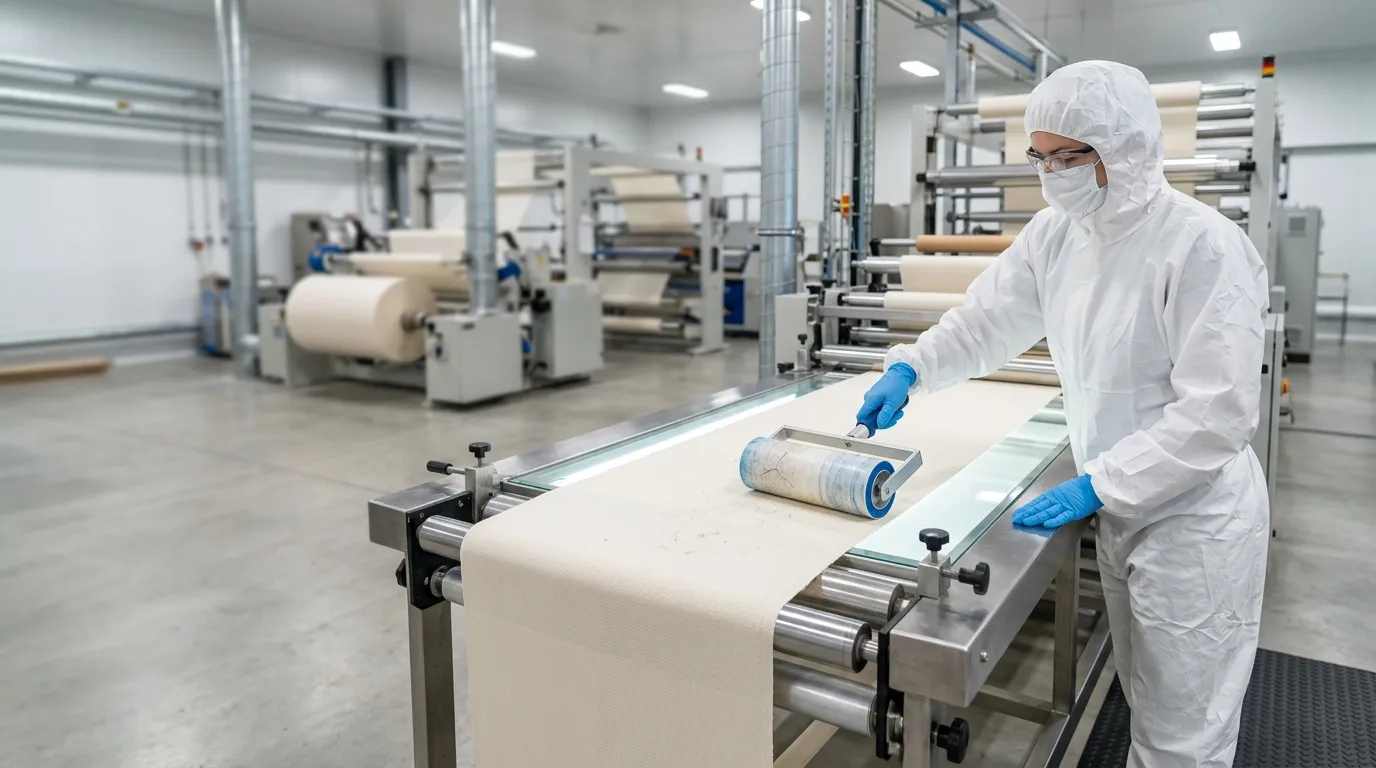
What Is an Industrial Sticky Roller for Textile and Nonwoven Lines?
An industrial sticky roller is a cylindrical cleaning tool covered with an adhesive-coated surface that lifts loose fibers, lint, and surface particles when it contacts a moving or staged web. Industrial sticky rollers are built in two basic formats:
- Disposable multi-layer rollers: a stack of adhesive-coated PE or PP film layers. When the outer layer becomes saturated, it is peeled away to expose a fresh adhesive surface.
- Reusable silicone rollers: a washable silicone surface that can be cleaned periodically and returned to service.
The textile and nonwoven context changes the selection criteria. A consumer lint roller needs only to remove pet hair and clothing fibers from finished garments. An industrial roller must do that on a production web, at a defined width, without depositing adhesive residue that could ruin coating, lamination, printing, or converting downstream. That difference in operating conditions is why material choice, tack level, and validation matter. For a broader look at how sticky rollers are used across industrial cleaning tasks, see our guide to the sticky roller for industrial cleaning.
Why Lint Control Matters on Textile and Nonwoven Lines
Lint and loose fibers are not just a cosmetic issue. They cause visual defects in finished fabric, interfere with subsequent coating or lamination, contaminate downstream processes, and can build up on machine rollers where they create wrinkles or tension variations.
Fibers commonly shed from:
- raw fabric and unfinished edges;
- cut edges of nonwoven webs;
- low-consolidation nonwoven surfaces;
- handling and unwinding operations.
A sticky roller is most useful for surface-level contamination immediately before inspection, coating, laminating, printing, or converting. It is not designed to remove embedded contamination, heavy process debris, or particles trapped within the web structure. It should also be seen as one step in a contamination-control sequence — upstream sticky mats at entrances and air showers in cleanroom environments handle foot-borne and airborne contamination, while the roller handles the web itself.
PE vs PP vs Silicone Rollers for Fabric and Nonwoven Surfaces
The roller material affects conformability, residue behavior, and whether the roller can be reused. There is no universal "best" material; the right choice depends on the web structure, the finish applied to the fabric, the tack required, and the process tolerance for residue and downtime.
| Roller Type | Material | Format | Typical Strength | Key Trade-Off |
|---|---|---|---|---|
| PE sticky roller | Polyethylene film | Disposable, multi-layer | Flexible; conforms to slightly uneven web surfaces | Requires a tack level matched to the substrate to avoid residue |
| PP sticky roller | Polypropylene film | Disposable, multi-layer | Firmer film; common in industrial and cleanroom dust-control applications | Less conformable; may require more carefully controlled contact pressure |
| Silicone roller | Silicone surface | Reusable, washable | Can be cleaned and reused repeatedly | Requires a wash step; surface and transfer behavior must be checked for each application |
For cleaner, dust-sensitive operations, a PP roller has been a common industrial choice. However, the selection of PE, PP, or silicone cannot be made on material alone; the tack level is the critical variable.
How to Choose the Right Tack for Textile and Nonwoven Lint Removal
Tack is the adhesive's ability to form a bond quickly under light contact pressure. In a roller application, tack determines how aggressively the roller lifts loose fibers from the web surface.
The trade-off is direct:
- Higher tack improves pickup of fine fibers and embedded lint.
- Higher tack also increases the risk of adhesive residue transfer, fiber pull, and surface damage, especially on coated, finished, or loosely anchored fibers.
- Lower tack is safer for delicate substrates but may leave too much lint behind.
The safe tack range is determined by the web's surface energy, fiber structure, coating or finish, and the downstream process's tolerance for contamination. A heavily finished fabric may need only light tack; a rough nonwoven with heavy loose-fiber generation may need more aggressive pickup. The goal is the lowest tack that consistently removes the lint without pulling the web.
Use the following table as a starting point for a selection discussion with your supplier:
| Substrate Condition | Recommended Approach | Risk If Tack Is Too High |
|---|---|---|
| Woven fabric with well-anchored fibers | Moderate tack | Fiber pull, surface distortion |
| Nonwoven with loose surface fibers | Tack sufficient for surface pickup | Web distortion, edge damage |
| Coated or laminated textile | Low tack; test before production use | Adhesive residue, coating damage |
| Delicate or finished fabric | Lowest effective tack | Fiber pull, residue, visible marking |
What Does "High Tack" Mean for Textile and Nonwoven Surfaces?
"High tack" is a relative description, not a standardized performance guarantee. A roller labeled high tack may work well on one nonwoven and damage another. The term should never be the sole basis for selection.
On delicate or coated textiles, high tack can pull individual fibers out of the structure, leave adhesive residue on the surface, or affect downstream coating adhesion. The correct tack depends on the web's surface energy, fiber anchoring, and the downstream process's sensitivity to contamination. For more information on this specific product category, see our high tack sticky roller page.
How Is Tack Measured, and Why Do Units Matter?
Tack is not a single universal number. Suppliers may describe it in several ways:
- Peel adhesion, often reported in gram-force per stated width, such as gf/25 mm, under a defined test method.
- A proprietary adhesive-grade number (for example a 200D–1500D style scale), which is a supplier-specific ranking rather than a measured force.
These are not interchangeable. Whenever you compare rollers, ask for the tack or peel-adhesion value with its test method and units. Without the units and method, a "high tack" or "adhesive grade" label cannot be compared between suppliers or matched to your substrate. For a fuller breakdown of the measurement itself, see our explanation of adhesive tack measurement gf/25mm explained.
How to Validate a Sticky Roller at Web Speed: Sample and Line-Trial Protocol
A sticky roller that works in a lab test can fail on a production line. Validation at web speed is the only reliable way to confirm pickup, residue behavior, and substrate safety. Follow this sequence:
- Request samples and the TDS before committing to a purchase. The technical data sheet gives you the roller's dimensions, material, construction, and stated handling or storage conditions.
- Confirm the roller width, core size, and material against your line geometry. The roller must cover the web width without forcing the web into an unnatural contact angle.
- Run a controlled trial at normal web speed and tension. Do not test only at low speed; adhesive behavior changes with contact time.
- Inspect the web immediately after the roller. Look for lint removal, adhesive residue, fiber pull, surface marking, and any change in web tension or tracking.
- Measure usable life. For a disposable multi-layer roller, record how many layers or rolls are consumed per shift. For a silicone roller, verify how many cleaning cycles it withstands without losing pickup.
- Repeat the trial with the actual production batch. A clean lab sample does not represent a real web with finishes, static charge, or ambient contamination.
- Re-check across multiple rolls. If the supplier cannot show batch consistency, the first roll's performance may not hold for subsequent deliveries.
A line trial answered by the supplier with a test report or a documented performance summary is far more valuable than a product page claim.
Specifications and Documentation to Request From Your Sticky-Roller Supplier
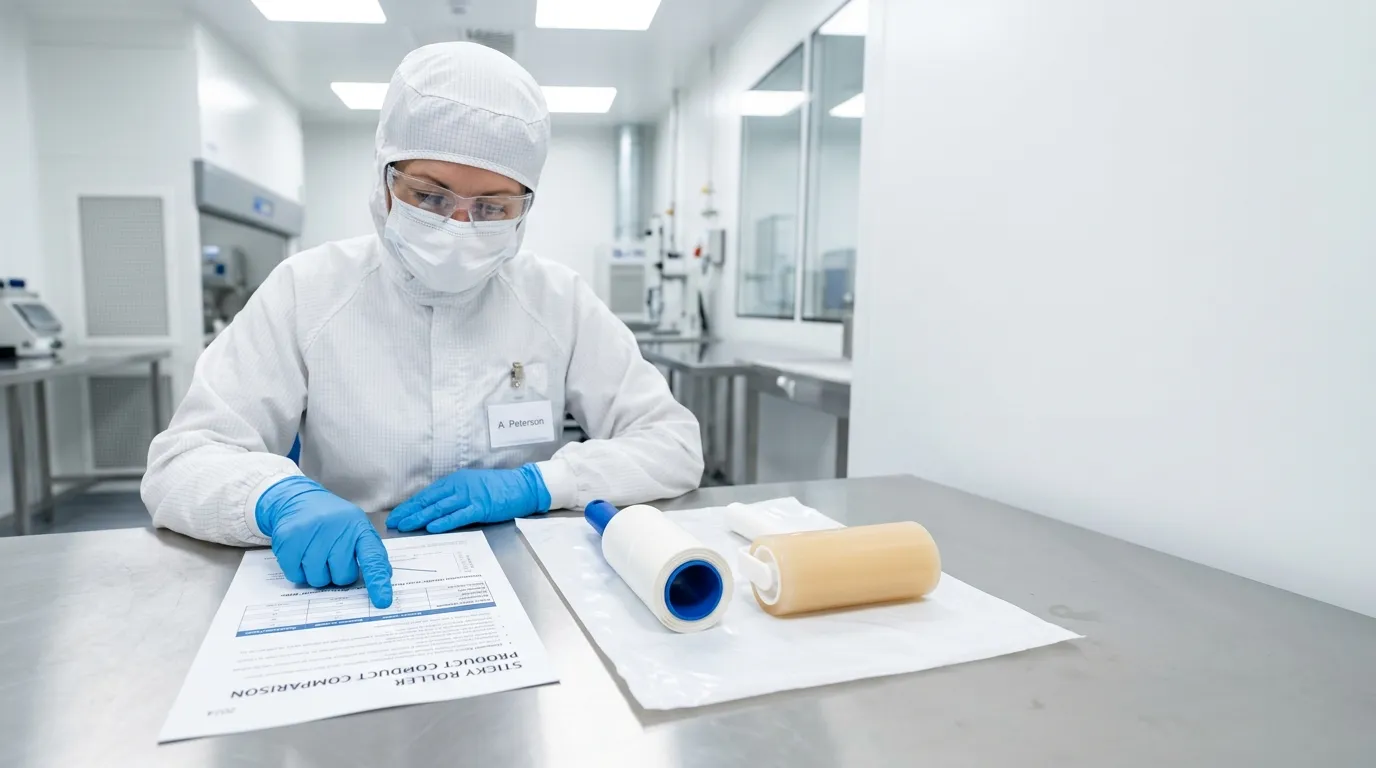
Formal documentation verifies whether a product is suitable for your process and whether the delivered batch matches the product specification.
| Document | What It Tells You | What It Does Not Tell You |
|---|---|---|
| TDS (Technical Data Sheet) | Product dimensions, material, construction, tack or adhesion values, storage conditions | Whether the specific delivered batch matches those values |
| Batch test report | Measured results from a specific production lot, where testing is performed | Expected performance of a different lot |
| SDS (Safety Data Sheet) | Handling, storage, and safety information | Process suitability or adhesive performance |
| RoHS / REACH declaration | Restricted-substance status, when applicable to your market | Mechanical or adhesive performance |
Ask for consistent units and identified test methods in every document. A batch test report for surface resistance should state whether the value is surface resistance in ohms or surface resistivity in ohms/square; these are different measurements and cannot be compared directly. Similarly, a tack value is only meaningful when the width basis and test method are included. If your process is ESD-sensitive, confirm the measurement standard as well as the value.
Common Sticky-Roller Failure Modes on Textile and Nonwoven Lines
Even with the right material and tack, production conditions can cause problems. The most common failure modes include:
- Insufficient pickup: tack too low, wrong material, or contact pressure set incorrectly.
- Adhesive residue: tack too high, adhesive incompatible with the web finish, or roller stored in poor conditions.
- Fiber pull: over-aggressive tack that lifts anchored fibers out of the structure.
- Static charging: synthetic webs can build charge during contact; verify ESD behavior separately from mechanical pickup.
- Edge lift or delamination: poor roller construction or excessive web tension at the edges.
- Saturation and carryover: the roller becomes loaded with lint and begins depositing particles back onto the web; replacement interval was not controlled.
- Batch inconsistency: a new delivery behaves differently; the supplier should provide batch test evidence.
Most of these failures are avoidable when the roller is selected for the specific substrate and validated at line speed before full adoption.
How to Work With a Sticky-Roller Supplier for Textile and Nonwoven Lines
When you approach a supplier, bring the information that determines whether their roller fits your process:
- web width and line speed;
- substrate type: woven, knitted, nonwoven, coated, or laminated;
- surface finish or coating present;
- whether residue or fiber-pull risk has been observed before;
- whether the line is ESD-sensitive or cleanroom-controlled.
Ask directly for samples, a TDS, and the option to run a line trial. Confirm whether custom widths, packaging, and documentation language are available, and whether the supplier supports OEM or private-label programs.
A sticky roller is only as reliable as the specification behind it. A supplier who cannot provide a TDS, explain batch-level testing, or discuss your web speed and substrate honestly should not be your first choice. The right supplier for textile and nonwoven lint control is the one who treats the roller as a process component — not as a generic consumable.
If you are evaluating a roller for your textile or nonwoven line, contact Nabai with your web width, substrate type, and line speed, and request a sample and technical documentation to begin your own line trial.
NEWS
GET SERVICE
With quality parts to meet every budget and friendly staff trained to make your visit informative and hassle free.