
Cleanroom Swabs for Electronics: Selection & Verification

Cleanroom Swabs for Electronics: Selection & Verification
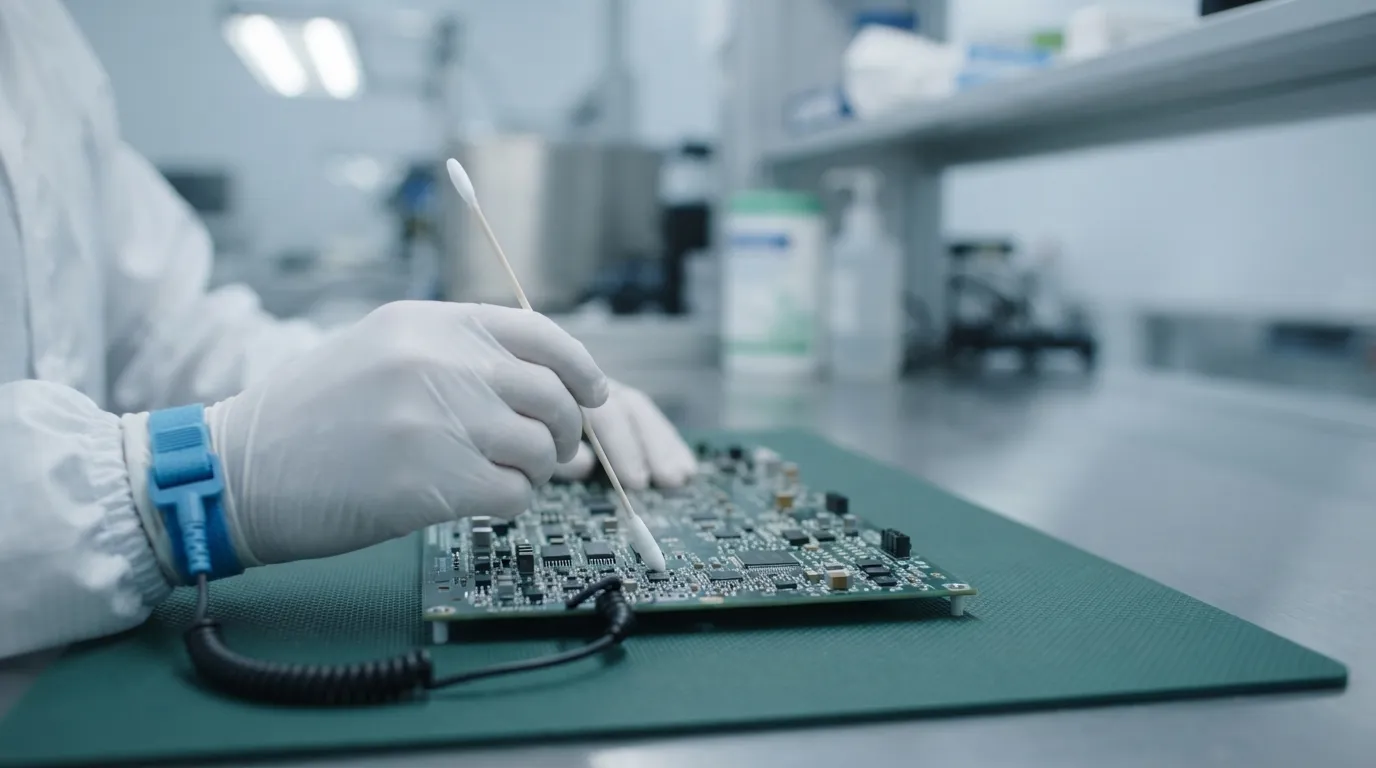
Cleanroom swabs are precision cleaning tools designed to remove particles, flux residue, and other contamination from confined electronics surfaces that wipes and sticky rollers cannot reach. They differ from ordinary cotton swabs in their controlled materials, low particle shedding, and documented cleanliness, making them essential for PCB assemblies, connectors, fine-pitch components, and other static-sensitive electronics. Choosing the right swab depends on tip material, geometry, ESD properties, solvent compatibility, and the supplier documentation that proves the swab performs as claimed.
What Are Cleanroom Swabs and Why Electronics Cleaning Needs Them?
A cleanroom swab is a contamination-controlled applicator manufactured, packaged, and tested for use in controlled environments where particles, fibers, and residues can compromise product quality. In electronics cleaning, these swabs serve one primary purpose: delivering controlled cleaning action to small, recessed, or delicate areas that broad-surface tools cannot reach.
Cleanroom Swab vs. Cotton Swab: What Changes in Electronics Cleaning?
Ordinary cotton swabs are not suitable for electronics cleaning. Cotton fibers can shed and leave filaments on components, and the binders or processing aids used in consumer swabs may introduce ionic or organic contamination. Cleanroom swabs are manufactured from engineered materials such as polyurethane foam, polyester, or microfiber, and are processed, cleaned, and packaged to minimize particle shedding and extractable residue. For electronics, this distinction is not a matter of preference — it is a matter of process reliability.
How to Select a Cleanroom Swab for an Electronics Cleaning Task
Selecting the right cleanroom swab requires matching the swab's physical and chemical characteristics to the specific cleaning task. Four decisions matter most: tip material, tip geometry and shaft design, ESD-safe construction, and solvent compatibility. Cleanliness documentation provides the evidence that the chosen swab meets the required standard.
Choose the Tip Material: Foam, Polyester, or Microfiber
The tip material determines how the swab absorbs, holds, and releases solvents, and how it interacts with the surface being cleaned.
| Tip Material | Key Characteristics | Best Suited For | Limitations to Check |
|---|---|---|---|
| Foam | Open-cell polyurethane; high absorbency; good solvent retention; soft contact | Applying solvents to a controlled area; removing flux or residue from accessible surfaces | May shed particles if not thermally bonded or if the foam quality is poor |
| Polyester | Woven or knitted fabric; low particle shedding; durable; chemically resistant | General precision cleaning; dry particle removal; wiping small flat areas | Lower absorbency than foam; may require multiple passes for heavy residue |
| Microfiber | Ultra-fine synthetic fibers; high surface area; effective particle capture | Fine particle removal; polishing or final cleaning of sensitive surfaces | Must verify NVR and extractables; not all microfiber is cleanroom-compatible |
No single tip material is universally best. Foam suits solvent-intensive cleaning, polyester suits general low-particle precision work, and microfiber suits fine-particle removal when its cleanliness is documented.
Match Tip Geometry and Shaft Design to the Access Point
The shape of the tip and the design of the shaft determine whether the swab can reach the contamination without damaging surrounding components.
- Pointed tips reach tight corners, narrow gaps, and the spaces between closely spaced components.
- Rectangular tips provide a flat, controlled contact area for cleaning small surfaces such as connector faces or edge connectors.
- Rounded or microtips suit delicate components where precise, low-pressure contact is required.
- Shaft length and flexibility affect how far the swab can reach and how much pressure is applied. A longer, flexible shaft can navigate around components, while a rigid shaft gives more control for direct contact.
For cleaning narrow gaps in cleanrooms, the general techniques for accessing confined spaces apply, but the swab itself must be sized to the geometry of the target area. For more on the broader method, see how to clean narrow gaps in cleanrooms.
Confirm ESD-Safe Construction
Static-sensitive electronic components can be damaged by uncontrolled electrostatic discharge. An ESD-safe swab is designed to reduce the accumulation or discharge of static charge, but the label "ESD-safe" alone is not sufficient evidence of performance.
To verify an ESD-safe claim, ask the supplier for the product's surface resistance or surface resistivity value, the test method used, and the units of measurement. Surface resistance is expressed in ohms (Ω) and measures the resistance between two points on the surface. Surface resistivity is expressed in ohms per square (Ω/sq) and measures the resistance of a square area of the surface. These are not interchangeable values.
For a swab to be considered static-dissipative in an ESD-protected area, it should meet the resistance range defined by the applicable ESD control program, such as those based on standards like ANSI/ESD S20.20 or IEC 61340-5-1. These standards define the requirements for ESD control programs, but they do not by themselves certify that a specific swab meets a specific resistance range. The swab supplier must provide the measured value and the test method.
Check Solvent Compatibility and Choose Wet or Dry Cleaning
The cleaning task determines whether the swab should be used dry or wet.
- Dry swabs are suitable for removing loose particles from accessible surfaces. A polyester or microfiber tip with low particle shedding is often the right choice.
- Wet swabs are used with solvents such as isopropyl alcohol (IPA) to dissolve flux, adhesive residues, or other films. The tip must be compatible with the solvent — it must not degrade, dissolve, or release extractables into the cleaning chemistry.
When using a solvent, the swab tip's absorbency and solvent-release behaviour matter. A highly absorbent tip holds more solvent and releases it gradually, which helps control the cleaning action. A lower-absorbency tip delivers less solvent and may be better for fine, localized work.
Verify Cleanliness: Particle Shedding, Lint, NVR, Extractables, and Bonding
The word "cleanroom" on a swab package does not automatically mean the swab meets a specific cleanroom classification. Cleanliness must be verified with data.
| Cleanliness Factor | What It Measures | Why It Matters | Evidence to Request |
|---|---|---|---|
| Particle shedding | Number and size of particles released from the swab under controlled conditions | Particles can contaminate optics, connectors, or bare boards | Particle count test report with test method and units |
| NVR (non-volatile residue) | Amount of residue left after solvent evaporation | Residue can affect adhesion, coating, or electrical contact | NVR value in mg/swab or equivalent, with test solvent and method |
| Extractables | Compounds that can be extracted from the swab material by a solvent | Extractables can leave contamination on sensitive surfaces | Extractables data with solvent and analytical method |
| Lint / fiber release | Tendency of the tip to shed fibers | Fibers can entrap particles or cause electrical failures | Fiber-release test or visual inspection method |
| Tip bonding | How the tip is attached to the handle | Adhesive bonding may introduce residue; thermal bonding reduces that risk | Bonding method statement from the supplier |
A responsible supplier should provide a technical data sheet (TDS) describing the swab's materials and dimensions, and a certificate of analysis (CoA) or batch test report with the specific results for the batch supplied. For more on what to request, see the supplier documentation section below.
Cleanroom Swabs vs. Wipes vs. Sticky Rollers: Which Tool Fits Which Task?
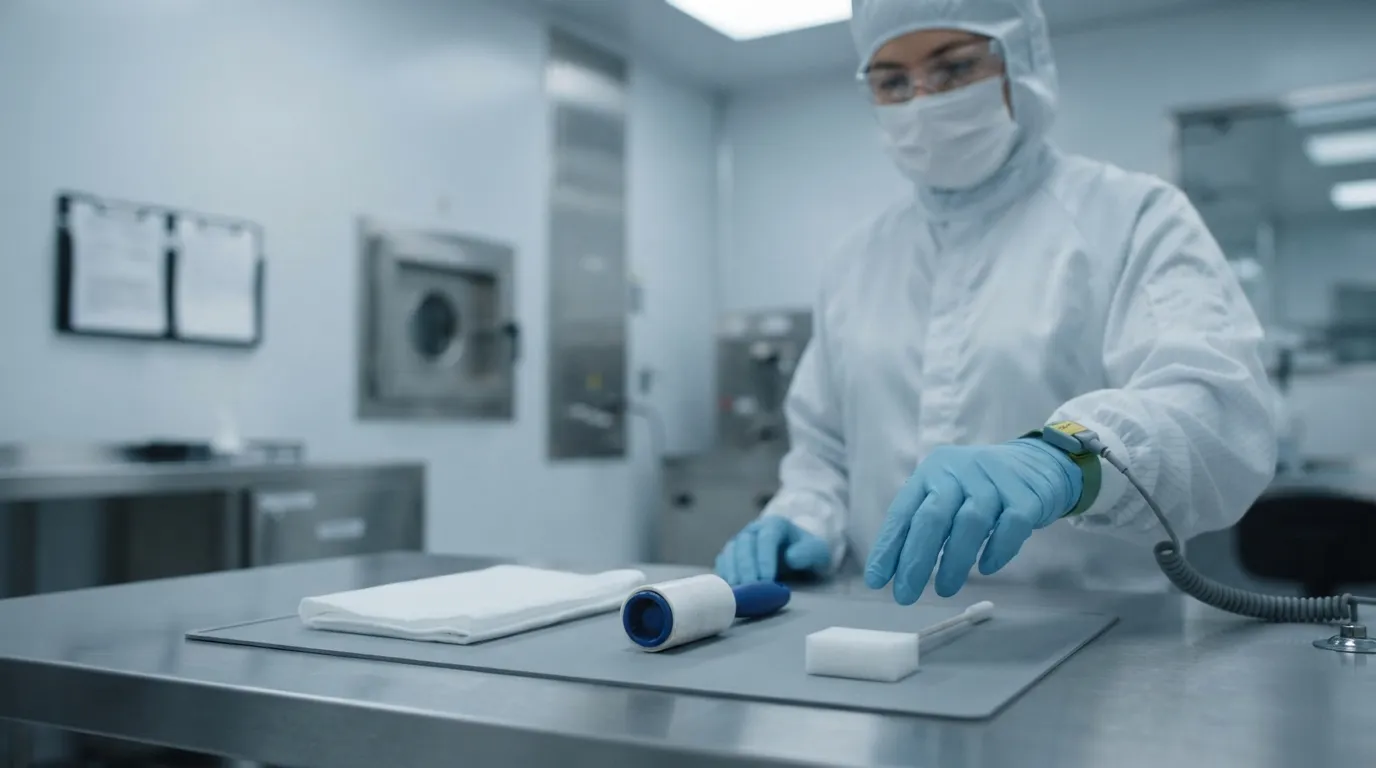
Swabs, wipes, and sticky rollers are complementary tools, not interchangeable ones. Each is designed for a different contamination-control job.
| Tool | Best For | Limitations |
|---|---|---|
| Cleanroom swab | Narrow gaps, connectors, fine-pitch components, localized residue or flux removal | Small contact area; not efficient for large surfaces |
| Cleanroom wipe | Large, accessible flat surfaces; applying solvents over a broad area | Cannot reach recessed or confined spaces |
| Sticky roller | Broad, exposed particle pickup on surfaces such as PCBs or film | Cannot remove liquid residue or flux; not for recessed areas |
For particle control on exposed PCB surfaces, a pcb sticky roller can quickly remove loose dust. For large-area solvent cleaning, a lint free cleanroom wipes supplier provides the appropriate broad-surface tool. When the contamination sits in a corner, under a component, or inside a connector, only a swab can reach it effectively.
What Documentation Should a Reliable Swab Supplier Provide?
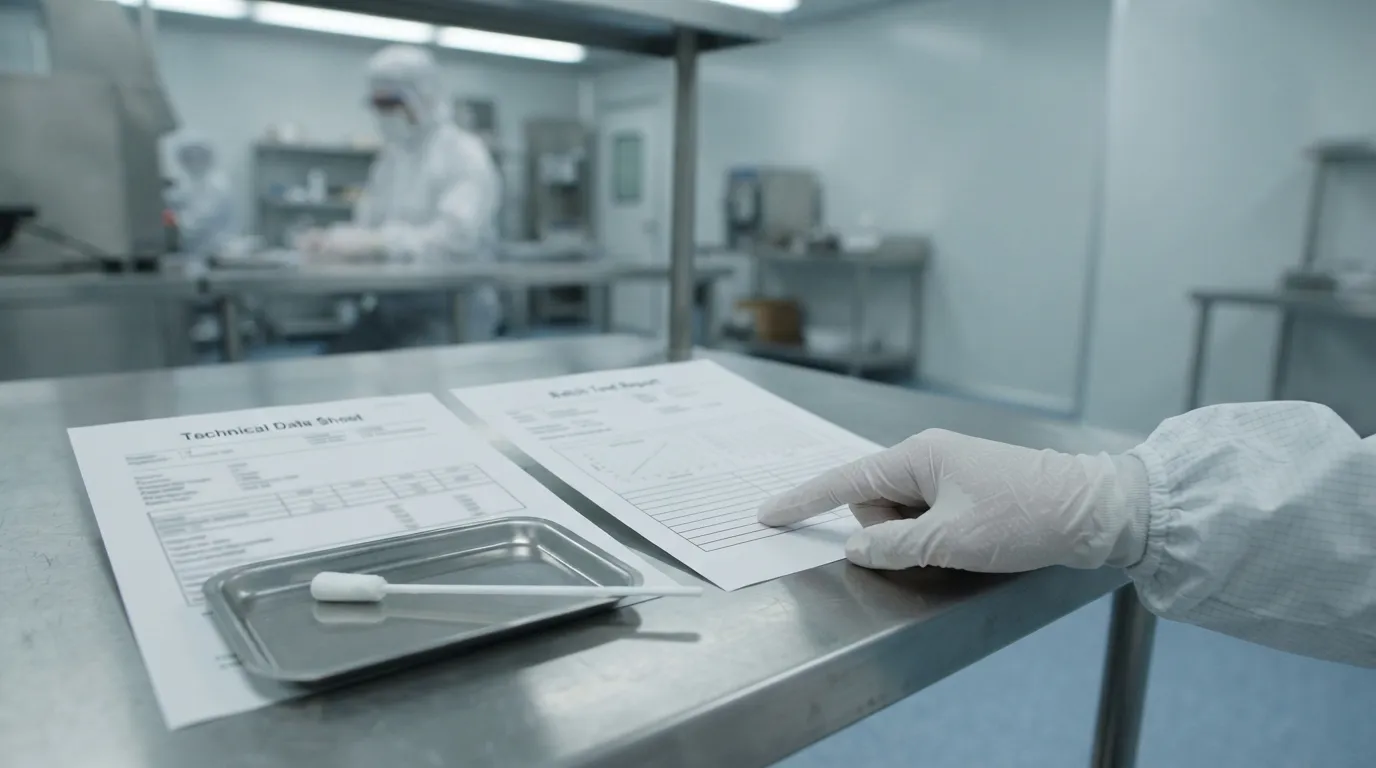
A reliable supplier should provide documentation that allows you to verify the swab's performance before you introduce it into your process. Three documents matter most.
| Document | What It Contains | Why It Matters |
|---|---|---|
| Technical Data Sheet (TDS) | Physical specifications, material composition, dimensions, available sizes | Confirms the product's construction and helps you match it to the application |
| Safety Data Sheet (SDS) | Chemical and safety information for handling and storage | Required for safe use, especially when the swab is used with solvents |
| Certificate of Analysis (CoA) or Batch Test Report | Batch-specific test results, including particle count, NVR, or resistance values | Verifies that the specific batch supplied meets the claimed specifications |
When reviewing a CoA or test report, check the test method and the units. A particle count measured under one method cannot be compared directly to a count measured under another. Similarly, an NVR value is meaningful only when the solvent and extraction method are stated.
Also asks: Are cleanroom swabs reusable? For critical electronics cleaning, no. Swabs are single-use tools because reusing a swab can reintroduce removed contamination or transfer residue to another area. Use a fresh swab for each task or zone.
Common Cleanroom Swab Mistakes in Electronics Cleaning
Several common mistakes can compromise an otherwise well-designed cleaning process.
- Using a cotton swab as a substitute. Cotton can shed fibers and introduce contamination that the cleaning step was meant to remove.
- Choosing a tip that is too large for the gap. Forcing a large tip into a narrow space can damage components or push contamination deeper.
- Applying excessive pressure. Delicate leads, bond wires, and fine-pitch features can be bent or broken by aggressive swabbing.
- Assuming "ESD-safe" also means low-particle or residue-free. ESD performance and cleanliness are separate properties that must both be verified.
- Ignoring solvent compatibility. A tip that degrades in the chosen solvent can leave particles or dissolve into the cleaning chemistry.
- Accepting claims without test evidence. "Low-lint" and "high purity" are marketing terms until a test report confirms them.
Conclusion: Build a Complete Electronics-Cleaning Toolkit
Effective electronics cleaning requires matching the tool to the task. Use cleanroom swabs for confined surfaces and precision residue removal, wipes for large accessible areas, and sticky rollers for broad particle pickup. Demand documentation — TDS, SDS, CoA, and batch test reports — for every claimed specification, and do not rely on marketing labels alone.
For a complete range of cleanroom and ESD contamination-control supplies, including sticky rollers and lint-free wipes, contact Nabai to discuss your cleaning requirements.
NEWS
GET SERVICE
With quality parts to meet every budget and friendly staff trained to make your visit informative and hassle free.