
ESD Audit Checklist: 30 Points for Electronics Factories

ESD Audit Checklist: 30 Points for Electronics Factories
An ESD audit checklist for an electronics factory is a structured review of the facility’s ESD control program. It verifies whether the right controls are documented, installed, grounded, measured, and recorded in every area where electrostatic-discharge-sensitive devices are handled. The 30 points below are designed as a pre-inspection readiness tool, not as a replacement for the standard your facility follows or for a formal certification audit.
Use this checklist as a practical starting point. Adapt it to your own ESD control program, your production flow, and the requirements set by your customer or certifying body.

What an ESD Audit Is in an Electronics Factory
An ESD audit is not a quick walkthrough to see whether a few wrist straps and mats are present. It is a check of whether the facility’s ESD control program is documented, implemented, and actually verified.
In an electronics factory, the audit typically covers the full material flow:
- receiving and incoming inspection
- storage
- SMT and PCB assembly
- manual assembly and inspection
- test and repair/rework
- packaging and shipping
The auditor looks for proof that controls exist and that people use them correctly. That proof can be visual, documentary, or measured.
An internal ESD audit helps you find gaps before an external inspection. A formal certification audit, by contrast, is usually conducted by a third-party body against a specific standard. The checklist below supports the first activity. It does not, by itself, certify anything.
Which Standard Drives Your Audit?
The two most commonly cited ESD control program standards are:
| Standard | Publisher | What it provides |
|---|---|---|
| ANSI/ESD S20.20-2021 | ESD Association | Requirements for an ESD control program framework |
| IEC 61340-5-1:2024 | International Electrotechnical Commission | Requirements for establishing, implementing, and maintaining an ESD control program |
ANSI/ESD S20.20-2021 is widely used in North America and by many electronics manufacturers worldwide. IEC 61340-5-1:2024 is the international program-level standard. The ESD Association describes IEC 61340-5-1 as technically equivalent to ANSI/ESD S20.20 in the context of program requirements.
Your audit should be built on the standard your facility has chosen, but the real starting point is your own written ESD control program. The program defines your scope, your responsibilities, and your compliance verification plan. The checklist translates that plan into verifiable checks.
For a more detailed line-by-line review, see the separate ANSI/ESD S20.20 compliance checklist.
Before You Audit: Scope, ESDS Items, and Evidence Pack

Before you start the 30-point walkthrough, define what the audit will cover.
- Which production areas are in scope?
- Which shifts will be observed?
- Which ESDS items are handled, and where?
- Which processes create the highest risk: SMT, rework, test, hand assembly, or shipping?
Then gather your evidence pack. Published ESD audit guidance from ComplianceOnline shows that ESD audits typically cover management, training, engineering, procurement, storage, work areas, and quality functions. In practice, that means you should be able to produce:
- the written ESD control program
- the compliance verification plan
- training records
- calibration records for test equipment
- measurement and verification logs
- the qualified materials list
- nonconformance and corrective-action records
Collect the evidence at the same time as the physical walkthrough. A missing record is just as important as a missing ground cord.
How to Use the 30-Point Checklist
Every check below is marked with one or more verification types:
| Check type | What it proves |
|---|---|
| Visual | The control is present, labelled, and in usable condition |
| Documentary | A required record exists, is current, and covers the right people, equipment, or areas |
| Measured | A value was obtained with calibrated equipment and compared with defined limits |
Some points need more than one type. For example, a wrist strap can be visually present and still fail its test. A grounding point can look connected but have an invalid resistance value.
Record the evidence location, the result, and any deviation for every point.
The 30-Point ESD Audit Checklist
The following checklist is grouped into six areas. Treat it as a template: your facility’s ESD control program may require additional checks, different frequencies, or stricter acceptance criteria.
Program Management and Documentation (Points 1–5)
| # | Check | Evidence to request | Type |
|---|---|---|---|
| 1 | A written ESD control program exists and is current | Current version, revision date, approval signature | Documentary |
| 2 | A named ESD coordinator or responsible person is assigned | Role and responsibility defined in the program | Documentary |
| 3 | The program scope identifies ESDS items and all protected areas | Scope section, list of EPAs | Documentary |
| 4 | A compliance verification plan defines test points, frequencies, and acceptance criteria | Verification plan with test methods and limits | Documentary |
| 5 | A qualified materials list is maintained and used | QML with approved products, suppliers, and approval dates | Documentary |
EPA Boundaries and Identification (Points 6–9)
| # | Check | Evidence to request | Type |
|---|---|---|---|
| 6 | EPA boundaries are physically marked or identified | Floor markings, signs, or area definition | Visual |
| 7 | Warning signage is visible at EPA entrances | ESD warning signs | Visual |
| 8 | Personnel entering the EPA are trained and authorised | Training records, access authorisation | Documentary |
| 9 | Visitors are logged and given ESD controls or supervision | Visitor log, visitor controls | Documentary |
Do not confuse EPA boundary controls with contamination-control products. Adhesive entrance mats, for example, control particles, not electrostatic charge. If your factory uses them at cleanroom or production entrances, treat them as a separate contamination-control measure. You can see the anti static sticky mat for electronics factory for that application, but it is not a substitute for ESD grounding controls.
Grounding and Personnel Grounding (Points 10–15)
| # | Check | Evidence to request | Type |
|---|---|---|---|
| 10 | The ground reference point is defined and verified | Grounding diagram, verification record | Documentary / Visual |
| 11 | Common point ground continuity is documented | Continuity test record | Documentary |
| 12 | Wrist straps are available, tested, and logged | Wrist strap test log | Measured / Documentary |
| 13 | ESD footwear and flooring are tested where required | Footwear and flooring test log | Measured / Documentary |
| 14 | Ground cords and connections are visually inspected | Inspection note or photo | Visual |
| 15 | Personnel are observed using grounding correctly during normal work | Observation record | Visual |
Resistance values must be compared with the limits defined in your compliance verification plan. Do not assume a universal number applies to every factory.
Workstations, Equipment, and Flooring (Points 16–21)
| # | Check | Evidence to request | Type |
|---|---|---|---|
| 16 | ESD worksurfaces are present in all ESDS handling areas | Workstation list, visual inspection | Visual |
| 17 | Worksurface resistance-to-ground is measured and recorded | Measurement log | Measured |
| 18 | Point-to-point resistance of worksurfaces is measured and recorded | Measurement log | Measured |
| 19 | ESD flooring is installed and tested where required | Flooring test record | Visual / Measured |
| 20 | Production equipment and tools are grounded or bonded | Equipment grounding diagram, inspection sheet | Visual / Documentary |
| 21 | Chairs, carts, racks, and mobile equipment are grounded or bonded | Mobile equipment inspection record | Visual / Documentary |
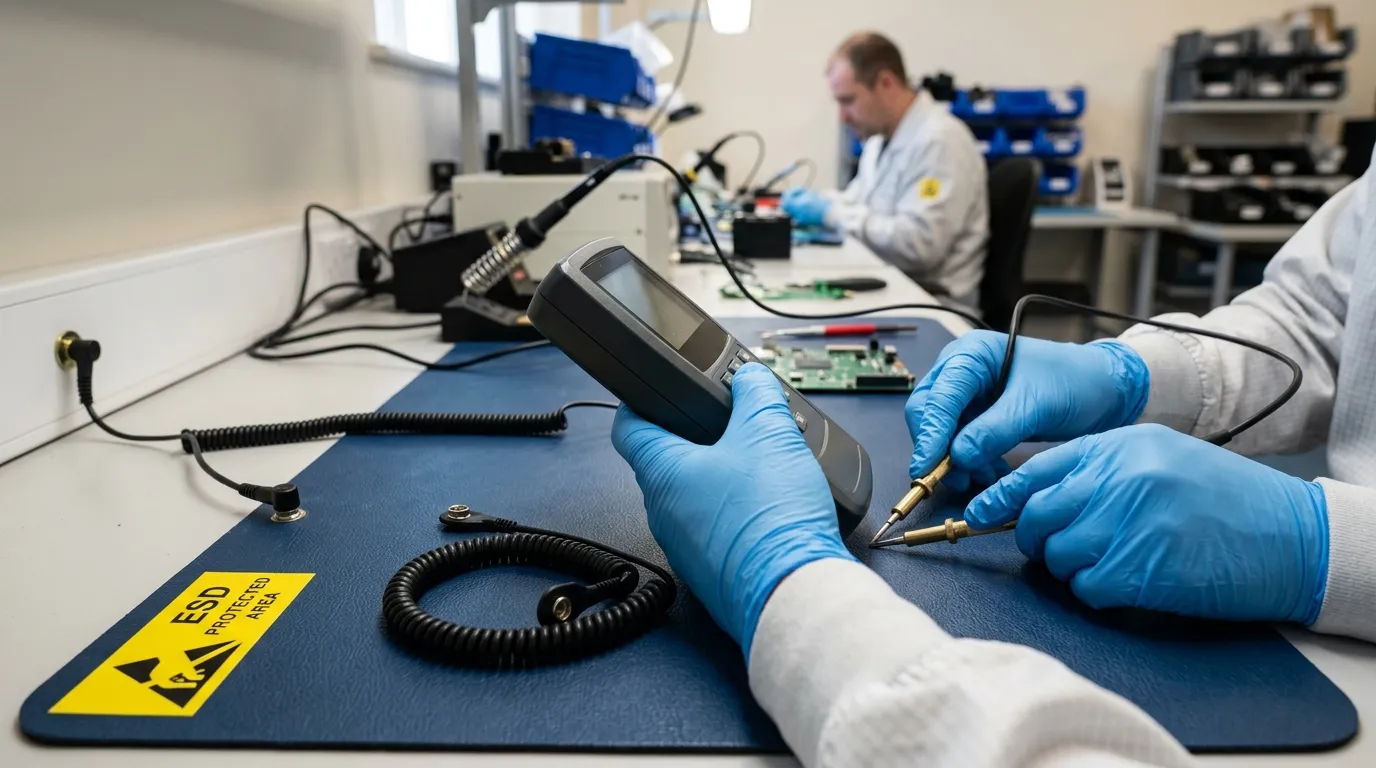
If you need the full test method for a mat or worksurface, see how to test esd mat resistance. The page explains the measurement procedure you would normally reference during an audit.
For a broader look at the types of controls used in these areas, the Nabai ESD equipment page is a useful reference.
ESD Packaging and Material Handling (Points 22–25)
| # | Check | Evidence to request | Type |
|---|---|---|---|
| 22 | ESDS items are protected when leaving the EPA | Packaging specification, handling procedure | Visual / Documentary |
| 23 | ESD packaging is available in receiving, storage, assembly, test, repair, and shipping | Visual inspection, stock check | Visual |
| 24 | Shielding packaging is used where required by the control plan | Packaging specification, usage check | Visual / Documentary |
| 25 | ESDS labels or markings identify sensitive items throughout material flow | Label audit, visual inspection | Visual |
ESD packaging is a control point that is often missed because it is not part of the workstation. Check every point where product moves from one area to another.
Training, Measurement, Records, and Corrective Action (Points 26–30)
| # | Check | Evidence to request | Type |
|---|---|---|---|
| 26 | Training records are current for all personnel | Training matrix, course records | Documentary |
| 27 | Measurement instruments are calibrated and traceable | Calibration certificates | Documentary |
| 28 | Verification and evaluation logs are maintained at the required frequencies | Daily, weekly, or monthly logs | Documentary |
| 29 | Nonconformities and corrective actions are documented and closed | NCR log, corrective-action records | Documentary |
| 30 | Audit results are reviewed by management | Management review minutes | Documentary |
The final group is the one that separates a mature ESD program from a paperwork exercise. If measurements are not being logged, or if corrective actions stay open, the program is not being maintained.
Turning Findings into Corrective Action
Once the checklist is complete, classify each finding so the response matches the risk.
| Severity | Typical meaning | Recommended response |
|---|---|---|
| Critical risk | An uncontrolled condition that could damage ESDS items immediately | Stop the affected activity until the condition is corrected |
| Major gap | A required control is missing or failing | Bring the control into compliance before the next production run |
| Minor gap | A control is present but evidence is incomplete or not current | Correct the record or process within a defined time |
| Documentary gap | A requirement is not fully documented | Update the relevant plan, log, or instruction |
For every finding, assign an owner and a deadline. Define the immediate containment action, then verify the fix after it is complete. Keep the closed-loop record for the next audit.
ESD Audit Checklist FAQ
What is the difference between an internal ESD audit and formal certification?
An internal ESD audit is a self-check that helps you find gaps before an external inspector or customer audit. Formal certification is an assessment by an independent body against a standard such as ANSI/ESD S20.20 or IEC 61340-5-1. A 30-point internal checklist supports readiness, but it does not replace a formal audit.
Do ESD mats and wrist straps alone make a factory compliant?
No. ESD mats and wrist straps are only part of an ESD control program. The program must also include a written plan, defined EPA boundaries, grounding verification, training, packaging controls, calibrated measurement equipment, and records. A mat can be grounded and tested, but if people are not trained or records are missing, the program is still incomplete.
What evidence should be kept after an ESD audit?
Keep the completed checklist, measurement logs, calibration certificates, training records, photos or notes for visual findings, and all corrective-action records. These documents show that the audit was real, the findings were assigned, and the fixes were verified.
Use the checklist as a structured starting point for your next internal audit. When you are reviewing the equipment side of your ESD controls, the Nabai ESD equipment page is a practical reference, and the related how to test esd mat resistance guide explains the measurement step in more detail.
NEWS
GET SERVICE
With quality parts to meet every budget and friendly staff trained to make your visit informative and hassle free.