
GMP Annex 1 Cleanroom Requirements: 2022 Changes

GMP Annex 1 Cleanroom Requirements: 2022 Changes
EU GMP Annex 1 cleanroom requirements are set out in the European Commission's revised Annex 1 for the manufacture of sterile medicinal products, and the 2022 revision makes a documented, risk-based Contamination Control Strategy the central requirement. Instead of treating cleanroom classification as the main measure of compliance, Annex 1 now expects manufacturers to connect facility design, personnel behaviour, environmental monitoring, cleaning, and supplier controls into one contamination-control framework.
This guide explains the cleanroom-specific requirements in the 2022 revision, the difference between GMP grades and ISO 14644 classes, and the evidence a sterile manufacturer should be able to produce. It does not replace the official text.
Annex 1 sits alongside iso 14644 cleanroom standards, which define airborne particle classes, but it does not borrow their authority. Both frameworks matter in a GMP cleanroom — for different reasons.
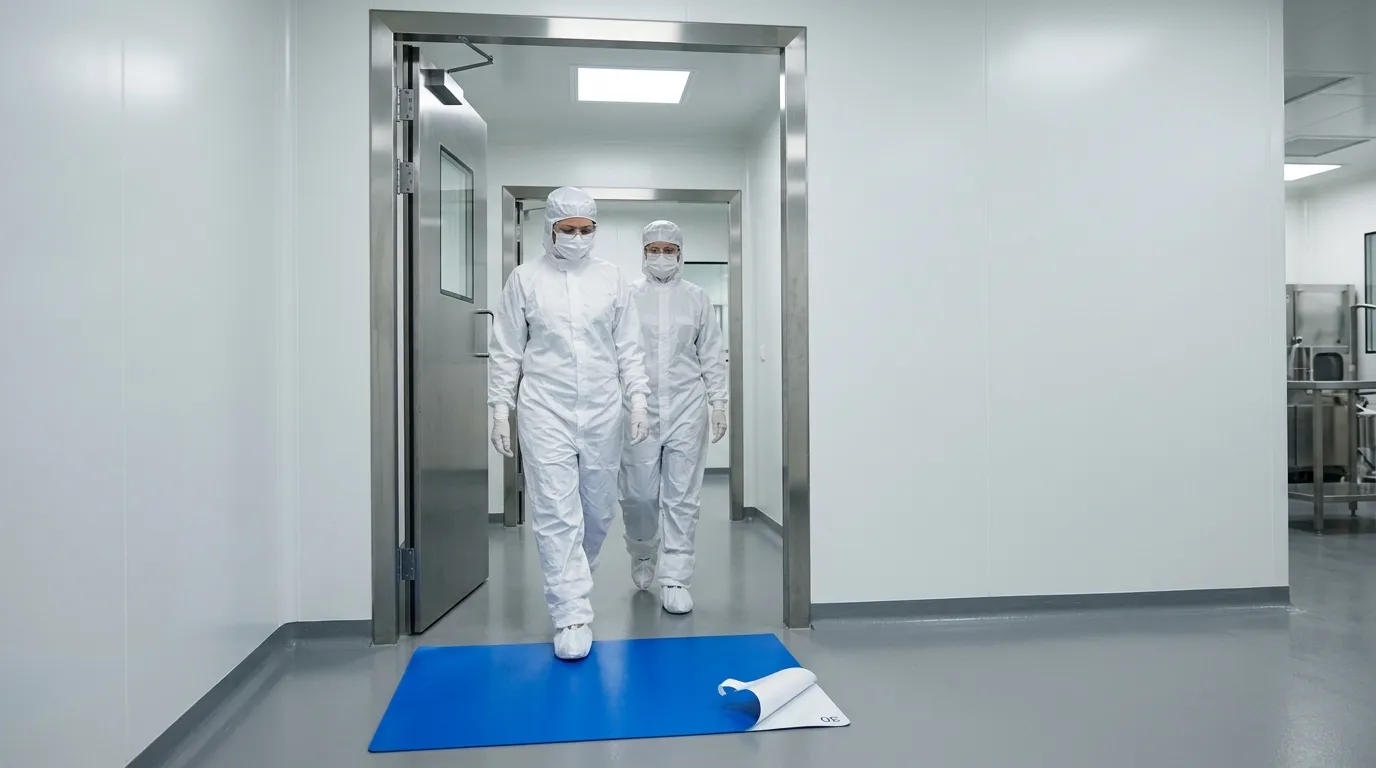
What Is EU GMP Annex 1 and Who Must Follow It?
EU GMP Annex 1 is the European Union's Good Manufacturing Practice (GMP) chapter covering the manufacture of sterile medicinal products. The official European Commission document describes the requirements for facilities, equipment, personnel, environmental monitoring, cleaning, and quality systems in sterile manufacturing.
Key points to understand:
- Annex 1 applies to the manufacture of sterile medicinal products, not to every cleanroom in every industry.
- It is part of EU GMP, so manufacturers supplying products to EU-regulated markets are expected to meet it.
- It is not a general industrial cleanroom standard.
- Compliance is site- and process-specific. There is no product you can buy that makes a cleanroom Annex 1 compliant by itself.
The scope matters because a semiconductor cleanroom, a medical-device assembly room, and a sterile pharmaceutical filling line are all "cleanrooms," but they are not all governed by Annex 1.
What Changed in the 2022 Annex 1 Revision?
The 2022 revision was not a minor rewrite. It restructured Annex 1 around contamination control and quality risk management. According to the EU GMP Annex 1 document and the practical breakdown in Cleanroom Technology, the revision's main changes include:
| Control area | 2022 emphasis | Facility or evidence impact |
|---|---|---|
| Contamination Control Strategy | A single, documented strategy covering the whole facility | Requires a written, risk-based CCS rather than isolated checks |
| Cleanroom grades | Stronger distinction between classification and operational monitoring | Classification alone is no longer treated as the ongoing control |
| Facility and flow design | More explicit expectations for personnel and material flows | Airlocks, pass-throughs, and pressure cascades must support the CCS |
| Barrier systems | RABS and isolators are accepted as contamination-reduction technologies | Selection must be justified by risk |
| Environmental monitoring | More emphasis on trending, alert/action limits, and response | Monitoring data must demonstrate sustained control |
| Cleaning and disinfection | Validation and rotation of disinfectants are expected | Cleaning evidence becomes part of the contamination-control record |
| Personnel | Training, qualification, and behaviour are treated as contamination controls | Aseptic behaviour must be demonstrated, not assumed |
The overall direction is simple: contamination control should be visible in documents, decisions, monitoring, and records — not just in the classification of the room.
GMP Grade A, B, C, and D Cleanroom Requirements vs ISO 14644 Classes
GMP grades are the operational cleanliness levels used in Annex 1. They describe what is expected in different parts of a sterile manufacturing facility, and they are tied to specific operational states: "at rest" and "in operation."
| GMP grade | Typical role | Key point |
|---|---|---|
| Grade A | Critical zone for high-risk operations, such as aseptic filling | Product protection and first-air control are central |
| Grade B | Background environment for Grade A operations | Supports the critical zone but does not replace it |
| Grade C | Controlled environment for less critical steps | Used for certain preparation activities |
| Grade D | Controlled support environment | Lower-risk support areas, still managed under GMP |
The exact particle and microbial limits are defined in the official Annex 1 tables. They should be read directly from that source rather than paraphrased here, because the conditions matter.
A common mistake is to treat GMP Grade A as identical to ISO 14644 Class 5. They are related but not interchangeable. ISO 14644 cleanroom standards describe airborne particle classification, while GMP grades describe operational requirements for sterile manufacturing. A room that meets an ISO class still needs to demonstrate that it meets the relevant GMP grade under the conditions defined by Annex 1.
The 2022 revision also reinforces that classification and routine monitoring are separate activities. Classification tells you what the cleanroom is capable of. Monitoring tells you what is happening during actual operations. Both are required.
The Contamination Control Strategy (CCS) Under Annex 1
The Contamination Control Strategy is the organising idea of the 2022 revision. An official statement in Annex 1 sets out the expectation that a CCS should be implemented, and that it should bring together all critical contamination-control elements in one documented approach.
A CCS should typically consider:
- facility design and layout;
- heating, ventilation, and air conditioning (HVAC) systems;
- utilities and water systems;
- raw materials and components;
- personnel and gowning;
- process design and intervention control;
- environmental monitoring;
- cleaning and disinfection;
- quality systems and documentation.
The strategy is risk-based. This means the controls chosen should be proportionate to the risks in the specific process. A CCS is not a single document generated once. It should be updated when processes, equipment, facilities, or risk profiles change.
For a cleanroom manager or quality professional, the CCS is the natural starting point for a gap assessment. If there is no documented strategy linking the facility, the monitoring programme, and the cleaning programme, the first task is to build that link.
Annex 1 Cleanroom Design, Airflow, and Personnel Flow Requirements
The 2022 revision places more emphasis on the physical layout and flow of a cleanroom because contamination often moves with people and materials.
The revised approach, as described in Cleanroom Technology's Annex 1 breakdown, focuses on preventing contamination before it reaches a critical zone.
Personnel and Material Flow Controls
Annex 1 expects facilities to be designed so that personnel and material movement do not compromise the cleanroom environment. This typically means:
- separate entry routes for people and materials;
- airlocks or pass-throughs between areas of different cleanliness;
- one-way or controlled flow through gowning rooms;
- pressure cascades that keep cleaner areas at higher pressure than adjacent lower-grade areas;
- gowning areas positioned at the boundary between controlled and classified spaces.
The reason is practical: a direct door from an unclassified corridor into a Grade B or Grade A environment would make contamination control impossible to manage. The flow itself is a control.
First Air, HEPA Filtration, and Pressure Differentials
First air is the uninterrupted supply of filtered air that reaches a critical zone before it touches any non-sterile surface. In aseptic processing, protecting the product and container from contamination depends on maintaining first-air coverage.
HEPA filtration supports this by removing particles from the supply air. Annex 1 expects clean air equipment to be qualified, and filter integrity testing is part of that qualification. Pressure differentials between zones help contain contamination by ensuring that air moves from cleaner areas to less clean areas.
Airflow visualisation is also expected. It is not enough to assume the air moves in the right way; the manufacturer should be able to demonstrate it.
RABS and Isolators in Annex 1 Cleanrooms
Restricted Access Barrier Systems (RABS) and isolators are two ways to reduce the risk of human-borne contamination.
- RABS provide a physical barrier around a critical process while allowing some manual intervention.
- Isolators fully separate the process environment from the surrounding room.
Annex 1 does not declare one technology universally better than the other. The choice depends on the process, the product risk, the intervention frequency, and the overall CCS. What matters is that the chosen solution is justified and qualified.
Qualification and Environmental Monitoring Under Annex 1
A cleanroom is not compliant because it is labelled Grade A or Grade B. It must be qualified to demonstrate that it can meet its design limits, and it must be monitored to show that it continues to do so.
Classification vs Routine Monitoring
Classification is a formal assessment of the cleanroom's capability. It is performed under defined conditions, including at rest and sometimes in operation, to show that the room can achieve the relevant GMP grade.
Routine monitoring is different. It is the ongoing sampling of particles and microorganisms during normal operation to verify that the environment remains in control.
The ECA Academy has highlighted the 2022 revision's treatment of 5 µm particles in Grade A and Grade B as an area where classification and monitoring are easily confused. The same concept is not necessarily applied in the same way in both activities, which is why the official text should be consulted directly.
In short:
- Classification answers: "Can this cleanroom meet the required conditions?"
- Monitoring answers: "Is this cleanroom maintaining those conditions during routine work?"
Both are required, but they are not the same exercise.
Particle and Microbial Monitoring Plans
Annex 1 expects environmental monitoring to be planned rather than improvised. A monitoring plan should define:
- sampling locations and their justifications;
- sampling frequencies;
- methods for non-viable particle monitoring;
- methods for viable microbial monitoring;
- alert and action limits;
- trending and data review;
- response procedures when limits are exceeded.
Microbial monitoring is especially important in aseptic operations because the environment itself can become a source of product contamination. Data should be reviewed over time, not only as single results.
Cleanroom Qualification and Re-Qualification
Qualification is the documented evidence that a cleanroom and its equipment perform as intended. Under Annex 1, this includes:
- cleanroom qualification at rest and in operation;
- HEPA filter integrity testing;
- airflow velocity and airflow visualisation;
- pressure difference testing;
- recovery or containment performance where applicable.
Re-qualification should be scheduled based on risk and historical performance. The point is to prove that the cleanroom continues to meet its specification — not merely to repeat a fixed set of tests.
Personnel, Gowning, and Training Requirements in Annex 1
Personnel remain one of the largest sources of contamination in sterile manufacturing. The 2022 revision treats personnel controls as part of the CCS, not as a separate HR exercise.
Annex 1 states that the number of personnel in cleanrooms should be minimised and that they should be appropriately qualified and trained. In practice, this means:
- staff understand why contamination control matters;
- gowning procedures are defined and followed;
- personnel are qualified for entry into classified areas;
- aseptic behaviour is assessed;
- training is repeated and documented.
Gowns, gloves, and other cleanroom garments are part of this control. They should be selected for the grade in which they are used and should not shed particles or transfer contamination. For more specific guidance on glove selection, see our cleanroom gloves supplier resource.
Personnel qualification is not limited to wearing the correct gown. It includes how a person moves, how they interact with equipment, how they avoid breaking first-air protection, and how they respond when something goes wrong.
Cleaning, Disinfection, and Validation in Annex 1 Cleanrooms
Cleaning and disinfection are contamination controls, and Annex 1 expects them to be validated.
For a GMP cleanroom, the cleaning programme should address:
- which surfaces are cleaned;
- which cleaning and disinfection agents are used;
- how often cleaning is performed;
- which methods are used;
- how disinfectants are rotated to prevent resistance;
- how the effectiveness of the method is validated.
Validation is the key difference between a cleaning schedule and a contamination-control programme. A manufacturer should be able to show that the disinfection method is effective on the surfaces and materials used in the facility, and that the results are reproducible.
The procedures themselves should be written and followed consistently. If cleaning is not documented, it is not part of the contamination-control record. For an operational procedure, see our cleanroom cleaning validation procedure.
How Annex 1 Cleanroom Requirements Affect Cleanroom Consumables and Supplier Evidence
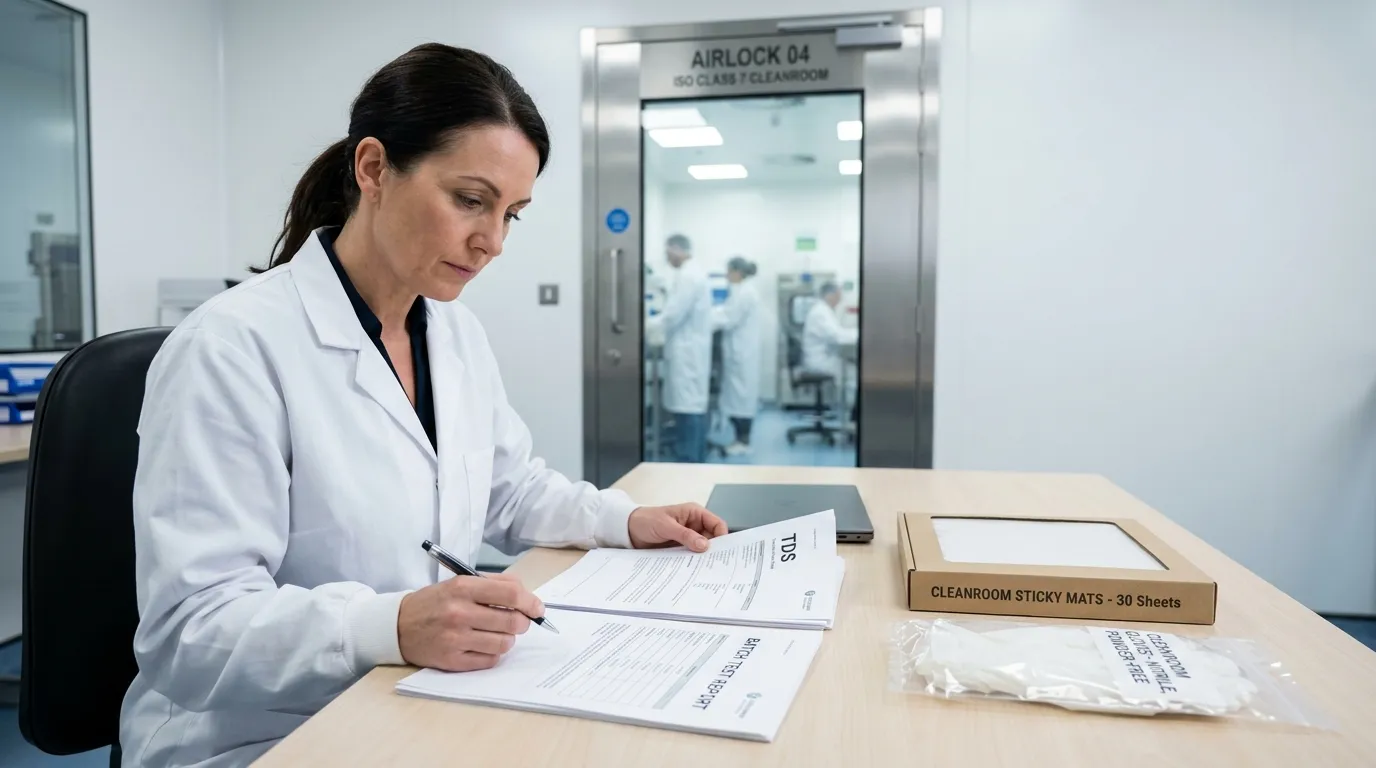
Annex 1 regulates manufacturing sites, processes, and quality systems. It does not certify individual products. A sticky mat, a cleanroom glove, or a cleaning agent can support a contamination-control programme, but it cannot by itself make a cleanroom Annex 1 compliant.
That distinction matters when buying consumables. The supplier's documentation is part of your incoming-control process. It helps you decide whether the product is suitable for the intended grade and application.
| Document | What it should tell you | Why it matters |
|---|---|---|
| Technical Data Sheet (TDS) | Product description, material, dimensions, and physical properties | Defines what the product is |
| Batch test report | Measured values for a specific batch | Verifies that the batch meets the stated specification |
| Safety Data Sheet (SDS) | Handling, storage, and hazard information | Supports safe use in the facility |
| Certificate or statement | Specific compliance claim, if provided | Must be checked for scope, product, and validity |
The same thinking applies to cleanroom entry products. A sticky mat for pharmaceutical cleanroom can capture particles from shoe soles before personnel enter a classified area. That supports contamination control, but it does not replace the need for proper gowning, airflow, training, monitoring, or cleaning. The mat is part of a larger system.
Nabai, for example, supplies cleanroom sticky mats and describes them as an entry-point contamination-control measure. As a company, Nabai presents itself as a cleanroom consumables and ESD-products supplier. That is useful context when evaluating a supplier, but it is not the same as a regulatory certification.
Some products carry additional claims, such as an antibacterial sticky mat or a silicone-free adhesive mat. Those claims should be assessed with the same evidence-based approach as any other consumable: ask for the TDS, ask for test reports, and verify that the claim applies to the exact product you are using.
For a wider view of the controls surrounding these products, see our cleanroom contamination control guide.
Annex 1 Cleanroom Gap-Assessment Checklist
Use this checklist as a starting point for reviewing a facility against the 2022 Annex 1 cleanroom requirements. Each item should be supported by written evidence.
- A Contamination Control Strategy exists and is current.
- The strategy covers facility, equipment, utilities, personnel, materials, processes, monitoring, cleaning, and quality systems.
- Cleanroom grades are defined for each operational area.
- Classification and routine monitoring are treated as separate activities.
- At-rest and in-operation conditions are defined and documented.
- Cleanroom qualification records include HEPA integrity, airflow, pressure differentials, and airflow visualisation.
- Environmental monitoring plans define locations, frequencies, methods, and limits.
- Personnel are trained, qualified, and assessed for aseptic behaviour.
- Gowning procedures are documented and followed.
- Cleaning and disinfection methods are validated.
- Disinfectant rotation is defined.
- Supplier documentation for consumables is reviewed as part of incoming control.
- Monitoring trends are reviewed regularly, not only at limit excursions.
- Deviations are investigated and appropriate corrective actions are taken.
If any item is missing, it is a gap in the contamination-control evidence file, not necessarily a regulatory finding. The next step is to understand the risk and close the gap in a way that is proportionate to the process.
Next Steps: Building Your Annex 1 Evidence File
The 2022 revision does not expect a perfect facility. It expects a coherent, documented, risk-based approach to contamination control. A practical first step is to build the evidence file around the CCS.
Start with the cleaning side. Cleaning and disinfection are visible, repeatable, and directly verifiable, which makes them a strong place to begin. Our cleanroom cleaning validation procedure explains how to turn written cleaning expectations into validated, documented practice.
If you are reviewing personnel controls, evaluate your glove specification as part of the gowning system. The cleanroom gloves supplier resource covers the selection and documentation points that matter in classified areas.
For a broader picture of the controls around the facility, see cleanroom contamination control. And if you are sourcing entry-point consumables, ask suppliers for the same level of evidence you would expect from any GMP-relevant material.
The goal is not to buy compliance. The goal is to build a contamination-control system that is documented, understood, and maintained.
NEWS
GET SERVICE
With quality parts to meet every budget and friendly staff trained to make your visit informative and hassle free.