
Cleanroom Classification Chart: ISO Class Particle Limits

Cleanroom Classification Chart: ISO Class Particle Limits
A cleanroom classification chart is a reference table showing the maximum allowable airborne particle concentration for each ISO 14644-1 cleanroom class, expressed in particles per cubic metre at defined particle-size thresholds. The older U.S. FED-STD-209E standard, now withdrawn, used particles per cubic foot, so legacy class names such as Class 100 and Class 10,000 should be read as historical equivalents to current ISO designations rather than parallel compliance categories.
This guide provides the complete ISO 14644-1 particle-limit chart, the approximate FED-STD-209E equivalents, and the interpretation rules you need to apply either system correctly in a real cleanroom specification.
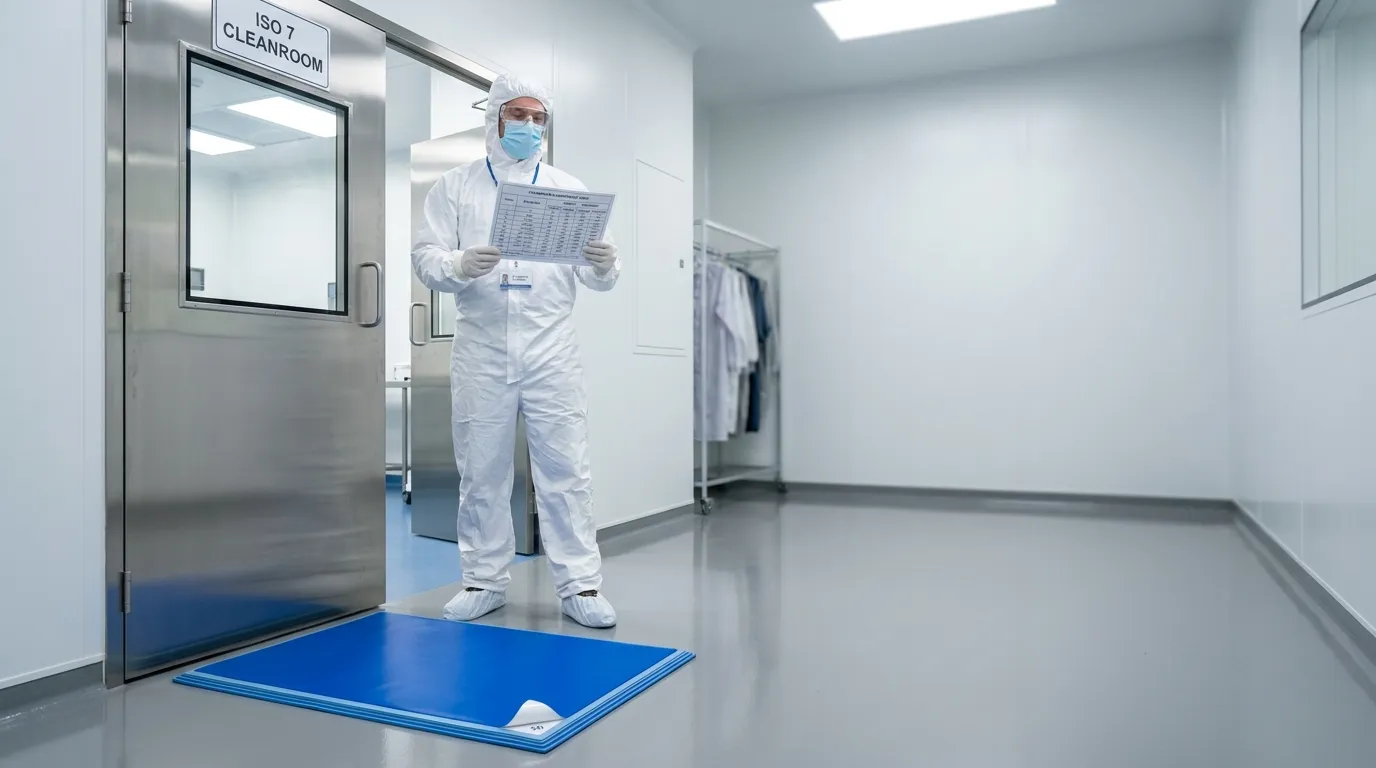
What Does an ISO 14644-1 Classification Measure?
ISO 14644-1:2015, "Cleanrooms and associated controlled environments — Part 1: Classification of air cleanliness by particle concentration," defines cleanroom classes by the maximum number of airborne particles permitted in a cubic metre of air at one or more specified particle sizes.
The standard applies to cleanrooms, clean zones, and separative devices. As the U.S. Food and Drug Administration notes in its recognition of the standard, the relevant particle-size range for classification is 0.1 µm to 5 µm, and particle concentration is determined using a light-scattering airborne particle counter at designated sampling locations.
Classification is therefore a numerical statement about airborne particles measured under defined conditions. It is not, by itself, a statement about sterility, microbial cleanliness, surface cleanliness, or process performance.
ISO 14644-1 Cleanroom Classification Chart: Particle Limits by ISO Class
The table below shows the maximum concentration limits, in particles per cubic metre, for ISO Classes 1 through 9 at each particle-size threshold.
| ISO Class | ≥0.1 µm | ≥0.2 µm | ≥0.3 µm | ≥0.5 µm | ≥1 µm | ≥5 µm |
|---|---|---|---|---|---|---|
| ISO Class 1 | 10 | 2 | — | — | — | — |
| ISO Class 2 | 100 | 24 | 10 | 4 | — | — |
| ISO Class 3 | 1,000 | 237 | 102 | 35 | 8 | — |
| ISO Class 4 | 10,000 | 2,370 | 1,020 | 352 | 83 | — |
| ISO Class 5 | 100,000 | 23,700 | 10,200 | 3,520 | 832 | 29 |
| ISO Class 6 | 1,000,000 | 237,000 | 102,000 | 35,200 | 8,320 | 293 |
| ISO Class 7 | — | — | — | 352,000 | 83,200 | 2,930 |
| ISO Class 8 | — | — | — | 3,520,000 | 832,000 | 29,300 |
| ISO Class 9 | — | — | — | 35,200,000 | 8,320,000 | 293,000 |
Source note: All values are in particles per cubic metre and follow the classification limits in ISO 14644-1:2015, which the U.S. FDA recognises for determining air cleanliness by particle concentration. A dash means no limit is assigned for that particle size in that class, not that the limit is zero.
FED-STD-209E Equivalents: Class 1 to Class 100,000
FED-STD-209E is the withdrawn U.S. Federal Standard that previously classified cleanrooms by the number of particles per cubic foot, most commonly at ≥0.5 µm. Although ISO 14644-1 has been the international basis for new cleanroom projects for years, legacy specifications, certificates, and audit documents still use FED-STD-209E terminology.
The table below gives the most common approximate mappings.
| FED-STD-209E Class | Approximate ISO 14644-1 Equivalent |
|---|---|
| Class 1 | ISO Class 3 |
| Class 10 | ISO Class 4 |
| Class 100 | ISO Class 5 |
| Class 1,000 | ISO Class 6 |
| Class 10,000 | ISO Class 7 |
| Class 100,000 | ISO Class 8 |
These equivalences are approximate. FED-STD-209E expressed limits in particles per cubic foot, while ISO 14644-1 uses particles per cubic metre, and the two systems also differ in how particle-size thresholds are applied. For any new specification, use ISO 14644-1 directly rather than translating an old class name.
How to Read the Chart: Particles per Cubic Metre and the "≥" Symbol
Several details in a cleanroom classification chart cause recurring confusion.
- "≥" means "equal to or greater than." The column labelled ≥0.5 µm counts every particle of 0.5 µm and larger, not only particles exactly 0.5 µm in size.
- Thresholds are cumulative. The ≥0.5 µm count includes the ≥1 µm and ≥5 µm populations. That is why the allowed numbers fall as the particle size increases: a 5 µm particle is also counted in the ≥1 µm and ≥0.5 µm columns.
- Blank cells are not zero. A dash indicates the standard does not assign a limit for that class and particle-size combination. For example, ISO Class 7 has no published limit at ≥0.1 µm.
- Units are particles per cubic metre. If you see a chart expressed in particles per cubic foot, it is based on legacy FED-STD-209E data, not current ISO limits.
- Lower ISO class numbers mean stricter limits. ISO Class 1 allows only 10 particles per cubic metre at ≥0.1 µm, while ISO Class 9 allows 35,200,000 particles per cubic metre at ≥0.5 µm.
When comparing two classes, always compare the same particle-size threshold. An ISO Class 5 limit at ≥0.5 µm cannot be compared directly with an ISO Class 7 limit at ≥1 µm.
ISO 5, ISO 7, and ISO 8 at a Glance
Most cleanroom users work with ISO Class 5, ISO Class 7, or ISO Class 8. These are the classes most often called out in manufacturing specifications and the ones most frequently confused with legacy terminology.
ISO Class 5 (Legacy FED-STD-209E Class 100)
ISO Class 5 permits 3,520 particles per cubic metre at ≥0.5 µm. It also limits ≥1 µm particles to 832 per cubic metre and ≥5 µm particles to 29 per cubic metre. The approximate legacy equivalent is Class 100. ISO Class 5 is commonly specified for aseptic processing areas, semiconductor facilities, and other high-cleanliness operations, though the exact requirement depends on the process and the applicable regulations. For a fuller comparison of these three classes, see iso class 5 vs class 7 vs class 8 cleanroom.
ISO Class 7 (Legacy FED-STD-209E Class 10,000)
ISO Class 7 permits 352,000 particles per cubic metre at ≥0.5 µm. It also limits ≥1 µm particles to 83,200 per cubic metre and ≥5 µm particles to 2,930 per cubic metre. The approximate legacy equivalent is Class 10,000. ISO Class 7 is common in controlled manufacturing and pharmaceutical support environments where air cleanliness matters but is less stringent than ISO Class 5.
ISO Class 8 (Legacy FED-STD-209E Class 100,000)
ISO Class 8 permits 3,520,000 particles per cubic metre at ≥0.5 µm. It also limits ≥1 µm particles to 832,000 per cubic metre and ≥5 µm particles to 29,300 per cubic metre. The approximate legacy equivalent is Class 100,000. ISO Class 8 is often applied to general controlled spaces in electronics, food processing, medical device, and other industrial settings.
What a Cleanroom Classification Does Not Tell You
A cleanroom classification chart answers exactly one question: how many airborne particles are permitted in a cubic metre of air. It is not a complete contamination-control specification. In particular:
- It does not prove sterility. A cleanroom can meet an ISO Class 5 particle limit and still be microbiologically contaminated.
- It does not define microbial limits. ISO 14644-1 counts particles; it does not count colony-forming units.
- It is not the same as a GMP grade. Pharmaceutical GMP frameworks use ISO particle concentration limits as one input, but a GMP grade also carries microbial action levels, operating-state requirements, and a broader contamination-control strategy.
- It does not specify air changes per hour. The ISO class is a cleanliness result, not a direct airflow specification. Ventilation design and filtration are separate engineering decisions.
- It does not measure surface cleanliness or particle deposition. The chart concerns airborne particles only.
- It does not validate a process. Classification is one piece of evidence within a larger qualification and monitoring program.
How Particle Limits Are Measured and Verified
A cleanroom is classified by measuring its actual airborne particle concentration and comparing the results with the limits in the chart. The process follows a defined sequence:
- Set the operating condition. Classification can be performed "as built," "at rest," or "in operation." The condition matters because occupancy and process activity change particle counts.
- Define sampling locations. The standard requires a specified number of sampling locations based on room size and the target class.
- Measure with a light-scattering airborne particle counter. The counter draws a known volume of air and counts particles at each location.
- Record concentrations at the particle-size thresholds required by the specification.
- Compare measured values with the class limit at each threshold and each sampling location.
- Document the results in a particle-count test report.
The measurement method is specified in ISO 14644-1 and recognised by the U.S. FDA's consensus-standard record, which describes classification as the determination of airborne particle concentration in the 0.1 µm to 5 µm range using a light-scattering airborne particle counter at designated sampling locations.
Using a Cleanroom Classification Chart in Specifications and Supplier Documents

To use the chart correctly in a real project, write the cleanroom requirement in a form that cannot be misread:
- Name the standard: ISO 14644-1.
- Identify the edition: for new specifications, ISO 14644-1:2015.
- State the class: for example, ISO Class 7.
- State the particle-size threshold: for example, ≥0.5 µm.
- State the operating condition: for example, "at rest" or "in operation."
A specification that only says "Class 10,000" leaves the standard, edition, threshold, and operating state undefined. When you review a supplier's test report, check the following before accepting the result:
- the standard and edition used;
- the cleanroom class claimed;
- the particle-size thresholds reported;
- the operating state;
- the number and location of sampling points;
- the instrument and its calibration documentation;
- the measured concentrations at each sampling location.
Also distinguish between document types. A TDS (technical data sheet) describes a product's specifications; it is not a room-classification report. A batch particle-count test report is the evidence that a specific cleanroom or clean zone met its ISO class at the time of testing.
Next Steps: Turn Your ISO Class into a Contamination-Control Plan
An ISO class sets the airborne-particle target for the room. Meeting and maintaining that target requires a wider contamination-control program covering people, materials, surfaces, and cleaning.
For the overall approach, Nabai's cleanroom contamination control guide explains how the pieces fit together. If you are controlling particles at the entrance, the cleanroom sticky mat range shows the entry-control options. For scheduled upkeep, cleanroom cleaning supplies covers the consumables side. If your project requires air-handling or filtration components, the fan filter unit ffu supplier page is the relevant starting point.
Once you have confirmed the ISO class for your application, the next question is usually whether the room's design, monitoring, and consumables are aligned with that class. If you know your target class and need help selecting contamination-control products or documentation, contact Nabai with your specification — the technical team can advise on the right approach for your cleanroom.
NEWS
GET SERVICE
With quality parts to meet every budget and friendly staff trained to make your visit informative and hassle free.