
ISO Class 5 vs 7 vs 8 Cleanroom Entry Control Compared

ISO Class 5 vs 7 vs 8 Cleanroom Entry Control Compared
ISO Class 5 is substantially cleaner than ISO Class 7, and ISO Class 7 is substantially cleaner than ISO Class 8: the class number reflects the maximum allowable airborne particle concentration, with a lower number indicating a stricter cleanroom. Entry control should become more rigorous as the required ISO class gets cleaner, but ISO 14644-1 does not itself prescribe a specific sticky mat, gowning sequence, or replacement interval — those decisions depend on your process, traffic, and supplier documentation.
This article compares the three classes by particle limits, explains what ISO 14644-1 does and does not require, and translates each class into practical entry-control decisions.
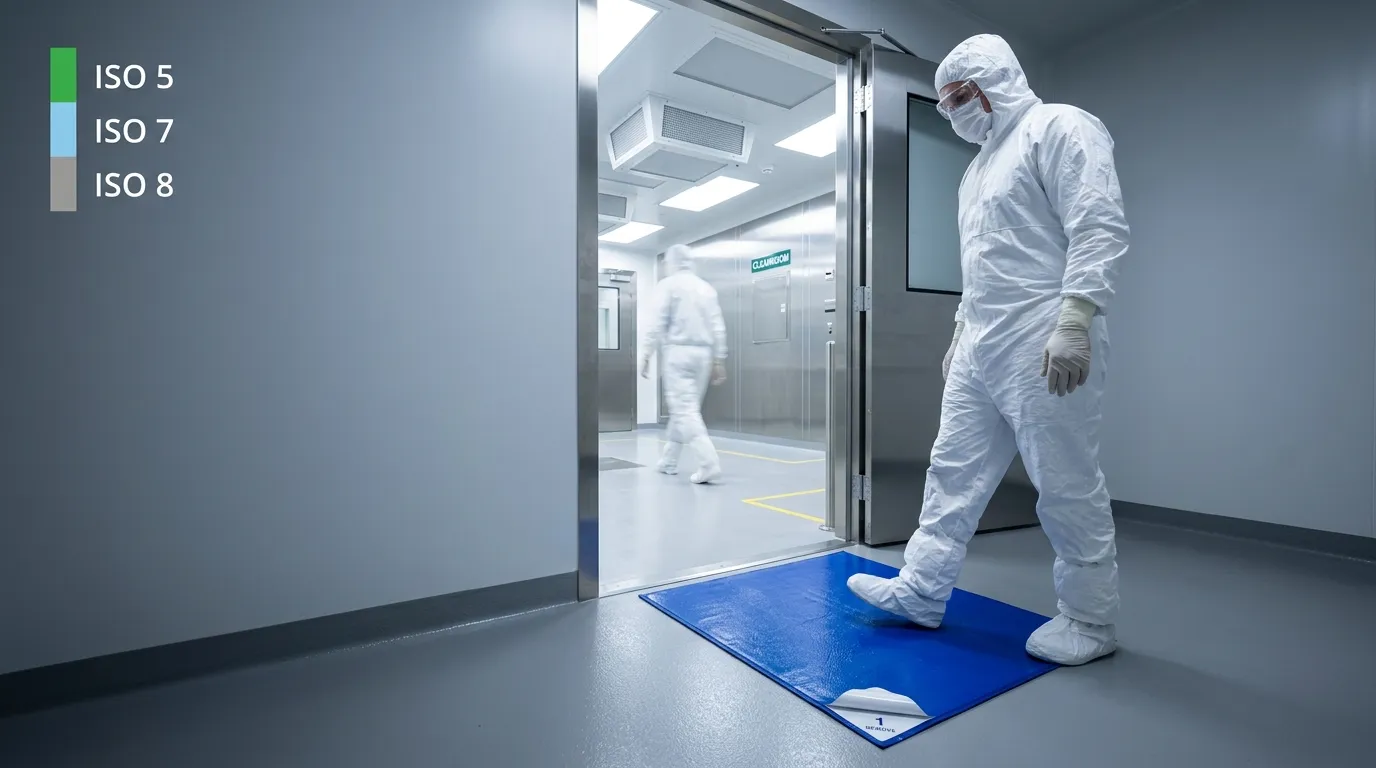
ISO Class 5 vs 7 vs 8: Cleanroom Grade Comparison
ISO 14644-1 classifies cleanrooms by the concentration of airborne particles of defined sizes, expressed in particles per cubic metre. The most commonly compared thresholds are particles at ≥0.5 µm and ≥5.0 µm.
| ISO Class | Maximum particles/m³ at ≥0.5 µm | Maximum particles/m³ at ≥5.0 µm | Approx. FS 209E equivalent |
|---|---|---|---|
| ISO Class 5 | 3,520 | 29 | Class 100 |
| ISO Class 7 | 352,000 | 2,930 | Class 10,000 |
| ISO Class 8 | 3,520,000 | 29,300 | Class 100,000 |
These limits follow ISO 14644-1:2015, as reproduced in the comparison table published in the NIH PubMed Central article on cleanroom classification. For a broader particle-limit reference covering additional classes, see the cleanroom classification chart particle limits.
The scale difference is large. ISO Class 8 permits roughly 1,000 times more ≥0.5 µm particles than ISO Class 5. Even at the larger 5.0 µm particle size, the ISO 8 limit is more than 1,000 times the ISO 5 limit.
Two caveats matter here. First, ISO 14644-1 classifies airborne particle count only — not surface contamination, microbial levels, or electrostatic charge. Second, the class measured at rest can differ from the class measured in operation, so the facility's classification evidence should state which condition applies.
For readers familiar with Federal Standard 209E, the approximate old equivalents are ISO 5 ≈ Class 100, ISO 7 ≈ Class 10,000, and ISO 8 ≈ Class 100,000.
What ISO 14644-1 Defines — and What It Doesn't
ISO 14644-1 is the international standard for classifying air cleanliness in cleanrooms and clean zones by airborne particle concentration (ISO 14644-1:2015). That scope has two practical consequences.
The standard does not define the operational controls needed to achieve a class. Gowning sequences, airlock usage, material transfer, cleaning schedules, pressure differentials, and entry-consumable choices are facility and process decisions, not direct outputs of the classification table.
The standard is also not a product certification. A sticky mat, wipe, or roller cannot be "ISO Class 5 certified" under ISO 14644-1, because the standard does not define consumable performance.
Adjacent requirements come from separate sources. EU GMP Annex 1 provides the regulatory cleanroom context for sterile pharmaceutical manufacturing, and the WHO GMP guidance on sterile products makes the same distinction between classification and ongoing environmental control. For electronics environments, ANSI/ESD S20.20 and IEC 61340-5-1 define electrostatic-control programs that sit alongside — but separate from — particle classification.
How Entry Control Changes by ISO Class
Entry control is the combination of procedures, physical separation, and equipment that keeps uncontrolled contamination from reaching a classified space. It usually includes personnel flow, material flow, gowning, airlocks, cleaning, and consumables such as sticky mats, wipes, and rollers.
The ISO class defines the air-cleanliness target. It does not define the exact mat, gown, or airlock sequence. What it does is separate the three classes into three different contamination-risk levels, and that risk should set the level of attention you give to entry.
ISO Class 5 Entry Control: Critical Zones and Personnel Flow
ISO Class 5 is the strictest of the three classes and is used where the process is most sensitive to particles — aseptic filling, semiconductor wafer handling, advanced electronics assembly, and other precision operations.
In many facilities, ISO Class 5 is not a whole room. It is a localized critical zone: a unidirectional airflow hood, isolator, or mini-environment supported by an ISO 7 or ISO 8 background. Entry control is usually the most demanding of the three classes: full gowning, staged entry through an airlock or gowning room, disciplined material transfer, and regular contamination monitoring.
A cleanroom sticky mat placed in or before the gowning area helps capture particles from footwear and wheeled traffic, but it supports the broader entry system rather than replacing it. For semiconductor-specific applications, see the sticky mat for semiconductor cleanroom page.
ISO Class 7 Entry Control: Controlled Transition and Background Spaces
ISO Class 7 is commonly the controlled background around an ISO 5 critical zone, and it also appears as a cleanroom grade in pharmaceutical compounding, medical device assembly, and electronics manufacturing.
Entry into ISO 7 typically requires a controlled transition from a lower-grade or uncontrolled space. That often means a gowning step, a door or airlock separating zones, and material transfer procedures. The level of restriction is usually lower than ISO 5 but still clearly disciplined.
Because ISO 7 often sits next to ISO 5, the entry design should account for the next step: an ISO 7 room that feeds an ISO 5 zone needs more discipline than a standalone ISO 7 room used for less critical work. Pharmaceutical facilities, in particular, should review the applicable GMP guidance before fixing their entry protocol. For product context, see the sticky mat for pharmaceutical cleanroom page.
ISO Class 8 Entry Control: Foundation and Perimeter Separation
ISO Class 8 is the least stringent of the three classes, but it is not uncontrolled. It is often used for staging, preparation, parts storage, equipment rooms, and transition spaces that sit at the edge of cleaner areas.
Entry into ISO 8 may require only basic gowning and a sticky mat or equivalent footwear control. The key design question is what lies beyond the ISO 8 room. If the ISO 8 space feeds an ISO 7 or ISO 5 area, its entry control should be planned as the first stage of a longer contamination-control sequence, not as an isolated room.
Choosing Entry-Consumables for ISO 5, 7, and 8
Once the class and entry path are clear, the next question is which consumables to use. The central principle is the same at every grade: ISO class alone does not determine tack level, layer count, or replacement interval.
Product selection depends on:
- the volume and type of traffic — foot traffic versus carts and wheels;
- residue tolerance — how much adhesive transfer the process can accept;
- ESD requirements — whether the area needs static-dissipative or conductive products;
- material compatibility — for example, whether silicone should be avoided;
- the documentation the supplier provides to verify its claims.
Nabai's cleanroom sticky mat page covers the product range, and the company's sticky-mat selection guide walks through the selection process in more detail.
Sticky Mats and Other Entry Mat Products
A sticky mat — also called a tacky mat or adhesive mat — uses adhesive-coated layers to capture particles from footwear and wheeled traffic before personnel enter a classified space. Three product attributes matter most:
- Layer count or sheet count: more layers usually mean more peel-off cycles between mat replacements.
- Tack level: higher tack can improve particle pickup but may also increase residue-transfer risk on shoes or wheels.
- ESD-safe construction: relevant in electronics and other static-sensitive areas, but static control remains a separate requirement from airborne particle classification.
The right choice depends on the specific entry area. A general-purpose mat may be adequate at an ISO 8 staging entrance, while an ISO 5 gowning room may require a stricter specification, better residue control, and stronger documentation. High tack is not automatically "better" — the product must fit the traffic, the cleaning routine, and the process tolerance for residue.
Complementary Consumables: Wipes and Rollers
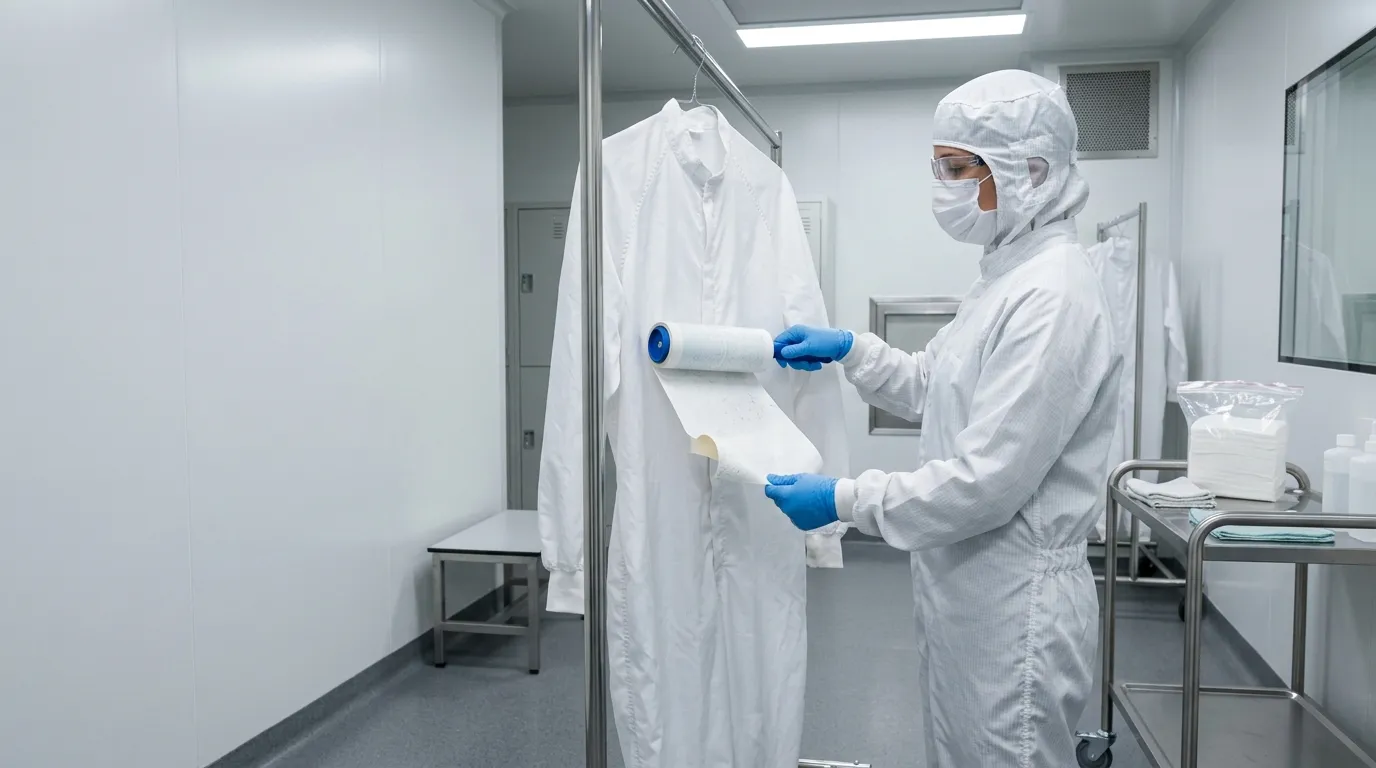
Entry control rarely stops at the mat. Lint-free wipes support the cleaning of equipment, racks, and surfaces during material transfer. Sticky rollers can be used in gowning areas for clothing and small-item cleaning. The correct specification depends on the cleanroom class, the surface, and the residue tolerance of the process.
For product options, see Nabai's lint free cleanroom wipes supplier page.
Documentation and Test Evidence to Request
Before finalizing any entry-consumable purchase, ask the supplier for:
- A Technical Data Sheet (TDS) for each product, covering dimensions, sheet or layer count, roll length where relevant, thickness, tack or adhesion value, surface resistance where applicable, and storage conditions.
- A batch test report when a specific property must be verified for a specific lot. The TDS describes the general product line; the batch report documents the actual lot delivered.
- Named test methods, so the values are comparable — for example, surface resistance in ohms (not ohms/square), peel adhesion in gram-force per stated width, and particle-shedding or residue-transfer test methods.
Do not accept vague claims such as "high tack" or "ESD safe" without units and a test method. Also confirm whether a certificate or report applies to one model, one batch, or the whole product line — a single test result should not be generalized across a supplier's entire catalog.
Common Entry-Control Mistakes to Avoid
- Assuming the ISO class determines the exact mat model or layer count. The class defines the air target; traffic and procedure define the consumable.
- Assuming all ISO 5 areas are full rooms. Many are localized critical zones inside ISO 7 or ISO 8 backgrounds.
- Confusing ISO classification with GMP grade or sterility. ISO 14644-1 measures particles; GMP guidance adds broader operational and microbiological expectations.
- Confusing air cleanliness with ESD protection. A cleanroom can meet its particle class and still have a damaging static environment.
- Accepting product claims without documentation. Request TDS, batch reports, and named test methods.
- Using consumer-grade adhesive mats in an industrial cleanroom. Household products are not designed for cleanroom contamination control and may introduce residues or particles.
Next Step: Build an Entry-Control Plan for Your ISO Class
Start by confirming your target ISO class and the state in which it is measured — at rest or in operation. Then map the personnel and material paths into the room, define the transition steps, and choose consumables by documented specification rather than by class number alone.
If sticky mats are part of your entry plan, the cleanroom sticky mat page is the direct product reference. For a more detailed selection process, the sticky-mat selection guide covers specification and supplier-qualification questions in depth.
NEWS
GET SERVICE
With quality parts to meet every budget and friendly staff trained to make your visit informative and hassle free.